Back
From Mendelian Genetics to Gene Mapping: Extensions, Linkage, and Bacterial Genetics
Study Guide - Smart Notes
 Tailored notes based on your materials, expanded with key definitions, examples, and context.
Overview: Connecting Mendelian Genetics to Gene Mapping
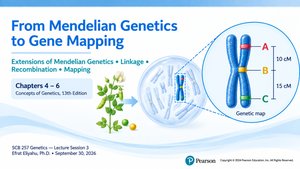
This study guide covers the transition from classical Mendelian genetics to modern gene mapping, focusing on extensions of Mendelian principles, linkage, recombination, and mapping in both eukaryotes and bacteria. The material is structured around Chapters 4–6, which include extensions of Mendelian genetics, chromosome mapping, and genetic analysis in bacteria.
Today's Roadmap: Three Connected Ideas
1. Extend Mendel
Classical Mendelian genetics is expanded to include incomplete dominance, codominance, and gene interactions. Dominance is not always complete, and multiple alleles or gene interactions can alter expected phenotypes.
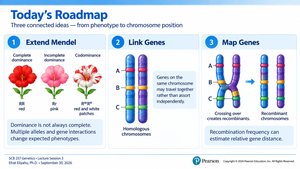
2. Link Genes
Genes located on the same chromosome may travel together and are not always inherited independently. This concept is central to understanding genetic linkage.
3. Map Genes
Recombination frequency, observed during crossing over in meiosis, is used to estimate the relative distance between genes on a chromosome.
Review: Mendelian Principles
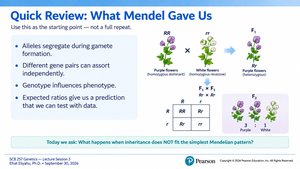
What Mendel Gave Us
Mendel's laws established that alleles segregate during gamete formation, gene pairs assort independently, and genotype influences phenotype. Expected ratios allow predictions that can be tested with data.
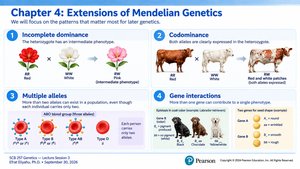
Chapter 4: Extensions of Mendelian Genetics
Incomplete Dominance
Heterozygotes display an intermediate phenotype, as seen in pink snapdragons from red and white parents.
Codominance
Both alleles are clearly expressed in the heterozygote, such as AB blood type expressing both A and B antigens.
Multiple Alleles
More than two alleles can exist for a gene in a population, exemplified by the ABO blood group system.
Gene Interactions
Multiple genes can contribute to a single phenotype, modifying classic Mendelian ratios.
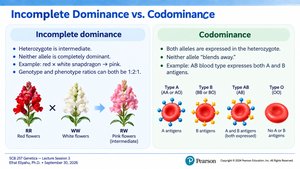
Incomplete Dominance vs. Codominance
Comparison
Incomplete dominance: Neither allele is completely dominant; heterozygote is intermediate.
Codominance: Both alleles are expressed; neither blends away.
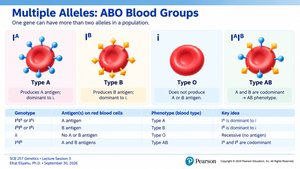
Multiple Alleles: ABO Blood Groups
Genetic Basis
The ABO blood group system is determined by three alleles: IA, IB, and i. Each genotype produces a specific antigen and blood type.
Genotype | Antigen on RBC | Phenotype (Blood Type) | Key Idea |
|---|---|---|---|
IAIA, IAi | A antigen | Type A | A is dominant |
IBIB, IBi | B antigen | Type B | B is dominant |
ii | No antigen | Type O | O is recessive |
IAIB | A and B antigens | Type AB | A and B are codominant |
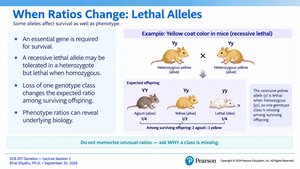
When Ratios Change: Lethal Alleles
Lethal Alleles
Some alleles affect survival as well as phenotype. Recessive lethal alleles may be tolerated in heterozygotes but are lethal in homozygotes, altering expected ratios.
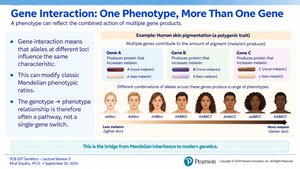
Gene Interaction: One Phenotype, More Than One Gene
Polygenic Traits
Gene interaction means that alleles at different loci influence the same characteristic, such as human skin pigmentation. This can produce a range of phenotypes and modify Mendelian ratios.
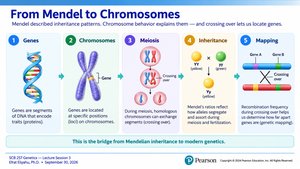
From Mendel to Chromosomes
Connecting Inheritance Patterns to Chromosome Behavior
Mendelian inheritance is explained by chromosome behavior during meiosis, which allows crossing over and gene mapping.
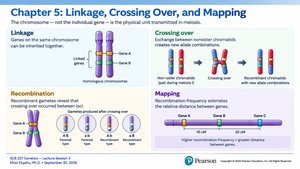
Chapter 5: Linkage, Crossing Over, and Mapping
Linkage
Genes on the same chromosome can be inherited together, forming linkage groups.
Crossing Over
Exchange between nonsister chromatids during meiosis creates new allele combinations.
Recombination
Recombination generates new combinations of alleles, which can be used to estimate gene distances.
Mapping
Recombination frequency estimates the relative distance between genes.
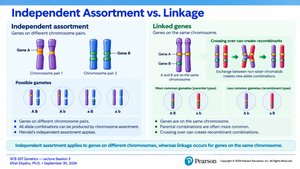
Independent Assortment vs. Linkage
Comparison
Independent assortment: Applies to genes on different chromosomes.
Linked genes: Occurs for genes on the same chromosome; crossing over can create recombinants.
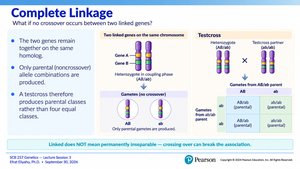
Complete Linkage
No Crossover Between Linked Genes
If no crossover occurs, only parental allele combinations are produced. Testcrosses reveal parental classes.
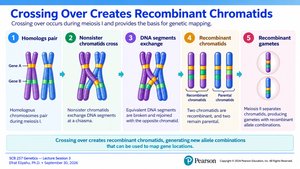
Crossing Over Creates Recombinant Chromatids
Mechanism
Crossing over during meiosis generates recombinant chromatids, which can be used for genetic mapping.
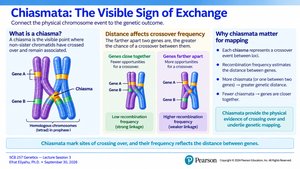
Chiasmata: The Visible Sign of Exchange
Physical Evidence
Chiasmata mark sites of crossing over. Their frequency reflects the distance between genes.
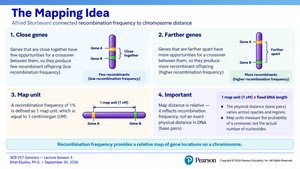
The Mapping Idea
Recombination Frequency and Gene Distance
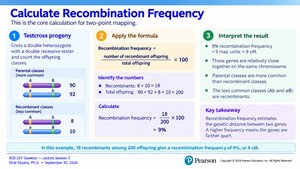
Genes that are close together have fewer opportunities for crossover, resulting in lower recombination frequency. Map units (centimorgans) are used to express gene distance.
Calculate Recombination Frequency
Formula
Recombination frequency is calculated as:
Quick Check: Which Genes Are Closer?
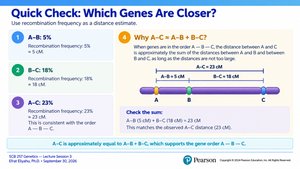
Using Recombination Frequency
Gene distances can be estimated by recombination frequency. The sum of distances between adjacent genes approximates the total distance between the outer genes.
Why Mapping Gets Harder at Long Distances
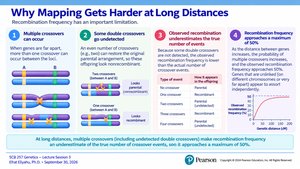
Limitations
Multiple crossovers can occur, and some double crossovers go undetected, causing observed recombination frequency to underestimate the true number of events. As the distance increases, recombination frequency approaches a maximum of 50%.
Three-Point Mapping: Why Use Three Genes?
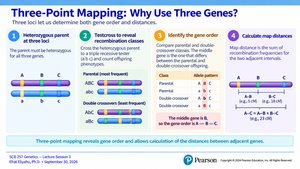
Gene Order and Distances
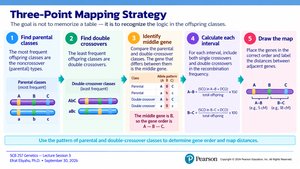
Three loci allow determination of both gene order and distances. The middle gene is identified by comparing parental and double-crossover classes.
Three-Point Mapping Strategy
Steps
Find parental classes
Find double crossovers
Identify middle gene
Calculate each interval
Draw the map
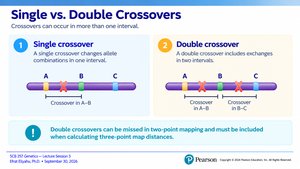
Single vs. Double Crossovers
Mapping Implications
Single crossovers change allele combinations in one interval; double crossovers include exchanges in two intervals. Double crossovers must be included in three-point mapping.
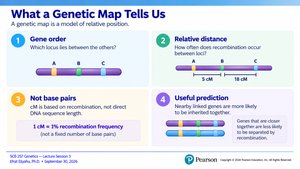
What a Genetic Map Tells Us
Interpretation
Gene order
Relative distance
Not base pairs (map units are based on recombination, not DNA sequence length)
Useful prediction: Nearby linked genes are more likely to be inherited together
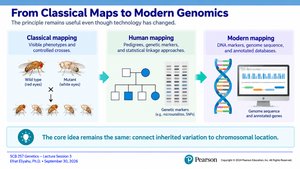
From Classical Maps to Modern Genomics
Evolution of Mapping Techniques
Classical mapping used visible phenotypes and crosses; modern mapping uses DNA markers, genome sequences, and annotated genes. The principle remains: connect inherited variation to chromosomal location.
Chapter 6: Genetic Analysis and Mapping in Bacteria
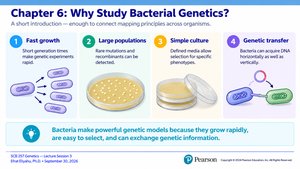
Why Study Bacterial Genetics?
Bacteria are powerful genetic models due to fast growth, large populations, simple culture, and genetic transfer capabilities.
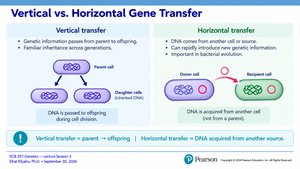
Vertical vs. Horizontal Gene Transfer
Definitions
Vertical transfer: DNA passed from parent to offspring
Horizontal transfer: DNA acquired from another cell or source
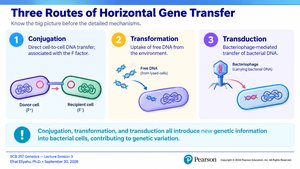
Three Routes of Horizontal Gene Transfer
Mechanisms
Conjugation: Direct cell-to-cell DNA transfer
Transformation: Uptake of free DNA from the environment
Transduction: Bacteriophage-mediated transfer of bacterial DNA
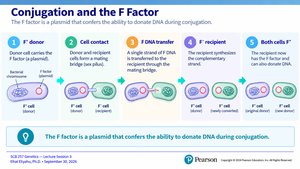
Conjugation and the F Factor
Mechanism
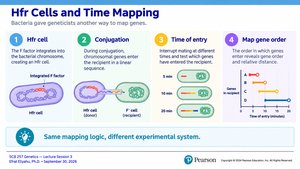
The F factor is a plasmid that confers the ability to donate DNA during conjugation. F+ cells can transfer DNA to F- cells, resulting in both cells being F+.
Hfr Cells and Time Mapping
Mapping Genes in Bacteria
Hfr cells integrate the F factor into their chromosome, allowing gene transfer during conjugation. The time of entry of genes into the recipient cell is used to map gene order and relative distance.
One Big Idea Across Chapters 4–6
Summary
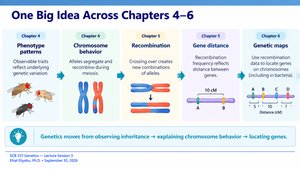
Genetics moves from observing inheritance to explaining chromosome behavior and locating genes. Phenotype patterns, chromosome behavior, recombination, gene distance, and genetic maps are interconnected concepts.
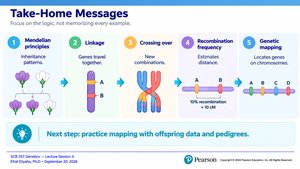
Take-Home Messages
Key Concepts
Mendelian principles: inheritance patterns
Linkage: genes travel together
Crossing over: new combinations
Recombination frequency: estimates distance
Genetic mapping: locates genes on chromosomes