 Back
BackGene Expression in Eukaryotes: Transcription, RNA Processing, and Translation
Study Guide - Smart Notes
 Tailored notes based on your materials, expanded with key definitions, examples, and context.
Gene Expression in Eukaryotes
Overview of the Central Dogma
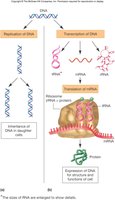
The central dogma of molecular biology describes the flow of genetic information within a biological system: DNA → RNA → Protein. Replication copies DNA, transcription produces RNA, and translation synthesizes proteins, linking genotype to phenotype.
Replication: DNA is duplicated during the S phase of the cell cycle.
Transcription: DNA is transcribed into RNA (mRNA, tRNA, rRNA).
Translation: mRNA is translated into a polypeptide chain (protein).
Gene Expression: Prokaryotes vs. Eukaryotes
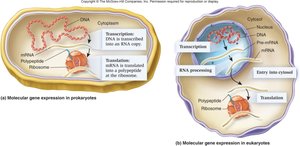
Gene expression in eukaryotes is compartmentalized, allowing for greater regulation and quality control compared to prokaryotes.
Prokaryotes: Transcription and translation occur simultaneously in the cytoplasm.
Eukaryotes: Transcription and RNA processing occur in the nucleus; translation occurs in the cytosol.
Transcription in Eukaryotes
Key Elements of a Eukaryotic Gene
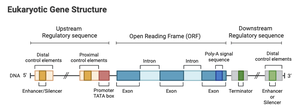
Eukaryotic genes contain several regulatory and coding regions that control transcription and translation.
TATA box (~–25): Defines the transcription start site; bound by TATA-binding protein (TBP).
CAAT box (~–80): Regulates promoter strength and transcription frequency.
GC-rich box (~–90): Binds transcriptional activators or repressors.
+1 site: The first nucleotide transcribed into RNA.
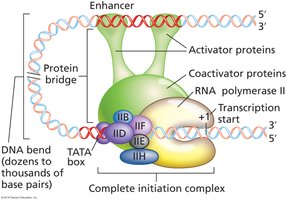
Enhancers: Can be located far from the promoter; bind activator proteins to increase transcription.
Exons and Introns: Exons are coding sequences; introns are non-coding and removed during RNA processing.
Element | Location (approx.) | Function |
|---|---|---|
GC-rich box | –90 | Regulation by activators/repressors |
CAAT box | –80 | Promoter strength |
TATA box | –25 | Transcription start site definition |
+1 site | 0 | Transcription initiation |
Initiation of Transcription
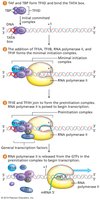
Transcription in eukaryotes requires the assembly of multiple proteins at the promoter region to form the pre-initiation complex (PIC).
RNA polymerase II cannot bind DNA alone; it is recruited by transcription factors (TFs).
TBP binds the TATA box, helping position RNA polymerase II at the +1 site.
Other general transcription factors stabilize the complex and open the DNA for transcription.
Promoters and Enhancers
Promoters contain core elements (TATA box, BRE, +1 site) and proximal elements (CAAT box, GC-rich box). Enhancers can be located far from the gene and interact with the promoter via DNA looping, increasing transcription efficiency.
Elongation and Termination
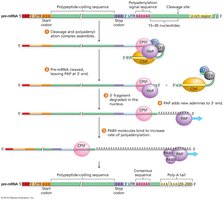
During elongation, RNA polymerase II synthesizes pre-mRNA in the 5′ → 3′ direction, using the DNA template strand. Termination occurs when a polyadenylation signal (AAUAAA) is transcribed, leading to cleavage of the RNA and addition of the poly-A tail.
Multiple RNA polymerases can transcribe a gene simultaneously.
Termination involves cleavage factors and poly(A) polymerase (PAP).
RNA Processing in Eukaryotes
Introns and Exons
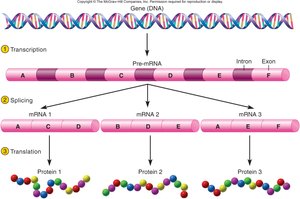
Eukaryotic genes are often interrupted by introns, which are removed from the pre-mRNA during processing. Exons are joined together to form the mature mRNA.
Introns: Non-coding sequences removed by splicing.
Exons: Coding sequences retained in mature mRNA.
Post-Transcriptional Modifications
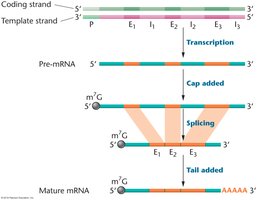
Pre-mRNA undergoes several modifications before becoming mature mRNA:
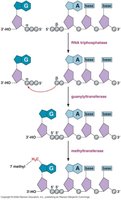
5′ Cap: Addition of a 7-methylguanosine cap to the 5′ end, protecting mRNA and aiding in translation initiation.
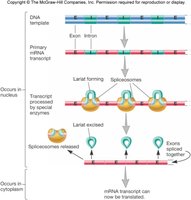
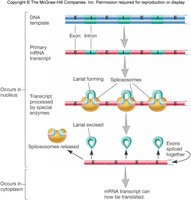
Splicing: Removal of introns and joining of exons by the spliceosome (snRNAs + proteins).
3′ Poly-A Tail: Addition of ~100–250 adenines to the 3′ end, stabilizing mRNA and aiding in export.
5′ Cap Addition
The 5′ cap is added soon after transcription begins and is essential for mRNA stability and translation.
Structure: 7-methylguanosine linked via a 5′–5′ triphosphate bond.
Functions: Protects from exonucleases, required for ribosome binding, aids in nuclear export.
Splicing
Splicing removes introns from pre-mRNA and joins exons to form a continuous coding sequence. The spliceosome, composed of snRNAs and proteins, catalyzes this process. The excised intron forms a lariat structure before degradation.
Polyadenylation (Poly-A Tail Addition)
After cleavage at the polyadenylation signal, poly(A) polymerase adds a poly-A tail to the 3′ end of the mRNA. Poly-A binding proteins (PABPs) bind the tail, protecting the mRNA and enhancing translation.
Alternative Splicing
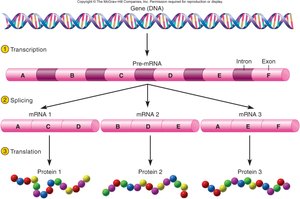
Alternative splicing allows a single gene to produce multiple protein isoforms by varying the combination of exons included in the mature mRNA.
Translation in Eukaryotes
Overview of Translation
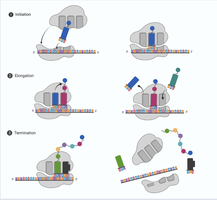
Translation is the process by which ribosomes synthesize proteins using the codon sequence of mRNA. It occurs in three main stages: initiation, elongation, and termination.
Initiation: Ribosome assembles at the start codon (AUG) in the context of the Kozak sequence.
Elongation: Amino acids are joined together as the ribosome moves along the mRNA.
Termination: Translation stops at a stop codon; the polypeptide is released.
Initiation of Translation
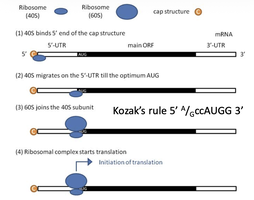
The small ribosomal subunit binds to the 5′ cap of the mRNA and scans for the start codon within a Kozak sequence (5′–(A/G)CCAUGG–3′). The initiator tRNA carrying methionine binds to the AUG codon, and the large subunit joins to form the complete ribosome.
Elongation and Termination
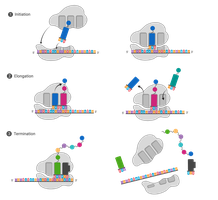
During elongation, tRNAs bring amino acids to the ribosome, where peptide bonds are formed. The process continues until a stop codon (UAA, UAG, UGA) is reached, at which point release factors promote the release of the polypeptide and dissociation of the ribosome.
From DNA to Protein: Summary Table
Step | Location | Key Features |
|---|---|---|
Transcription | Nucleus | Promoter recognition, RNA polymerase II, pre-mRNA synthesis |
RNA Processing | Nucleus | 5′ capping, splicing, 3′ polyadenylation |
Translation | Cytoplasm | Ribosome assembly, Kozak sequence, polypeptide synthesis |
Practice: Identifying Gene Structures
Given a coding strand, students should be able to identify the TATA box, +1 site, start and stop codons, and predict the resulting amino acid sequence using the genetic code.
