 Back
Gene Interaction and Extensions to Mendelian Inheritance: Study Notes
Study Guide - Smart Notes
 Tailored notes based on your materials, expanded with key definitions, examples, and context.
Gene Interaction and Extensions to Mendelian Inheritance
Types of Gene Interactions
Genetic traits are often influenced by more complex interactions than simple Mendelian inheritance. These interactions expand the classical view and include multiple alleles, incomplete dominance, codominance, gene–gene interactions, and gene–environment interactions.
Multiple alleles: More than two alleles may exist for a gene within a population, leading to a variety of phenotypes.
Incomplete dominance: Dominance of one allele over another may not be complete, resulting in intermediate phenotypes.
Gene interactions: Two or more genes may affect a single trait, often modifying expected Mendelian ratios.
Gene–environment interactions: The expression of a trait may depend on both genetic and nongenetic factors.
Interactions Between Alleles and Dominance Relationships
The molecular basis of dominance is determined by the protein products of alleles. The phenotype is the result of the activities of these protein products.
Dominant allele: Produces enough functional protein to display the dominant phenotype in heterozygotes.
Recessive allele: Often produces little or no functional protein.
Example 1: Mutant Allele Recessive to Wild-Type
Wild-type allele (R+): Produces active enzyme (50 units).
Mutant allele (r): Produces little or no enzyme (0 units).
Phenotype: ≥40 units yields wild-type; R+R+ and R+r are wild-type, rr is mutant.
Haplosufficiency: One copy of the wild-type allele is sufficient for normal function.
Example 2: Mutant Allele Dominant to Wild-Type
Allele T1: 10 units enzyme; allele T2: 5 units enzyme.
Phenotype: ≥18 units yields wild-type; only T1T1 is wild-type, T1T2 and T2T2 are mutant.
Haploinsufficiency: One copy of the wild-type allele is not enough for normal function.
Functional Effects of Mutation
Mutations can alter gene function in several ways:
Loss-of-function: Decreased or absent gene product.
Gain-of-function: Increased or novel gene activity.
Types of Loss-of-Function Mutations
Null (amorphic): No functional product; often lethal when homozygous.
Leaky (hypomorphic): Partial loss of function; phenotype severity depends on activity level.
Dominant negative: Mutant polypeptides interfere with normal protein function, especially in multimeric proteins.
Types of Gain-of-Function Mutations
Hypermorphic: Increased gene activity; phenotype may be more severe in homozygotes.
Neomorphic: Novel gene function; mutant phenotype in both heterozygotes and homozygotes.
Extensions to Mendelian Inheritance
Incomplete Dominance
In incomplete dominance, heterozygotes display an intermediate phenotype between the two homozygotes. The phenotype is usually closer to one homozygote than the other.
Example: Flowering time in pea plants, where heterozygotes flower at an intermediate time compared to the two homozygotes.
Codominance
Codominance occurs when both alleles in a heterozygote are fully expressed, resulting in a phenotype distinct from either homozygote. A classic example is the ABO blood group system.
Example: ABO blood types, where both A and B antigens are expressed in type AB individuals.
Dominance Relationships of ABO Alleles
Three alleles: IA, IB, and i.
IA and IB are codominant to each other and dominant over i.
Blood types: A, B, AB, O, determined by antigen presence on red blood cells.
Blood Type | Response to Anti-A | Response to Anti-B | Possible Genotypes |
|---|---|---|---|
A | Clumping | No clumping | IAIA or IAi |
B | No clumping | Clumping | IBIB or IBi |
AB | Clumping | Clumping | IAIB |
O | No clumping | No clumping | ii |
Molecular Basis of ABO Dominance and Codominance
The ABO antigens are glycolipids based on the H antigen, which is modified by specific enzymes encoded by the IA and IB alleles. The i allele encodes a nonfunctional enzyme, leaving the H antigen unmodified.
Allelic Series and Multiple Alleles
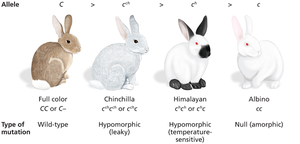
Some genes have more than two alleles, forming an allelic series with a specific dominance hierarchy. The C-gene system for mammalian coat color is a classic example.
C allele: Full color (wild-type, 100% active tyrosinase).
cch allele: Chinchilla, hypomorphic (leaky).
ch allele: Himalayan, hypomorphic (temperature-sensitive).
c allele: Albino, null (amorphic).
Variable Phenotypes and Gene–Environment Interactions
Penetrance and Expressivity
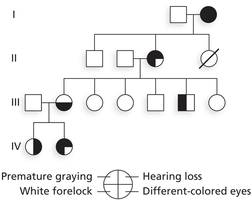
Penetrance and expressivity describe the variability in phenotype among individuals with the same genotype.
Penetrance: The proportion of individuals with a genotype who display the expected phenotype.
Complete penetrance: All individuals with the genotype show the phenotype.
Incomplete penetrance: Some individuals with the genotype do not show the phenotype (e.g., polydactyly).
Expressivity: The degree or range of expression of a phenotype among individuals with the same genotype (e.g., Waardenburg syndrome).
Sex-Limited and Sex-Influenced Traits
Sex-limited traits: Genes present in both sexes but expressed in only one (e.g., milk production in mammals).
Sex-influenced traits: Phenotype expression depends on sex (e.g., chin beard in goats).
Gene–Environment Interactions
Environmental factors can influence gene expression and phenotype. For example, dietary modification can prevent the expression of genetic diseases such as phenylketonuria (PKU).
Example: PKU is managed by restricting phenylalanine in the diet, preventing neurological damage.
Pleiotropy
Pleiotropy occurs when a single gene affects multiple distinct traits. This is often observed in developmental genes and certain diseases.
Example: Sickle cell disease, caused by a mutation in the β-globin gene, leads to multiple symptoms affecting various organs and systems.
Gene Interaction and Modification of Mendelian Ratios
Gene Interaction in Pathways
Multiple genes often collaborate in biochemical pathways (anabolic, catabolic, signal transduction, developmental) to produce phenotypes. Mutations in any gene in the pathway can alter the final phenotype.
Epistasis
Epistasis is a form of gene interaction where one gene masks or modifies the effect of another gene, leading to altered phenotypic ratios compared to Mendelian expectations. Epistasis is commonly observed in dihybrid crosses, where the phenotypic ratio deviates from the classic 9:3:3:1 due to gene interactions.
Additional info: The notes have been expanded with academic context and examples to ensure completeness and clarity for Genetics college students.
