 Back
Gene Interactions and Variations from Classic Mendelian Genetics
Study Guide - Smart Notes
 Tailored notes based on your materials, expanded with key definitions, examples, and context.
Gene Interactions and Variations from Classic Mendelian Genetics
Gene Interaction: Introduction
Gene interaction refers to the phenomenon where two or more genes influence a single phenotype, or where the effect of one gene is modified by another. This concept is central to understanding the complexity of inheritance patterns beyond simple Mendelian genetics.
Transmission Genetics: X-Linked Inheritance
X-Linked Inheritance Patterns
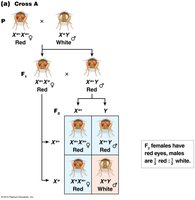
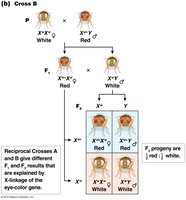
X-linked inheritance involves genes located on the X chromosome. The inheritance pattern differs between males (XY) and females (XX), leading to unique phenotypic ratios and characteristics.
X-linked recessive traits: Phenotype is visible in homozygous females and hemizygous males. More males than females show the trait.
X-linked dominant traits: Phenotype is visible in both homozygous and heterozygous females, and hemizygous males. Both sexes are affected equally.
Examples of X-linked recessive inheritance: Red-green color blindness, Hemophilia, Charcot-Marie-Tooth disease.
Examples of X-linked dominant inheritance: Rett Syndrome, Goltz syndrome.
X-linkage explains inheritance patterns in Drosophila eye color: The w+ allele (red, dominant) and w allele (white, recessive) demonstrate classic X-linked inheritance.
X Chromosome Dosage Compensation and Inactivation
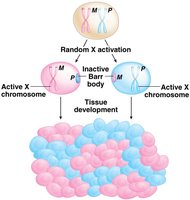
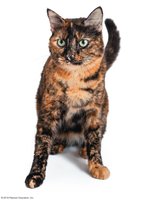
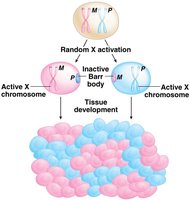
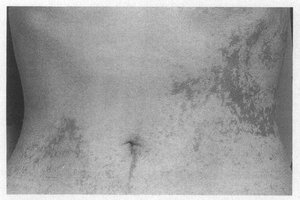
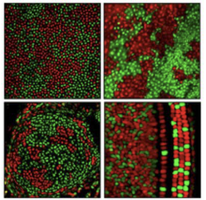
In mammals, females have two X chromosomes while males have one. To balance gene expression, one X chromosome in females is randomly inactivated during development, forming a Barr body. This leads to mosaicism in female heterozygotes, where different cells express different X-linked alleles.
Barr body: The condensed, inactive X chromosome in female cells.
Mosaicism: Female heterozygotes display a mosaic phenotype due to random X inactivation.
Reactivation: The Barr body is reactivated during meiosis to produce eggs.
Gene Mutation and Allelic Variation
Functional Types of Mutations/Alleles
Mutations can alter gene function in various ways, leading to different phenotypic outcomes. Understanding these types is essential for interpreting genetic data and inheritance patterns.
Wild Type: The normal, functional allele.
Loss-of-function: Mutation reduces or eliminates gene function.
Null (amorphic): Complete loss of function.
Hypomorphic: Partial loss of function.
Dominant negative: Mutant allele interferes with normal allele function.
Gain-of-function: Mutation increases or changes gene activity.
Hypermorphic: Increased normal function.
Neomorphic: New function not seen in wild type.
Haplosufficiency vs. Haploinsufficiency: Haplosufficient alleles provide enough gene product for normal function even when only one copy is present. Haploinsufficient alleles do not.
Variations from Classic Mendelian Genetics
Types of Non-Mendelian Inheritance
Several inheritance patterns deviate from Mendel's laws, resulting in altered phenotypic ratios and complexity in genetic analysis.
Incomplete dominance: Heterozygotes have a phenotype intermediate between the two alleles.
Co-dominance: Both alleles are fully expressed in heterozygotes.
Multiple alleles: More than two alleles affect a phenotype.
Lethal alleles: Homozygotes for certain alleles cannot survive.
Penetrance and expressivity: Degree to which a genotype is expressed as a phenotype.
Environmental impact: Genetically identical individuals may show different phenotypes due to environmental factors.
Pleiotropy: One gene affects multiple phenotypic traits.
Epistasis: One gene alters the expression of another gene.
Polygenic inheritance: Multiple genes contribute to a single phenotype.
Examples of Incomplete Dominance and Co-dominance
Incomplete dominance and co-dominance are classic examples of gene interaction, where the heterozygote phenotype differs from either homozygote.
Incomplete dominance: In snapdragons, CR/CR produces red flowers, CW/CW produces white flowers, and CR/CW produces pink flowers.
Co-dominance: In human blood types, IA and IB alleles are co-dominant, resulting in AB blood type when both are present.
Allelic series: When multiple alleles exist, there is an order of dominance. For example, in the C gene for melanin synthesis: C > cch > ch > c.
Pedigree Analysis and Probability Calculations
Pedigree Analysis Tips
Pedigree analysis is a fundamental tool in genetics for determining inheritance patterns and calculating genotype probabilities.
Draw the pedigree: Map family relationships and affected/unaffected status.
Write genotypes: Use available information to assign possible genotypes.
Conditional probability: Calculate probabilities based on known affected/unaffected status.
Formula for offspring probability:
Mode of inheritance hints: Unaffected parents with affected child suggest recessive; affected parents with unaffected child suggest dominant; differences in trait frequency between sexes suggest X-linked.
Gene-Environment Interactions
Gene-Environment Interaction
Gene-environment interaction describes how environmental factors influence the expression of genes and the resulting phenotype. This is important for understanding variation among genetically identical individuals.
Example: Phenylketonuria (PKU) is an autosomal recessive disorder caused by the absence of an enzyme for phenylalanine breakdown. Environmental intervention (diet) can prevent the toxic effects.
Sex Determination Mechanisms
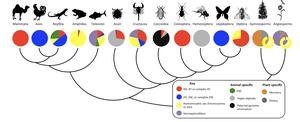
Variation in Sex Determination
Sex determination mechanisms vary widely across species, from chromosomal to environmental systems. This diversity is a key topic in genetics and evolutionary biology.
Summary Table: Types of Mutations
Type | Effect | Example |
|---|---|---|
Null (amorphic) | No function | Nonsense mutation early in gene |
Hypomorphic | Partial function | Leaky mutation |
Dominant negative | Interferes with wild type | Mutant protein blocks normal function |
Hypermorphic | Increased function | Oncogene overexpression |
Neomorphic | New function | Protein expressed in new tissue |
Learning Objectives
Describe classes of gain-of-function and loss-of-function mutations and relate to dominant/recessive alleles.
Describe variations from classic Mendelian genetics.
Explain altered phenotypic ratios in F1 and F2 generations and apply chi-square tests.
Additional info: Some context and explanations were inferred to ensure completeness and academic clarity.
