 Back
BackGene Interactions: Mechanisms, Phenotypes, and Modified Mendelian Ratios
Study Guide - Smart Notes
 Tailored notes based on your materials, expanded with key definitions, examples, and context.
Gene Interactions
Introduction to Gene Interactions
Gene interactions refer to the various ways in which different genes collaborate or interact to influence a phenotype. Unlike simple Mendelian inheritance, where one gene controls one trait, gene interactions often involve multiple genes and can result in complex phenotypic outcomes. These interactions are fundamental to understanding the molecular basis of heredity and variation.
Multiple alleles: There may be more than two alleles for a given locus within a population.
Incomplete dominance: Dominance of one allele over another may not be complete, leading to intermediate phenotypes.
Gene-gene and gene-environment interactions: The expression of a trait may depend on the interaction of more than one gene and/or the interaction of genes with nongenic factors.
Types of Gene Interactions
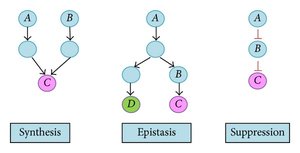
Gene interactions can be classified based on how genes affect a single trait. The main types include synthetic, epistatic, and suppressive interactions.
Synthetic interaction: Genes act in parallel pathways; loss of both is required to lose the phenotype.
Epistatic interaction: One gene's effect masks or modifies the effect of another gene.
Suppressive interaction: One gene suppresses the effect of another, restoring the wild-type phenotype in double mutants.
The Molecular Basis of Dominance
Dominance and Recessiveness
The terms dominant and recessive describe phenotypic outcomes, but the molecular basis lies in the protein products of alleles. The overall phenotype is determined by the activities of these protein products.
Haplosufficiency: One copy of the wild-type allele is sufficient for normal function.
Haploinsufficiency: One copy of the wild-type allele is not enough for normal function.
Examples of Dominance Relationships
Recessive mutant allele: A wild-type allele produces enough enzyme for a normal phenotype; the mutant allele produces little or no enzyme.
Dominant mutant allele: The mutant allele is dominant if heterozygotes and mutant homozygotes both show the mutant phenotype due to insufficient wild-type product.
The Functional Consequences of Mutation
Types of Mutations
Mutant alleles can have various effects on gene function, classified as loss-of-function or gain-of-function mutations.
Loss-of-function mutations: Significant decrease or complete loss of functional gene product.
Gain-of-function mutations: Gene product acquires a new function or expresses increased wild-type activity.
Loss-of-Function Mutations
Null (amorphic) mutations: Produce no functional gene product; often lethal when homozygous.
Leaky (hypomorphic) mutations: Result in partial loss of function; phenotype severity depends on residual activity.

Dominant Negative Mutations
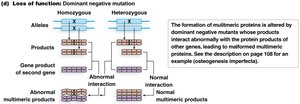
Multimeric proteins are particularly susceptible to dominant negative mutations, where the mutant polypeptide disrupts the function of the entire protein complex.
Dominant negative: The mutant allele interferes with the normal allele's product, causing a loss of function even in heterozygotes.
Gain-of-Function Mutations
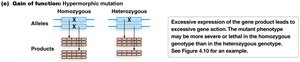
Hypermorphic mutations: Produce more gene activity than normal.
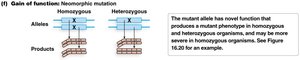
Neomorphic mutations: Acquire novel gene activities not found in the wild type.
Non-Mendelian Dominance Relationships
Incomplete Dominance
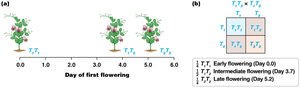
Incomplete dominance occurs when heterozygotes display intermediate phenotypes between either homozygous type. The heterozygote is typically more similar to one homozygote than the other.
Codominance
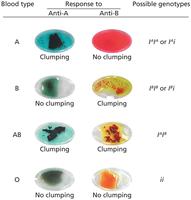
Codominance results in heterozygotes with a phenotype distinct from either homozygote, with both alleles being detectably expressed. The ABO blood group system is a classic example.
IA and IB alleles: Codominant with each other, both expressed in type AB individuals.
i allele: Recessive to both IA and IB.
Multiple Alleles and Allelic Series
Allelic Series
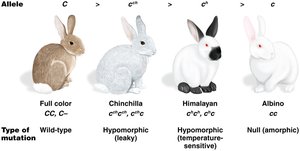
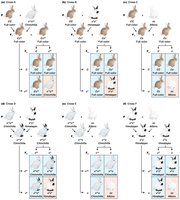
A locus with more than two alleles is said to have multiple alleles. An order of dominance among these alleles forms an allelic series.
The C-Gene System for Mammalian Coat Color
The C gene in mammals controls coat color by producing an enzyme involved in melanin production. Four main alleles form an allelic series with different dominance relationships and phenotypic effects.
Lethal Alleles
Definition and Detection
Lethal alleles are single-gene mutations that cause death when present in certain genotypes, typically as recessive alleles. They can be detected by missing classes of progeny in segregation ratios.
The Agouti Locus in Mice
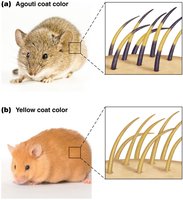
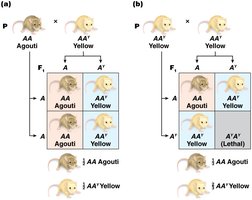
The AY allele at the agouti locus is dominant for yellow coat color but recessive lethal. Homozygotes (AY AY) die, so all yellow mice are heterozygous (AYA).
Molecular Basis of AY Lethality
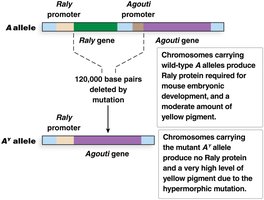
The AY mutation is a deletion affecting both the Agouti and Raly genes. Raly is essential for development, and its absence in homozygotes causes lethality.
Delayed Age of Onset
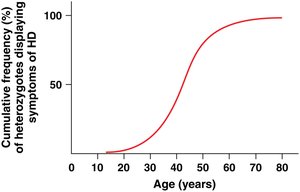
Dominant lethal alleles can persist in populations if their effects are not expressed until after reproduction. Huntington disease is a classic example.
Variable Phenotypes from the Same Genotype
Penetrance and Expressivity
Complete penetrance: Genotype always produces the same phenotype.
Incomplete penetrance: Not all individuals with the genotype show the phenotype.
Variable expressivity: Individuals with the same genotype show the phenotype to varying degrees.
Sex-Limited and Sex-Influenced Traits
Sex-limited traits: Expressed in only one sex, though both sexes carry the genes.
Sex-influenced traits: Phenotype depends on the sex of the organism, even with the same genotype.
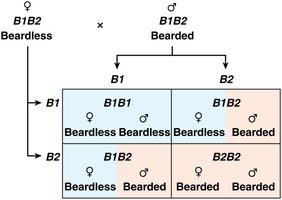
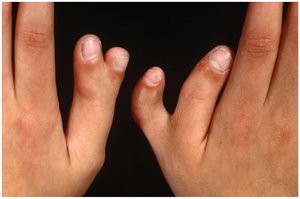
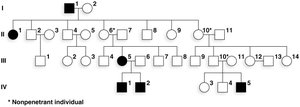
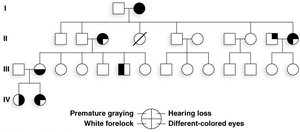
Examples of Incomplete Penetrance and Variable Expressivity
Polydactyly: Autosomal dominant trait with incomplete penetrance; not all carriers show extra digits.
Waardenburg syndrome: Same genotype, but different combinations of symptoms among individuals.
Gene–Environment Interactions and Pleiotropy
Gene–Environment Interactions
Environmental factors can influence gene expression and phenotype. For example, phenylketonuria (PKU) can be managed by dietary restriction of phenylalanine, preventing the disease phenotype.
Pleiotropy
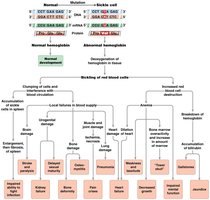
Pleiotropy occurs when a single gene mutation affects multiple distinct traits. Sickle cell disease is a classic example, where a mutation in the β-globin gene leads to multiple symptoms.
Gene Interaction Modifies Mendelian Ratios
Gene Interaction and Phenotypic Ratios
Gene interactions can modify the classic Mendelian 9:3:3:1 dihybrid ratio, producing new phenotypic ratios depending on the type of interaction.
Complementary gene interaction: 9:7 ratio
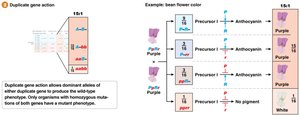
Duplicate gene action: 15:1 ratio
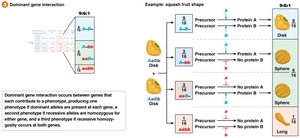
Dominant gene interaction: 9:6:1 ratio
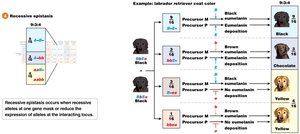
Recessive epistasis: 9:3:4 ratio
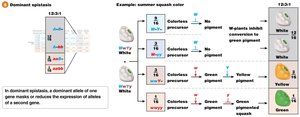
Dominant epistasis: 12:3:1 ratio
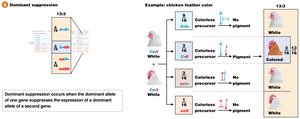
Dominant suppression: 13:3 ratio
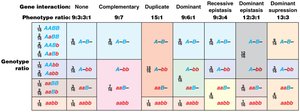
Examples of Modified Ratios
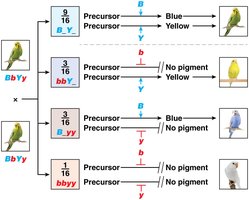
No interaction (9:3:3:1): Each gene independently affects the phenotype, as in budgerigar feather color.
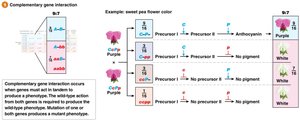
Complementary gene interaction (9:7): Both genes are required for the phenotype, as in sweet pea flower color.
Duplicate gene action (15:1): Either gene can provide the function, as in bean flower color.
Dominant gene interaction (9:6:1): Both genes contribute to the phenotype, as in squash fruit shape.
Recessive epistasis (9:3:4): Recessive alleles at one locus mask the effect of another gene, as in Labrador retriever coat color.
Dominant epistasis (12:3:1): Dominant allele at one locus masks the effect of another gene, as in summer squash color.
Dominant suppression (13:3): Dominant allele at one locus suppresses the effect of another gene, as in chicken feather color.
Summary Table: Gene Interaction Ratios
Gene Interaction | Phenotype Ratio | Example |
|---|---|---|
None | 9:3:3:1 | Budgerigar feather color |
Complementary | 9:7 | Sweet pea flower color |
Duplicate | 15:1 | Bean flower color |
Dominant | 9:6:1 | Squash fruit shape |
Recessive epistasis | 9:3:4 | Labrador retriever coat color |
Dominant epistasis | 12:3:1 | Summer squash color |
Dominant suppression | 13:3 | Chicken feather color |
Additional info: This guide covers the core concepts of gene interactions, their molecular basis, and the resulting modifications to Mendelian ratios, with examples and diagrams to reinforce understanding.
