 Back
BackChap 15
Study Guide - Smart Notes
 Tailored notes based on your materials, expanded with key definitions, examples, and context.
Gene Mutation, DNA Repair, and Transposition
Introduction
This chapter explores the nature of gene mutations, their classification, mechanisms of occurrence, and the cellular systems that repair DNA damage. Understanding these processes is fundamental to genetics, as mutations are the source of genetic variation and can lead to genetic disorders or be harnessed for research and biotechnology.
Gene Mutations: Classification and Effects
Types of Gene Mutations
Gene mutations are changes in the nucleotide sequence of DNA. They can be classified based on their effects on the DNA sequence and the resulting protein product.
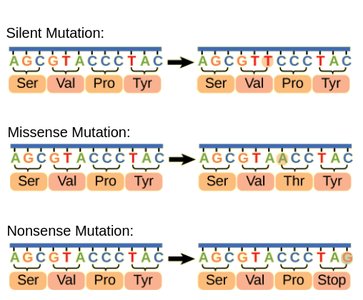
Silent Mutation: Alters a nucleotide but does not change the amino acid due to the redundancy of the genetic code.
Missense Mutation: Changes a nucleotide, resulting in a different amino acid and potentially a less or non-functional protein.
Nonsense Mutation: Converts a codon into a stop codon, leading to premature termination of translation and a truncated protein.
Frameshift Mutation: Insertion or deletion of nucleotides that shifts the reading frame, altering the downstream amino acid sequence.
Mutations in Non-coding Regions: Can affect gene expression by altering regulatory sequences.
Somatic vs. Germline Mutations
Mutations can occur in different cell types, affecting inheritance and organismal impact.
Somatic Mutations: Occur in non-germ cells; not heritable and affect only the individual.
Germline Mutations: Occur in gametes; heritable and present in every cell of the offspring.
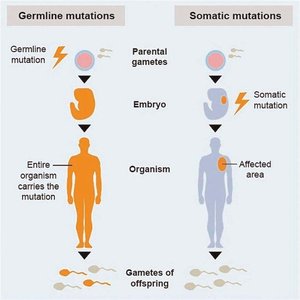
Key Point: Somatic mutations are more likely due to the higher number of cell divisions and greater exposure to environmental factors compared to germline cells.
Origins of Mutations
Spontaneous vs. Induced Mutations
Mutations arise from two main sources:
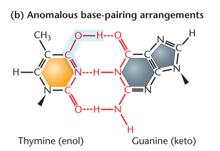
Spontaneous Mutations: Result from natural biological or chemical processes, such as errors during DNA replication or spontaneous base modifications. These occur at low rates.
Induced Mutations: Caused by external agents (mutagens) like ultraviolet light, X-rays, or chemicals, which increase mutation rates.
Genetic Approaches to Studying Mutations
Geneticists use mutations to study gene function through two main approaches:
Forward Genetics: Begins with a mutant phenotype and seeks to identify the underlying gene(s).
Reverse Genetics: Starts with a known gene and investigates the phenotypic effects of specific mutations.
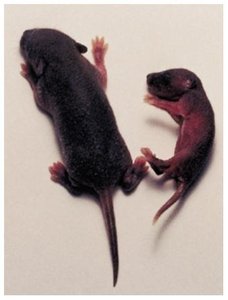
Example: Inducing mutations in mice to study the genetic basis of diseases such as spinal muscular atrophy (SMA).
DNA Repair Mechanisms
Overview of DNA Repair Systems
Cells have evolved multiple DNA repair pathways to maintain genomic integrity. Double-strand breaks (DSBs) are particularly hazardous and are repaired by specialized mechanisms.
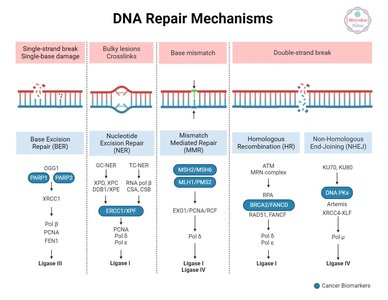
Double-Strand Break Repair: Homologous Recombination (HR)
Homologous recombination is a high-fidelity repair pathway for DSBs, active after DNA replication when a sister chromatid is available.
DSB is recognized and the 5' ends are resected to produce 3' overhangs.
The 3' overhang invades the sister chromatid, using it as a template for accurate repair.
Gaps are filled and ligated, restoring the original sequence.
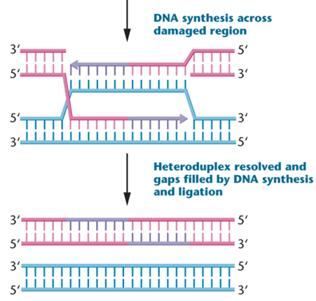
Key Point: HR is highly accurate because it uses the undamaged sister chromatid as a template.
Double-Strand Break Repair: Nonhomologous End Joining (NHEJ)
NHEJ is an alternative DSB repair pathway that does not require a homologous template and is more error-prone.
Proteins bind to the broken DNA ends and ligate them together.
This process can result in the addition or deletion of nucleotides at the break site, potentially causing mutations.
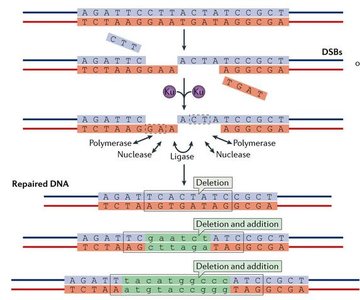
Key Point: NHEJ is essential for cell survival but can introduce small mutations at the repair site.
Summary Table: Types of Mutations and Repair Mechanisms
Mutation Type | Effect on Protein | Repair Mechanism |
|---|---|---|
Silent | No change | Mismatch Repair (MMR) |
Missense | Altered amino acid | MMR, Base Excision Repair (BER) |
Nonsense | Premature stop codon | MMR, Nonsense-mediated decay |
Frameshift | Altered reading frame | MMR, NHEJ (if due to DSB) |
Double-strand break | Potential gene disruption | HR, NHEJ |
Key Equations and Concepts
Mutation Rate: The frequency at which a specific mutation occurs in a given gene per generation.
DNA Repair Fidelity: Homologous recombination is more accurate than NHEJ due to the use of a template.
Applications and Importance
Understanding mutation and repair mechanisms is crucial for studying genetic diseases, cancer, and for biotechnological applications such as CRISPR-based genome editing.
Geneticists use induced mutations to dissect gene function and model human diseases in organisms like mice.
