 Back
Gene Mutation, DNA Repair, and Transposition: Study Notes for Genetics
Study Guide - Smart Notes
 Tailored notes based on your materials, expanded with key definitions, examples, and context.
Gene Mutation, DNA Repair, and Transposition
Gene Mutations: Classification and Types
Gene mutations are alterations in the DNA sequence that can affect genetic function and phenotype. They may occur in somatic or germ cells and can be classified by molecular change, phenotype, or location.
Point Mutation (Base Substitution): Change from one base pair to another. Types include missense (different amino acid), nonsense (stop codon), and silent (same amino acid).
Frameshift Mutation: Result from insertions or deletions, causing a shift in the reading frame during translation.
Transitions: Pyrimidine replaces pyrimidine or purine replaces purine.
Transversions: Purine and pyrimidine are interchanged.
Example: Substitution, deletion, and insertion mutations can alter the reading of a sentence, analogous to changes in DNA. 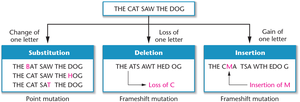
Classification by Phenotype
Loss-of-function: Reduces or eliminates gene product function.
Gain-of-function: Produces enhanced, negative, or new function.
Null mutation: Complete loss of function.
Suppressor mutation: Second mutation that relieves effects of a previous mutation.
Conditional mutations: Expressed only under certain conditions (e.g., temperature-sensitive).
Classification by Location
Somatic mutations: Occur in non-germ cells; not heritable.
Germ-line mutations: Occur in gametes; inherited.
Autosomal mutations: Located on autosomes.
X- and Y-linked mutations: Located on sex chromosomes.
Spontaneous and Induced Mutations
Mutations can occur spontaneously due to natural processes or be induced by external factors.
Spontaneous mutations: Arise from replication errors, base modifications, or cellular by-products.
Induced mutations: Result from exposure to radiation, chemicals, or other mutagens.
Replication Errors and Base Modifications
Replication slippage: DNA polymerase misses looped-out nucleotides, causing insertions/deletions.
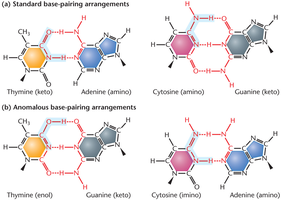
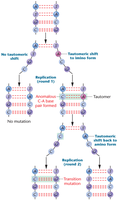
Tautomeric shifts: Alternate chemical forms of bases increase mispairing probability.
Depurination: Loss of purine base, creating apurinic sites.
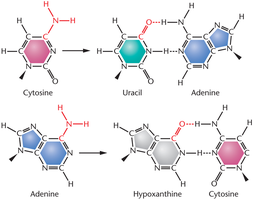
Deamination: Conversion of cytosine to uracil or adenine to hypoxanthine, altering base pairing.
Oxidative damage: Caused by superoxides, hydroxyl radicals, and hydrogen peroxide.
Transposable Elements
Transposons: DNA elements that move within or between genomes, causing chromosomal damage.
Induced Mutations: Chemical and Radiation Damage
Mutagens are agents that induce mutations, including chemicals and radiation.
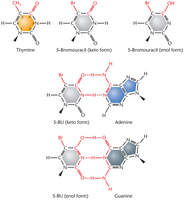
Base analogs: Substitute for normal bases, increasing mutation rates (e.g., 5-bromouracil).
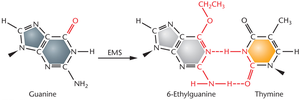
Alkylating agents: Donate alkyl groups, altering base-pairing affinity (e.g., mustard gas).
Intercalating agents: Wedge between DNA bases, causing distortions (e.g., ethidium bromide).
Adduct-forming agents: Covalently bind to DNA, interfering with replication (e.g., acetaldehyde, heterocyclic amines).
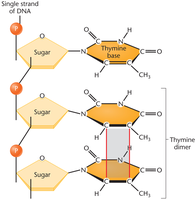
UV light: Creates pyrimidine dimers, distorting DNA.
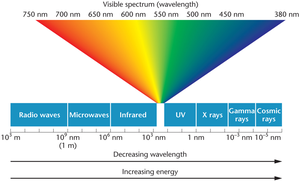
Ionizing radiation: X-rays, gamma rays, cosmic rays cause ionization and DNA damage.
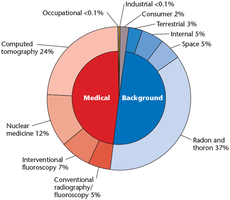
Single-Gene Mutations and Human Disease
Single-gene mutations can cause a wide range of human diseases, including monogenic and polygenic disorders.
Monogenic diseases: Caused by single base-pair changes (e.g., beta thalassemia).
Trinucleotide repeat sequences: Excessive repeats cause disorders like Fragile-X syndrome and Huntington disease.
DNA Repair Systems
Organisms possess multiple DNA repair systems to counteract mutations and maintain genetic integrity.
Proofreading and mismatch repair: DNA polymerase removes and replaces incorrect nucleotides; mismatch repair corrects errors missed by proofreading.
Strand discrimination: Based on DNA methylation; newly synthesized strands are unmethylated and recognized for repair.
Postreplication repair: RecA protein directs recombination exchange with undamaged parental strand.
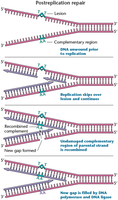
SOS repair system: Error-prone repair in bacteria, allowing survival with DNA damage.
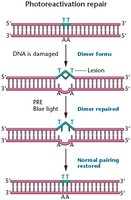
Photoreactivation repair: Cleaves bonds between thymine dimers using light; absent in humans.
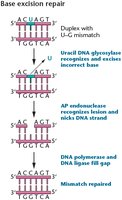
Base excision repair (BER): Corrects damaged bases; DNA glycosylase recognizes and excises altered base.
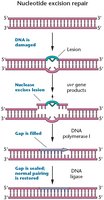
Nucleotide excision repair (NER): Repairs bulky lesions; exonuclease removes error, DNA polymerase fills gap, ligase seals nick.
Genetic Disorders Due to Defective Repair
Xeroderma pigmentosum: Defective NER pathway; severe skin problems and high cancer risk.
Cockayne syndrome: Developmental and neurological issues; sunlight sensitivity, premature aging.
Trichothiodystrophy: Dwarfism, intellectual disabilities, brittle hair/skin, sunlight sensitivity.
Double-Strand Break Repair
Homologous recombination repair: Uses sister chromatid as template; occurs in late S or early G2 phase.
Nonhomologous end joining: Joins free DNA ends; activated in G1 phase.
The Ames Test: Assessing Mutagenicity
The Ames test uses strains of Salmonella typhimurium to detect mutagenic compounds by measuring reverse mutation frequency. It is widely used in industrial and pharmaceutical development.
Transposable Elements and Mutations
Transposable elements, or "jumping genes," can move within and between chromosomes, causing mutations and chromosomal rearrangements.
Ac–Ds system in maize: Mobile genetic elements in corn; movement of Ds gene depends on Ac gene.
Retrotransposons: Amplify and move using RNA intermediates; include LTR and non-LTR types.
Copia elements in Drosophila: Retrotransposons dispersed throughout genome; cause mutations like white-apricot eye color.
Human transposable elements: LINEs and SINEs make up 34% of human genome.
Summary Table: Types of Mutations
Type | Description | Example |
|---|---|---|
Point Mutation | Single base substitution | Missense, nonsense, silent |
Frameshift Mutation | Insertion/deletion causing reading frame shift | Loss or addition of nucleotide |
Transition | Pyrimidine replaces pyrimidine or purine replaces purine | A-G or C-T |
Transversion | Purine replaces pyrimidine or vice versa | A-T or G-C |
Summary Table: DNA Repair Mechanisms
Repair Type | Mechanism | Key Enzymes |
|---|---|---|
Proofreading | Removes incorrect nucleotides during replication | DNA polymerase |
Mismatch Repair | Detects and repairs mismatches | Endonuclease, exonuclease, DNA polymerase |
Photoreactivation | Cleaves thymine dimers using light | Photoreactivation enzyme |
Base Excision Repair | Removes damaged bases | DNA glycosylase, AP endonuclease |
Nucleotide Excision Repair | Removes bulky lesions | Exonuclease, DNA polymerase, DNA ligase |
Homologous Recombination | Uses sister chromatid for repair | RecA, other recombination proteins |
Nonhomologous End Joining | Joins free DNA ends | Kinase, BRCA1, ligase |
Key Equations
Mutation Rate:
Additional info: Academic context was added to clarify mechanisms, examples, and applications for each mutation and repair type. Tables were inferred and expanded for completeness.
