 Back
Gene Mutations and DNA Repair: Structured Study Notes for Genetics
Study Guide - Smart Notes
 Tailored notes based on your materials, expanded with key definitions, examples, and context.
Gene Mutations and DNA Repair
Introduction to Mutations
Mutations are inherited alterations in the DNA sequence that serve as the source of all genetic variation, providing the raw material for evolution. They are also responsible for many diseases and disorders, and are useful for probing fundamental biological processes. Mutations can be harmful, beneficial, or neutral.
Categories of Mutations by Tissue
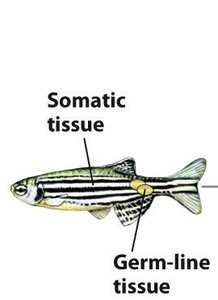
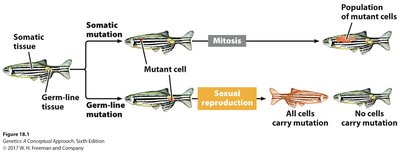
Multicellular organisms have two main types of tissue: germline tissue (reproductive cells that produce gametes) and somatic tissue (all other cells in the body). The location of a mutation determines whether it is passed onto offspring.
Somatic mutations: Occur in somatic tissue and are not inheritable.
Germline mutations: Occur in germline tissue and are inheritable.
Tp53: The Guardian of the Genome
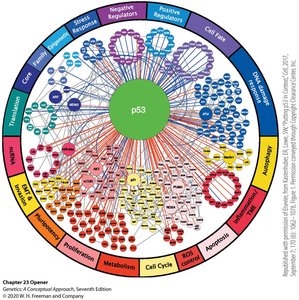
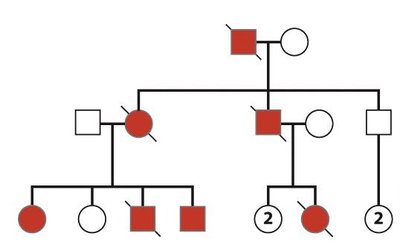
The p53 protein is a critical regulator of the cell cycle and genome stability. Somatic mutations in Tp53 occur in about 50% of human cancers, while germline mutations can cause Li-Fraumeni syndrome, a hereditary cancer predisposition.
Categories of Mutations
Chromosomal Rearrangements
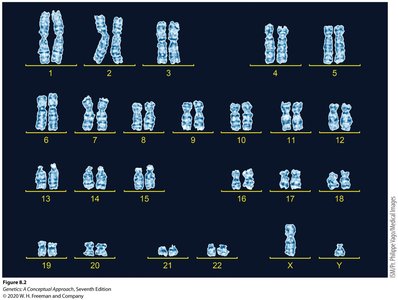
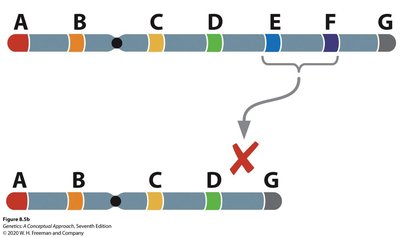
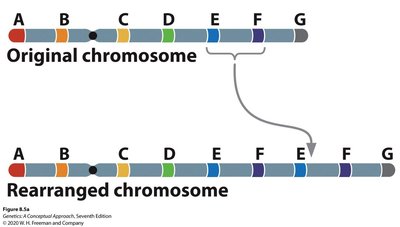
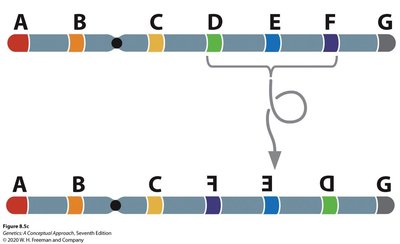
Chromosomal rearrangements are large-scale mutations that affect multiple genes. There are four basic types:
Deletion: Loss of a chromosome segment, resulting in loss of genetic material. Consequences range from neutral to severe defects depending on size and location.
Duplication: Doubling of a chromosome segment, resulting in gain of genetic material. Can cause problems in chromosome pairing during meiosis and alter gene dosage.
Inversion: A chromosome segment is inverted, with no loss or gain of genetic material. May break a gene or cause position effects.
Translocation: Genetic material moves from one chromosome to another, often accompanied by deletions and position effects.
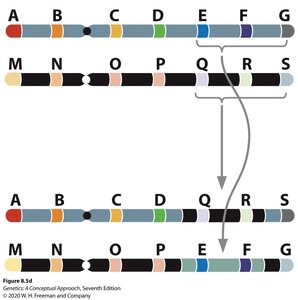
Gene Mutations
Gene mutations are small-scale changes that affect single genes. The three basic types are:
Base pair substitutions: Alteration of a single nucleotide.
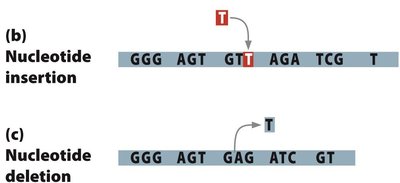
Insertions/deletions (indels): Addition or removal of one or more nucleotides, often causing frameshift mutations.
Expanding nucleotide repeats: Increase in the number of copies of a set of nucleotides, often associated with genetic diseases.
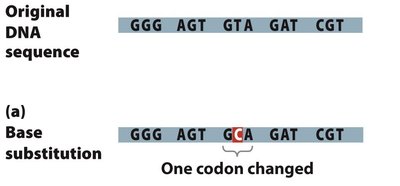
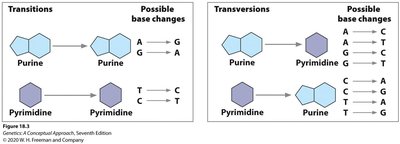
Types of Base Pair Substitutions
Transition: Substitution of a purine for a purine (A ↔ G) or a pyrimidine for a pyrimidine (C ↔ T).
Transversion: Substitution of a purine for a pyrimidine or vice versa (A or G ↔ C or T). Usually more severe.
Expanding Nucleotide Repeats
Genes contain short tandem repeats (STRs) that can expand in disease states. Most expanding repeats involve a set of three nucleotides (CNG). Diseases such as ALS, Huntington disease, and Fragile-X syndrome are caused by expanding nucleotide repeats.
Disease | Repeated Sequence | Normal Range | Disease Range |
|---|---|---|---|
Spinal and bulbar muscular atrophy | CAG | 11–33 | 40–62 |
Fragile-X syndrome | CGG | 6–54 | 50–1500 |
Huntington disease | CAG | 9–37 | 37–121 |
Amyotrophic lateral sclerosis | GGGGCC | 2–23 | 700–1600 |
Myotonic dystrophy | CTG | 5–37 | 44–3000 |
Friedreich ataxia | GAA | 6–29 | 200–900 |
Additional info: See full table in original notes for more diseases. |
Causes of Mutations
Spontaneous vs. Induced Mutations
Spontaneous mutations: Result from mistakes in DNA replication or meiosis, or spontaneous chemical changes in DNA.
Induced mutations: Caused by environmental mutagens such as chemicals or radiation.
Mechanisms of Spontaneous Mutation
Wobble: Flexibility in DNA strands permits mispairing of bases, leading to base pair substitutions.
Strand slippage: Causes insertions and deletions during DNA replication.
Unequal crossing over: During meiosis, misalignment of homologous chromosomes can produce insertions and deletions.
Mutation Rates
Mutation rates vary among different organisms and genes. For example, the mutation rate for Huntington disease in humans is per gamete.
Types of DNA Damage
Depurination: Loss of a purine base (A or G) from a nucleotide, leading to random base incorporation.
Oxidative deamination: Loss of an amino group from a base, changing its pairing properties.
Oxidation by reactive oxygen species: Can cause G-C to T-A transversions.
Induced Mutations
Base analogs: Molecules that mimic normal DNA bases, such as 5-bromouracil, can cause base pair substitutions.
Intercalating agents: Flat molecules that insert between DNA bases, causing strand slippage and frameshift mutations.
Radiation: Ionizing radiation (X-rays, gamma-rays) and UV light can break DNA bonds or cause pyrimidine dimers.
Phenotypic Effects of Mutations
Types of Mutations and Their Effects
Type of Mutation | Definition |
|---|---|
Forward mutation | Changes wild-type phenotype to mutant phenotype |
Reverse mutation | Changes mutant phenotype back to wild-type phenotype |
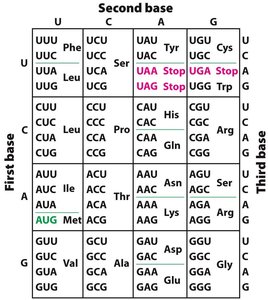
Missense mutation | Changes a sense codon to a different sense codon, resulting in a different amino acid |
Nonsense mutation | Changes a sense codon to a stop codon, causing premature termination |
Silent mutation | Changes a sense codon to a synonymous codon, leaving the amino acid sequence unchanged |
Neutral mutation | Changes the amino acid sequence without altering protein function |
Loss-of-function mutation | Causes complete or partial loss of protein function |
Gain-of-function mutation | Causes appearance of a new trait or function |
Lethal mutation | Causes premature death |
Suppressor mutation | Suppresses the effect of an earlier mutation |
Intragenic suppressor mutation | Suppresses effect within the same gene |
Intergenic suppressor mutation | Suppresses effect in another gene |
DNA Repair Mechanisms
Summary of Common DNA-Repair Mechanisms
Repair System | Type of Damage Repaired |
|---|---|
Mismatch | Replication errors, mispaired bases, strand slippage |
Direct | Pyrimidine dimers, other specific alterations |
Base excision | Abnormal bases, modified bases, pyrimidine dimers |
Nucleotide excision | DNA damage that distorts the double helix |
Homologous recombination | Double-strand breaks |
Nonhomologous end joining | Double-strand breaks |
Mismatch Repair: Detects and repairs replication errors.
Direct Repair: Restores altered nucleotides to their original structure.
Base Excision Repair: Removes abnormal bases and repairs the resulting AP site.
Nucleotide Excision Repair: Removes bulky DNA distortions.
Homologous Recombination: Uses sister chromatid to repair double-strand breaks.
Nonhomologous End Joining: Joins broken DNA ends, often error-prone.
Transposable Elements
Classes of Transposable Elements
Transposable elements, or "jumping genes," are DNA sequences that can move from one genomic location to another. They are a source of genomic instability and can cause mutations.
Class | Structure | Genes Encoded | Transposition | Examples |
|---|---|---|---|---|
Class I (Retrotransposons) | Long terminal direct repeats; short flanking direct repeats | Reverse-transcriptase gene | By RNA intermediate | Ty (yeast), copia (Drosophila), Alu (human) |
Class II (DNA Transposons) | Short terminal inverted repeats; short flanking direct repeats | Transposase gene | Through DNA (replicative or nonreplicative) | IS1 (E. coli), Tn3 (E. coli), Ac, Ds (corn), P elements (Drosophila) |
DNA Transposons: Move via cut-and-paste mechanism, encode transposase.
Retrotransposons: Move via copy-and-paste mechanism, encode reverse transcriptase.
Some transposable elements carry antibiotic resistance genes, contributing to multi-drug resistance in bacteria.
Summary
Mutations are central to genetic variation, disease, and evolution. They can be classified by tissue, scale, and mechanism. DNA repair systems are essential for maintaining genome integrity, and transposable elements contribute to genetic diversity and instability.
