 Back
BackGene Regulation in Bacteria: The lac Operon and Mechanisms of Control
Study Guide - Smart Notes
 Tailored notes based on your materials, expanded with key definitions, examples, and context.
Gene Regulation in Bacteria
Introduction to Gene Expression
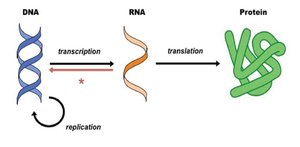
Gene expression is the process by which the information encoded in a gene is used to synthesize a functional gene product, typically a protein. This process is fundamental to cellular function and adaptation.
Gene expression can be unregulated (constitutive) or regulated, depending on cellular needs.
Regulation is crucial for processes such as metabolism, response to environmental stress, and cell division.
Levels of Gene Regulation
Gene expression can be regulated at multiple stages:
Transcriptional regulation: Control of RNA synthesis rate.
Translational regulation: Control of protein synthesis from mRNA.
Posttranslational regulation: Modification of proteins after synthesis.
Transcriptional Regulation in Prokaryotes
Regulatory Proteins
Transcriptional regulation is a common mechanism in both prokaryotes and eukaryotes. It involves two main types of regulatory proteins:
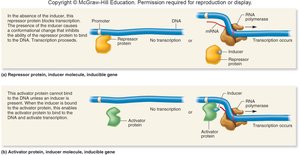
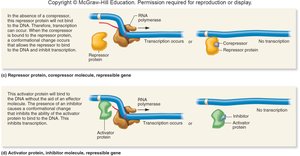
Repressors: Inhibit transcription (negative control).
Activators: Increase transcription (positive control).
Operons
An operon is a regulatory unit consisting of several structural genes under the control of a single promoter.
Operons encode polycistronic mRNA, which contains coding sequences for multiple genes.
This allows coordinated regulation of genes involved in a common process.
The lac Operon: A Model for Gene Regulation
Structure and Function
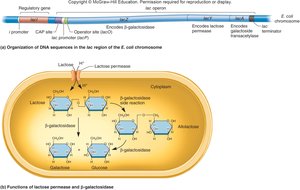
The lac operon in E. coli is a classic example of gene regulation, controlling genes involved in lactose metabolism.
Structural genes: lacZ (β-galactosidase), lacY (lactose permease), lacA (transacetylase).
Regulatory elements: Promoter (binds RNA polymerase), Operator (binds repressor), CAP site (binds activator protein CAP).
Negative Control: Repressor Mechanism
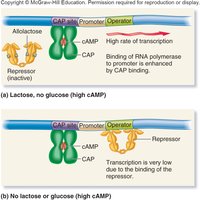
The lacI gene encodes a repressor protein that binds to the operator, preventing transcription in the absence of lactose.
When lactose is present, allolactose (a lactose metabolite) binds to the repressor, inactivating it and allowing transcription.
Genetic Proof of the Operon Model
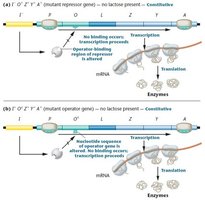
The I gene produces a diffusible (trans-acting) product.
The O region is involved in regulation and must be adjacent to structural genes (cis-acting).
Partially diploid bacteria (merozygotes) were used to test these predictions.
Loss-of-Function Mutations in lac Operon
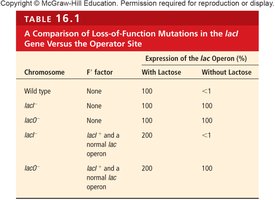
Mutations in the lacI gene or operator region affect the expression of the lac operon. The following table compares the effects:
Chromosome | F' factor | Expression of the lac Operon (%) With Lactose | Expression of the lac Operon (%) Without Lactose |
|---|---|---|---|
Wild type | None | 100 | <1 |
lacI- | None | 100 | 100 |
lacOc | None | 200 | 200 |
lacI- | lacI+ and a normal lac operon | 100 | <1 |
lacOc | lacI+ and a normal lac operon | 200 | 100 |
Constitutive vs. Inducible Expression
Mutations in the repressor or operator can lead to constitutive expression (always on) or inducible expression (regulated by presence of lactose).
Positive Control: Catabolite Repression
CAP and cAMP Regulation
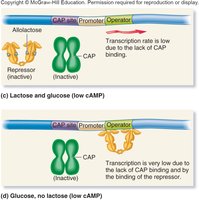
When both lactose and glucose are present, E. coli uses glucose first due to catabolite repression.
cAMP, produced from ATP, binds to CAP (Catabolite Activator Protein), which enhances transcription of the lac operon when glucose is absent.
Inducible vs. Repressible Regulation
Mechanisms of Regulation
Inducible genes: Transcription is increased by inducers (often involved in catabolism).
Repressible genes: Transcription is decreased by corepressors or inhibitors (often involved in anabolism).
Small Effector Molecules
Inducers bind activators or repressors to increase transcription.
Corepressors and inhibitors bind regulatory proteins to decrease transcription.
Regulation by RNA
Attenuation and Riboswitches
Attenuation: Regulation of transcription by formation of terminator structures in mRNA.
Riboswitches: RNA elements that bind small molecules to regulate gene expression.
Small noncoding RNAs (sRNAs): Base pair with transcripts to prevent translation.
Summary Table: Inducible vs. Repressible Regulation
Type | Regulatory Molecule | Effect | Example |
|---|---|---|---|
Inducible | Inducer | Increases transcription | lac operon (catabolism) |
Repressible | Corepressor/Inhibitor | Decreases transcription | trp operon (anabolism) |
Key Terms and Concepts
Operon: Cluster of genes under control of a single promoter.
Repressor: Protein that inhibits transcription.
Activator: Protein that increases transcription.
Inducer: Small molecule that increases gene expression.
Corepressor: Small molecule that decreases gene expression.
Polycistronic mRNA: mRNA encoding multiple proteins.
Example: lac Operon Regulation
In the absence of lactose, the lac operon is repressed.
In the presence of lactose, allolactose inactivates the repressor, allowing expression of genes for lactose metabolism.
When glucose is present, catabolite repression prevents expression of the lac operon.
Equations and Formulas
cAMP production:
Transcriptional regulation:
Additional info:
François Jacob and Jacques Monod's experiments with partial diploids (merozygotes) provided genetic proof for the operon model.
Regulation of gene expression is essential for bacterial adaptation to changing environments.
