 Back
BackGene Regulation in Bacteria: The Lac and Trp Operons CH 12 pt1/2
Study Guide - Smart Notes
 Tailored notes based on your materials, expanded with key definitions, examples, and context.
Gene Regulation in Bacteria
Introduction to Gene Regulation
Gene regulation in bacteria is essential for adapting to environmental changes and efficiently utilizing resources. Bacteria control gene expression primarily at the level of transcription, allowing them to turn genes on or off in response to environmental signals. This regulation is achieved through interactions between regulatory proteins and specific DNA sequences.
Key Terminology
Constitutive transcription: Continuous, unregulated transcription of a gene.
Regulated transcription: Transcription that is turned on or off in response to environmental conditions.
Inducible transcription: Genes are transcribed only in the presence of a specific inducer (e.g., lac operon).
Repressible transcription: Genes are transcribed unless a specific corepressor is present (e.g., trp operon).
Attenuation: A regulatory mechanism that fine-tunes gene expression after transcription initiation.
Levels and Mechanisms of Regulation
Transcriptional Regulation
Transcriptional regulation involves controlling the initiation and amount of mRNA produced. This is primarily achieved through regulatory proteins that bind to DNA sequences near the genes they regulate.
Negative regulation: Repressor proteins bind to operators to block transcription.
Positive regulation: Activator proteins enhance RNA polymerase binding to promoters, increasing transcription.
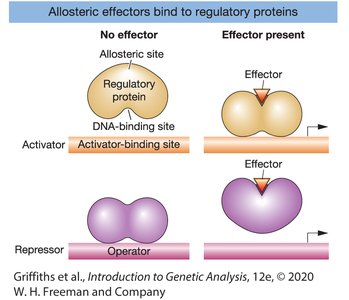
Allosteric effectors can bind to regulatory proteins, altering their ability to bind DNA and regulate transcription. Effectors can either activate or inhibit the function of activators and repressors.
Negative Regulation: Inducers and Corepressors
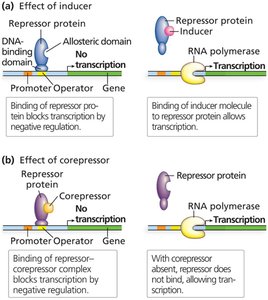
Inducer: A molecule that binds to a repressor, inactivating it and allowing transcription (e.g., allolactose in the lac operon).
Corepressor: A molecule that binds to a repressor, activating it and blocking transcription (e.g., tryptophan in the trp operon).
Coupled Transcription and Translation in Prokaryotes
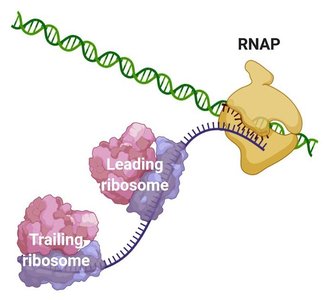
In bacteria, transcription and translation are coupled processes, meaning that translation of mRNA can begin before transcription is complete. This allows for rapid responses to environmental changes.
The Lac Operon: Model of Inducible Gene Regulation
Structure and Function
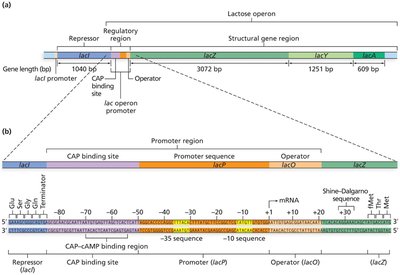
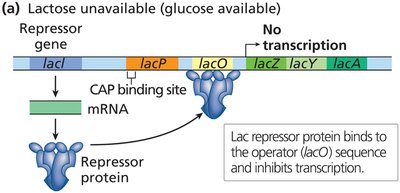
The lac operon is a classic example of an inducible operon in Escherichia coli that enables the bacterium to metabolize lactose when glucose is not available. The operon consists of three structural genes (lacZ, lacY, lacA), a promoter, an operator, and regulatory genes.
lacZ: Encodes β-galactosidase, which cleaves lactose into glucose and galactose.
lacY: Encodes permease, which transports lactose into the cell.
lacA: Encodes transacetylase, with a less clear role in lactose metabolism.
lacI: Encodes the repressor protein, which is constitutively expressed and regulates the operon.
Regulatory Elements
Promoter (P): Site where RNA polymerase binds to initiate transcription.
Operator (O): Site where the lac repressor binds to block transcription.
CAP binding site: Site where the catabolite activator protein (CAP) binds to enhance transcription in the absence of glucose.
Mechanism of Regulation
When lactose is absent, the lac repressor binds to the operator, preventing transcription.
When lactose is present, allolactose (an inducer) binds to the repressor, causing it to release from the operator, allowing transcription.
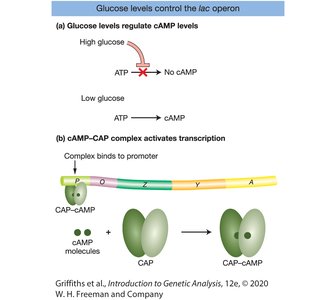
When glucose is low, cAMP levels rise, and the cAMP-CAP complex binds to the CAP site, enhancing transcription.
Catabolite Repression: Positive Regulation by CAP
Catabolite repression ensures that the lac operon is only highly expressed when glucose is absent. The CAP-cAMP complex binds to the promoter region, increasing RNA polymerase affinity and promoting transcription.
Summary Table: Lac Operon Regulation
Glucose | Lactose | cAMP | LacI (Repressor) | CAP/cAMP | Operon |
|---|---|---|---|---|---|
Low | High | High | Not bound | Bound | On (high expression) |
High | High | Low | Not bound | Not bound | On (low expression) |
Low | Low | High | Bound | Bound | Off |
High | Low | Low | Bound | Not bound | Off |
Mutations Affecting the Lac Operon
lacZ-: No β-galactosidase produced; lactose cannot be metabolized.
lacY-: No permease produced; lactose cannot enter the cell efficiently.
lacI-: Nonfunctional repressor; operon is constitutively on.
lacIs: Super-repressor; operon is always off, even in the presence of lactose.
lacOc: Constitutive operator; repressor cannot bind, operon always on.
lacP-: Defective promoter; RNA polymerase cannot bind, operon always off.
The Tryptophan (trp) Operon: Model of Repressible Gene Regulation
Structure and Function
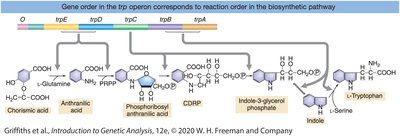
The trp operon in E. coli is a repressible operon that encodes enzymes for tryptophan biosynthesis. It is typically active but can be repressed when tryptophan is abundant.
Contains five structural genes (trpE, trpD, trpC, trpB, trpA), a promoter, an operator, and a leader sequence.
The trpR gene encodes the trp repressor protein, which is inactive without tryptophan.
Mechanism of Regulation
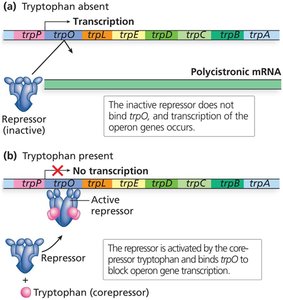
When tryptophan is absent, the repressor is inactive and does not bind the operator; the operon is transcribed.
When tryptophan is present, it acts as a corepressor, binding to the repressor and activating it. The active repressor binds the operator, blocking transcription.
Summary
Bacterial gene regulation is primarily achieved at the transcriptional level through the action of repressors, activators, and allosteric effectors.
The lac operon is an inducible system controlled by both negative (LacI repressor) and positive (CAP-cAMP) regulation, allowing efficient use of lactose only when glucose is absent.
The trp operon is a repressible system, turned off when tryptophan is abundant, conserving resources.
