 Back
Gene Regulation in Eukaryotes: Mechanisms and Epigenetic Control
Study Guide - Smart Notes
 Tailored notes based on your materials, expanded with key definitions, examples, and context.
Gene Regulation in Eukaryotes
Concept Overview: Multiple Levels of Gene Regulation
Gene expression in eukaryotes is controlled at several levels, allowing cells with identical genomes to perform diverse functions. Regulation involves DNA elements, chromatin structure, cellular memory, and RNA molecules.
DNA Control: Regulatory proteins bind to promoters, enhancers, and silencers to modulate transcription.
Chromatin: Nucleosome placement and histone modifications affect access to regulatory DNA.
Cell Memory: Chromatin states can persist through cell division, preserving gene expression patterns (epigenetics).
RNA Control: Long and small noncoding RNAs regulate chromatin, mRNA stability, and translation.
Central Idea: Different gene-expression programs enable cellular diversity despite similar genomes.

Cis-Regulatory DNA and Trans-Acting Factors
Promoters, Enhancers, and Silencers
Cis-regulatory DNA elements integrate signals from trans-acting factors to control transcription. Promoters are bound by general transcription factors, while enhancers and silencers can be located far from the gene and interact with promoters via DNA looping.
Promoters: DNA sequences where RNA polymerase and general factors assemble.
Enhancers: Increase transcription by binding activators; can act at a distance.
Silencers: Decrease transcription by binding repressors.
Insulators: Limit enhancer access to neighboring promoters, establishing boundaries.
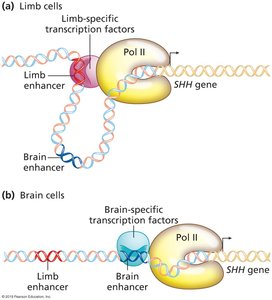
Tissue Specificity and Boundaries
Combinations of regulatory factors determine tissue-specific gene expression. Insulators prevent enhancers from activating unintended genes.
Chromatin Structure and Position Effects
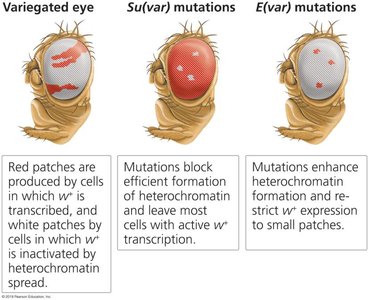
Heterochromatin Spreading and Position-Effect Variegation
Moving a gene near heterochromatin can silence it in some cells, leading to position-effect variegation. Daughter cells inherit patches of active or inactive gene expression.
Heterochromatin: Densely packed chromatin, generally transcriptionally silent.
Position-effect variegation: Variable gene expression due to chromatin environment.
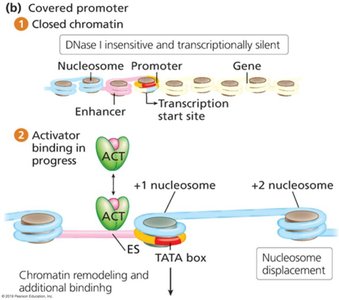
Nucleosome Occupancy and Promoter Access
Nucleosome-depleted regions favor access by regulatory factors, while covered promoters require histone displacement for transcription initiation.
Open promoters: Accessible to transcription factors.
Covered promoters: Require chromatin remodeling for access.
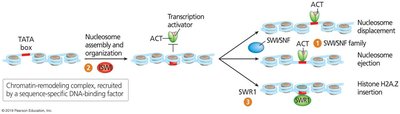
Chromatin Remodeling Complexes
Types and Functions
Chromatin remodelers reposition or exchange histones, affecting DNA accessibility. Major complexes include SWI/SNF, ISWI, and SWR1.
Complex | Principal Action | Regulatory Consequence |
|---|---|---|
SWI/SNF | Slides or ejects nucleosomes | Exposes regulatory DNA |
ISWI | Repositions and spaces nucleosomes | Covers regulatory DNA |
SWR1 | Exchanges H2A for H2A.Z | Changes nucleosome properties |
Histone Modifications: Writers, Readers, and Erasers
Acetylation and Methylation
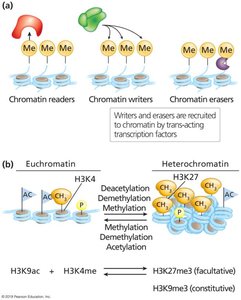
Histone acetyl transferases (HATs) add acetyl groups to histone tails, opening chromatin and favoring gene expression. Histone deacetylases (HDACs) remove acetyl groups, often reducing promoter accessibility. Histone methyltransferases (HMTases) can activate or repress transcription, depending on the residue modified.
Acetylation: Associated with open chromatin and active transcription.
Methylation: Can support heterochromatin or euchromatin, depending on the site.
Dynamic regulation: Modifications can be rapidly removed by erasers.
X-Chromosome Inactivation and Dosage Compensation
Xist RNA and Chromosome-Wide Repression
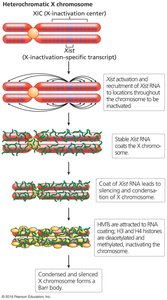
Xist (X-inactive specific transcript) is a long noncoding RNA transcribed from the X chromosome destined for inactivation. Xist RNA coats the chromosome, recruiting repressive chromatin machinery and forming a Barr body.
Dosage compensation: Balances expression of X-linked genes between sexes.
Mosaicism: Cells maintain the inactivation choice, producing clonal mosaics.
Genomic Imprinting
Parent-of-Origin Effects and DNA Methylation
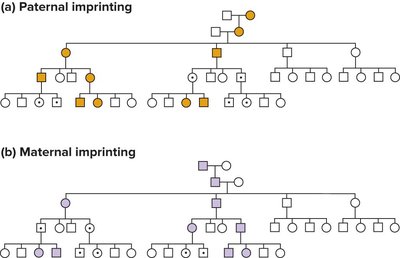
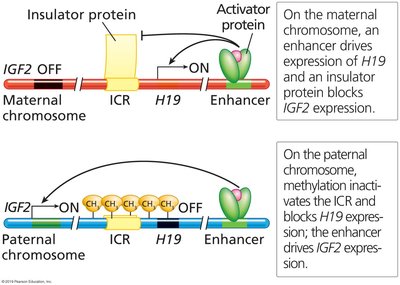
Genomic imprinting is a phenomenon where expression of an allele depends on the parent that transmits it. Methylation at imprinting control regions (ICRs) silences specific alleles.
Paternally imprinted: Paternal allele not transcribed.
Maternally imprinted: Maternal allele not transcribed.
Imprinted = silenced
DNA Methylation and Transcription Regulation
Methylation of CpG Islands
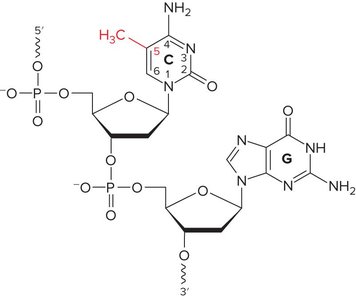
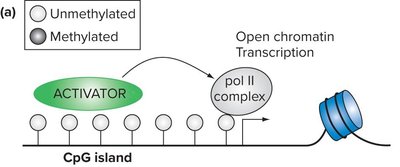
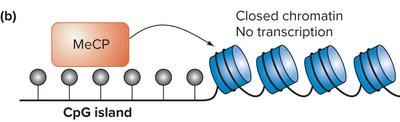
DNA methylation involves the addition of a methyl group to cytosine in CpG dinucleotides by DNA methyl transferases (DNMTs). CpG islands near promoters are usually unmethylated, allowing activators to bind and open chromatin for transcription.
Unmethylated CpG islands: Open chromatin, active transcription.
Methylated CpG islands: Closed chromatin, gene silencing via methyl-CpG-binding proteins (MeCPs).
Maintenance of DNA Methylation
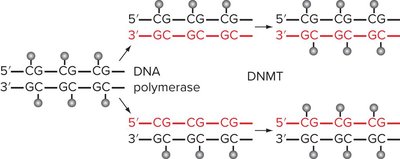
DNA methylation patterns are copied during DNA replication, ensuring long-term repression through epigenetic modification.
DNMT: Methylates newly synthesized DNA strand at replication fork.
Transcription Factors: Domains and Mechanisms
Activator Protein Domains
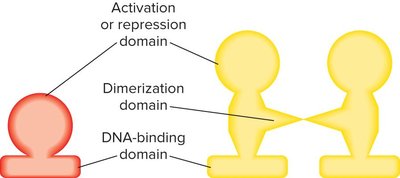
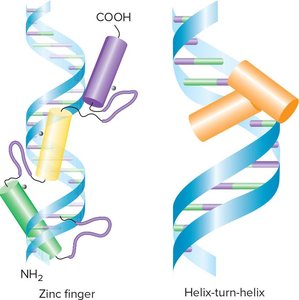
Activator proteins typically have at least two functional domains: a DNA-binding domain and an activation domain. Some also possess a dimerization domain for protein-protein interactions.
DNA-binding domain: Binds specific enhancer sequences.
Activation domain: Interacts with basal factors or coactivators.
Dimerization domain: Enables interaction with other proteins.
DNA Binding Domains
Common DNA binding domains include the helix-turn-helix and zinc finger motifs, which fit within the major groove of DNA.
Dimerization Domains
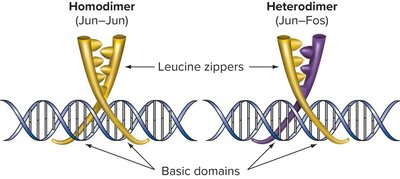
Dimerization domains facilitate the formation of multimeric proteins. Homodimers consist of identical subunits, while heterodimers are composed of nonidentical subunits.
Repressor Proteins and Corepressors
Mechanisms of Transcriptional Repression
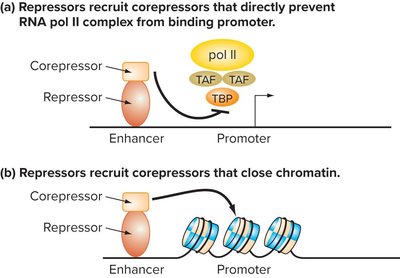
Repressor proteins suppress transcription initiation by recruiting corepressors, which either prevent RNA polymerase II from binding the promoter or modify histones to close chromatin structure.
Direct repression: Blocks RNA pol II complex assembly.
Chromatin modification: Induces closed chromatin state.
Context-Dependent Roles of Transcription Factors
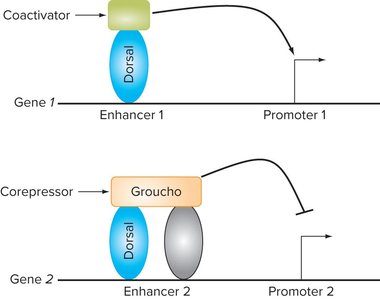
The same transcription factor can act as an activator or repressor depending on the combination of factors present in the cell.
Indirect Repression Mechanisms
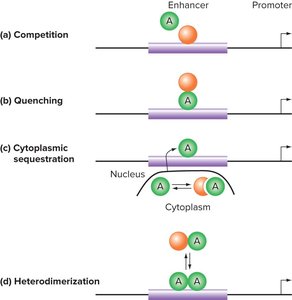
Repressor proteins can act through competition with activators, quenching, cytoplasmic sequestration, or preventing homodimerization.
Competition: Overlapping binding sites.
Quenching: Repressor binds activation domain.
Cytoplasmic sequestration: Keeps activator in cytoplasm.
Heterodimerization: Prevents activator function.
Genomic Imprinting: Parental Origin and Regulatory State
Imprinting Control Regions (ICRs)
Imprinting depends on the parental origin of the chromosome. On the maternal chromosome, an insulator protein binds the unmethylated ICR, activating H19 and blocking IGF2. On the paternal chromosome, ICR methylation silences H19 and allows IGF2 activation.
Small RNAs and Gene Silencing
RNA-Guided Silencing Mechanisms
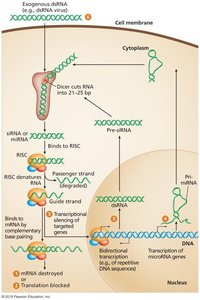
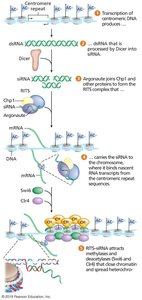
Small RNAs, such as siRNAs and miRNAs, guide sequence-specific gene silencing. Dicer processes double-stranded RNA into short duplexes, and one strand guides an Argonaute-containing silencing complex.
Posttranscriptional silencing: mRNA cleavage, decay, or translational repression.
Transcriptional silencing: Recruitment of chromatin modifiers to silence transcription.
miRNA Processing and RNA-Directed Chromatin Silencing
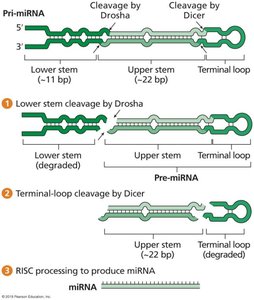
Animal miRNA pathway involves Drosha and Dicer processing to produce miRNA guides for Argonaute-mediated regulation. In fission yeast, the RITS pathway uses siRNA to recruit H3K9 methylation machinery for chromatin silencing.
Synthesis: Chapter Summary
Gene regulation in eukaryotes involves complex interactions between regulatory DNA, chromatin structure, cellular memory, and RNA-guided mechanisms. These processes ensure precise control of gene expression, enabling cellular diversity and adaptation.
Regulatory DNA: Enhancer-bound factors contact promoters through loops for tissue-specific transcription.
Chromatin access: Remodelers reposition nucleosomes; histone marks alter DNA access.
Cellular memory: Chromatin states persist through mitosis; Xist and imprinting regulate chromosome or allele activity.
RNA-guided control: Small RNAs direct mRNA repression or chromatin silencing.
Applications: RNAi suppresses transposons and viruses; knockdown experiments reveal gene function.
Key Question: How can gene expression change while the coding sequence remains unchanged?
