Back
BackGene Regulation in Eukaryotes: Mechanisms and Levels of Control
Study Guide - Smart Notes
 Tailored notes based on your materials, expanded with key definitions, examples, and context.
Gene Regulation in Eukaryotes
Overview of Gene Regulation
Gene regulation in eukaryotes is a complex, multi-layered process that ensures genes are expressed at the right time, place, and amount. This regulation is essential for cellular differentiation, development, and response to environmental signals. Eukaryotic gene regulation differs significantly from prokaryotic systems due to chromatin structure, compartmentalization, and the presence of multiple regulatory mechanisms.
Levels of Regulation: DNA/chromatin structure, transcription, post-transcription, translation, and post-translation.
Key Features: Chromatin remodeling, diverse promoter elements, alternative splicing, mRNA stability, and regulatory RNAs.
Differences Between Eukaryotic and Prokaryotic Gene Regulation
Structural and Functional Distinctions
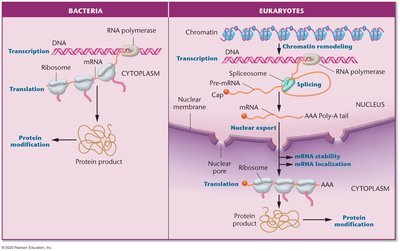
Eukaryotic gene regulation is more intricate than in prokaryotes due to the presence of chromatin, compartmentalization of transcription and translation, and the need for post-transcriptional modifications.
Chromatin Structure: DNA is packaged into nucleosomes, restricting access to transcription machinery.
RNA Polymerases: Eukaryotes have multiple RNA polymerases with distinct promoter requirements.
Transcription and Translation: These processes are separated by the nuclear envelope in eukaryotes, allowing for additional regulatory steps.
Post-Transcriptional Modifications: Eukaryotic mRNAs undergo capping, splicing, and polyadenylation.
Regulation of mRNA Stability and Translation: Eukaryotic mRNAs have variable half-lives and are subject to translational control.
Levels of Gene Regulation in Eukaryotes
Hierarchical Control Points
Gene expression in eukaryotes is regulated at multiple levels, from chromatin accessibility to post-translational modifications of proteins.
Chromatin Remodeling: Modifies DNA accessibility for transcription.
Transcriptional Regulation: Involves promoters, enhancers, and transcription factors.
Post-Transcriptional Regulation: Includes alternative splicing and mRNA processing.
mRNA Transport and Stability: Determines mRNA localization and degradation rates.
Translational and Post-Translational Regulation: Controls protein synthesis and modification.
Chromatin Structure and Remodeling
Chromatin Organization and Its Role in Gene Expression
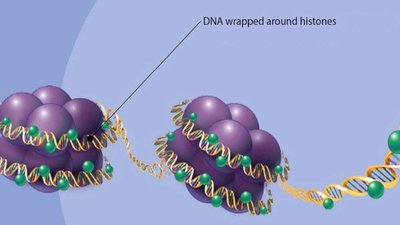
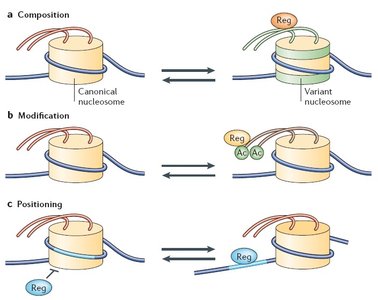
Chromatin must be remodeled to allow transcription. Nucleosomes, composed of histone proteins, package DNA and regulate its accessibility. Chromatin remodeling involves altering nucleosome composition, covalent modification of histones, and repositioning nucleosomes.
Nucleosome: The basic unit of chromatin, consisting of DNA wrapped around histone octamers.
Chromatin Remodeling: The process of modifying chromatin structure to expose or hide DNA regions from transcription machinery.
Nucleosome Modifications
Altering Nucleosome Composition: Replacement of standard histones (e.g., H2A) with variants (e.g., H2A.Z) at active promoters.
Histone Modifications: Covalent addition or removal of chemical groups (acetyl, methyl, phosphate, ubiquitin) to histone tails affects chromatin structure and gene expression.
Repositioning Nucleosomes: Sliding or removing nucleosomes to expose regulatory DNA sequences.
Histone Acetylation and Deacetylation
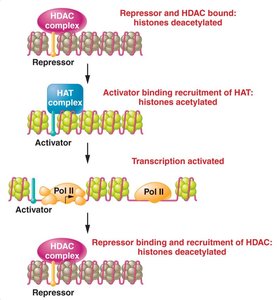
Acetylation of histone tails by histone acetyltransferases (HATs) is associated with increased transcription, while deacetylation by histone deacetylases (HDACs) is linked to repression.
HATs: Add acetyl groups, loosening chromatin and promoting transcription.
HDACs: Remove acetyl groups, condensing chromatin and repressing transcription.
Chromatin Remodeling Mechanisms
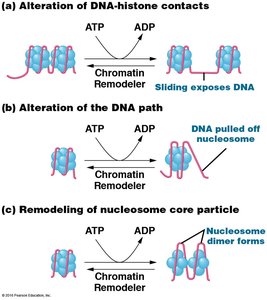
Chromatin remodeling complexes use ATP to alter nucleosome structure, enabling access to DNA for transcription factors and RNA polymerase.
Sliding Nucleosomes: Exposes DNA by moving nucleosomes along the DNA strand.
DNA Unwrapping: Temporarily removes DNA from nucleosomes.
Histone Dimer Exchange: Replaces histone subunits with variants.
DNA Methylation
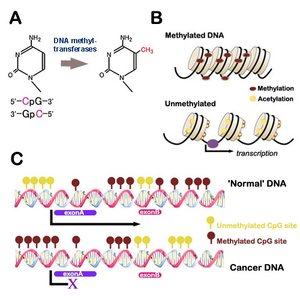
DNA methylation involves the addition of methyl groups to cytosine residues, typically at CpG dinucleotides. High levels of methylation are generally associated with gene silencing.
Heritability: Methylation patterns are tissue-specific and heritable during cell division.
Gene Expression: Inverse relationship between methylation and gene expression.
Transcriptional Regulation
Cis-Acting Elements
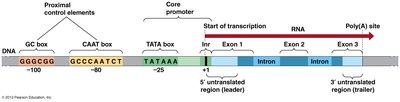
Cis-acting elements are DNA sequences that regulate the transcription of nearby genes. These include promoters, enhancers, silencers, and other regulatory sequences.
Promoter Elements: TATA box, CAAT box, and GC box are common motifs that bind transcription factors and RNA polymerase II.
Enhancers: Can function at a distance, in either orientation, and are essential for high-level, tissue-specific, and time-specific gene expression.
Silencers: Function similarly to enhancers but repress transcription.
Trans-Acting Factors
Trans-acting factors are proteins, such as transcription factors, activators, and repressors, that bind to cis-acting elements to regulate gene expression. Their activity can be modulated by post-translational modifications and interactions with other proteins.
Tissue and Developmental Specificity: Some factors are specific to certain cell types or developmental stages.
Signal Responsiveness: Some respond to external physiological signals.
Cooperative and Competitive Binding: Multiple factors can bind to the same site, allowing fine-tuned regulation.
Pre-Initiation Complex Formation
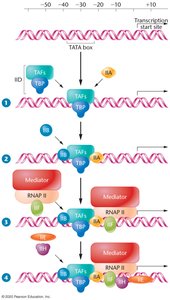
The assembly of the pre-initiation complex (PIC) is a critical step in transcription initiation. General transcription factors (e.g., TFIID, TFIIB, TFIIA) and RNA polymerase II assemble at the promoter, often facilitated by enhancer-bound activators.
TFIID: Recognizes the TATA box and initiates PIC assembly.
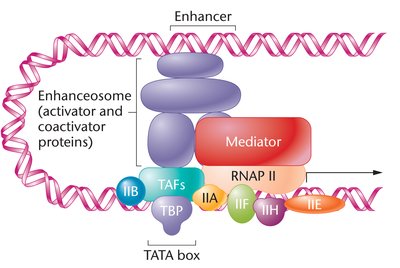
Enhanceosome: A large protein complex that integrates signals from multiple activators and coactivators to stimulate transcription.
Enhancer Action and DNA Looping
Enhancers can activate transcription from a distance by facilitating DNA looping, bringing enhancer-bound proteins into contact with the transcription initiation complex at the promoter.
Enhanceosome Formation: The combined action of enhancer-bound factors and the transcription machinery increases transcriptional output.
Post-Transcriptional Regulation
Alternative Splicing
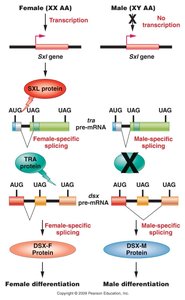
Alternative splicing allows a single gene to produce multiple mRNA variants, leading to the synthesis of different protein isoforms. This process is crucial for expanding proteomic diversity and regulating gene function in a tissue- or developmental-specific manner.
Example: Sex determination in Drosophila involves alternative splicing of the Sxl, tra, and dsx genes.
mRNA Stability
The stability of mRNA molecules affects the amount of protein produced. Regulatory elements in the 3' untranslated region (UTR) and interactions with RNA-binding proteins or microRNAs can increase or decrease mRNA half-life.
Translational and Post-Translational Controls
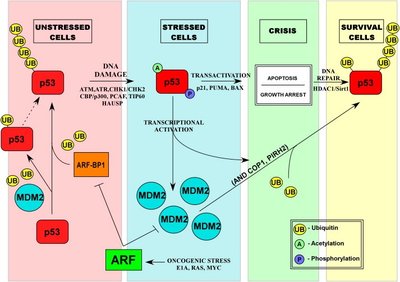
Translation can be regulated by proteins that bind to mRNA and block ribosome access. Protein stability is controlled by post-translational modifications such as ubiquitination, which targets proteins for degradation.
Example: The tumor suppressor protein p53 is regulated by Mdm2-mediated ubiquitination and degradation.
RNA-Induced Gene Silencing
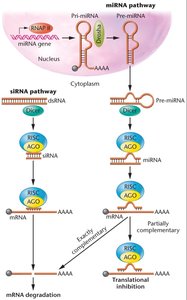
RNA interference (RNAi) and related mechanisms use small RNAs (siRNAs and miRNAs) to regulate gene expression post-transcriptionally. Double-stranded RNA is processed by Dicer, and the resulting small RNAs are incorporated into RISC or RITS complexes, leading to mRNA degradation or translational inhibition.
siRNAs: Typically induce mRNA degradation.
miRNAs: Usually inhibit translation or destabilize mRNA.