 Back
BackGene Regulation in Prokaryotes and Eukaryotes: The Lac, Trp, and Gal Systems CH 12 pt 3
Study Guide - Smart Notes
 Tailored notes based on your materials, expanded with key definitions, examples, and context.
Gene Regulation: Overview and Central Dogma
Central Dogma of Molecular Biology
The central dogma describes the flow of genetic information from DNA to RNA to protein. This process is fundamental to all living organisms and is tightly regulated at multiple steps to ensure proper gene expression.
Transcription: DNA is transcribed into messenger RNA (mRNA).
Translation: mRNA is translated into a protein, which carries out cellular functions.
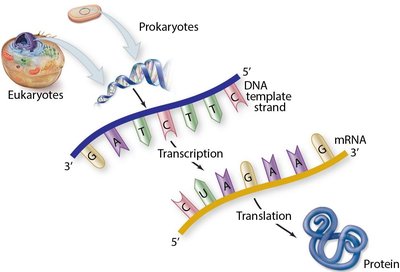
Gene regulation refers to the mechanisms that control the timing, location, and amount of gene expression. Regulation can occur at various steps, but transcriptional control is often the most efficient and widely used.
Gene Regulation in Prokaryotes: The Lac and Trp Operons
Lac Operon: Inducible System
The lac operon in Escherichia coli is a classic example of an inducible operon, which is turned on in the presence of lactose. It encodes proteins required for the uptake and metabolism of lactose.
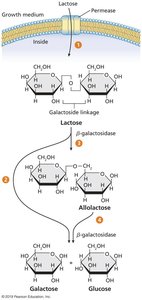
lacZ: Encodes β-galactosidase, which converts lactose into allolactose and cleaves lactose into glucose and galactose.
lacY: Encodes permease, which transports lactose into the cell.
lacA: Encodes transacetylase (function less central to regulation).
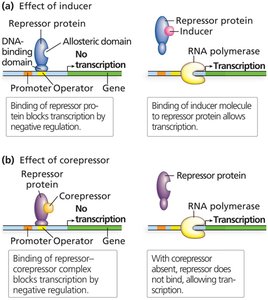
LacI: The repressor protein that binds the operator to block transcription when lactose is absent.
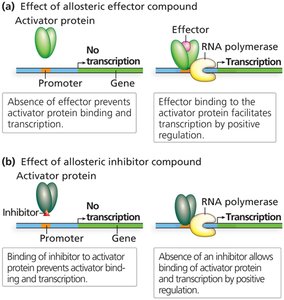
CAP (Catabolite Activator Protein): Binds to the promoter in the presence of cAMP (when glucose is low), enhancing transcription.
Regulation depends on the presence or absence of lactose and glucose:
No lactose, no glucose: LacI binds operator, CAP binds promoter, operon OFF.
Lactose present, no glucose: Allolactose binds LacI (removes it), CAP-cAMP binds promoter, operon ON (high transcription).
Lactose and glucose present: LacI removed, but CAP does not bind (low cAMP), operon ON (low transcription).
No lactose, glucose present: LacI binds operator, CAP does not bind, operon OFF.
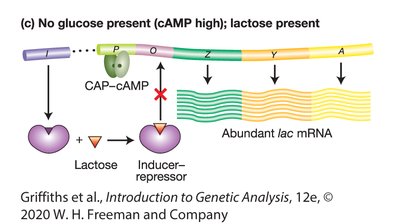
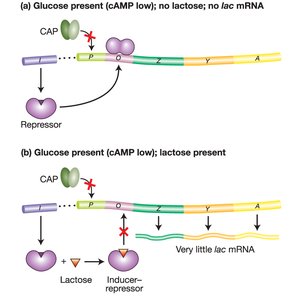
Example: In a bacterium with low glucose and high lactose, the lac operon is highly expressed, allowing the cell to metabolize lactose efficiently.
Lac Operon Enzyme Functions
β-galactosidase: Converts lactose to allolactose (inducer) and cleaves lactose into glucose and galactose.
Trp Operon: Repressible System
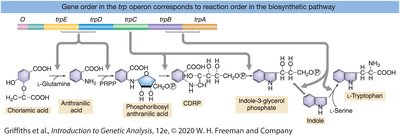
The trp operon in E. coli is a repressible operon, which is turned off in the presence of tryptophan. It encodes enzymes for the biosynthesis of tryptophan.
trpE, trpD, trpC, trpB, trpA: Genes encoding enzymes for tryptophan synthesis.
Trp repressor: Inactive without tryptophan; when tryptophan (corepressor) is present, it binds the repressor, which then binds the operator to block transcription.
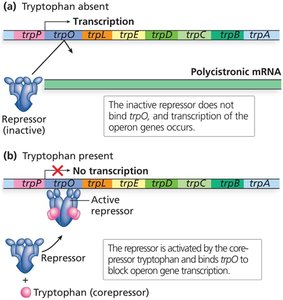
Example: When tryptophan is absent, the repressor is inactive and the operon is transcribed. When tryptophan is present, it acts as a corepressor, activating the repressor to block transcription.
Comparison: Lac vs. Trp Operons
Lac operon: Inducible, catabolic (breaks down lactose), default OFF, turned ON by substrate (lactose).
Trp operon: Repressible, anabolic (synthesizes tryptophan), default ON, turned OFF by end product (tryptophan).
Mechanisms of Regulation: Negative and Positive Control
Negative regulation: Repressor proteins block transcription (e.g., LacI, Trp repressor).
Positive regulation: Activator proteins enhance transcription (e.g., CAP-cAMP in lac operon).
Alternative Sigma Factors in Bacteria
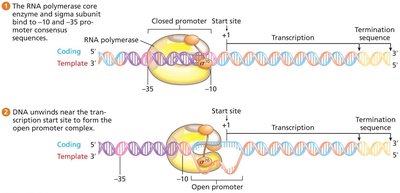
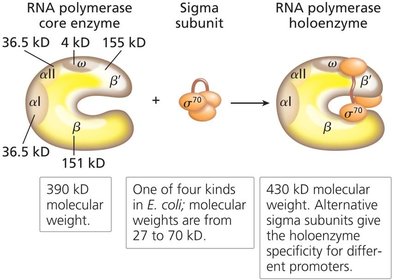
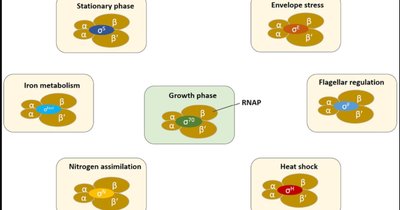
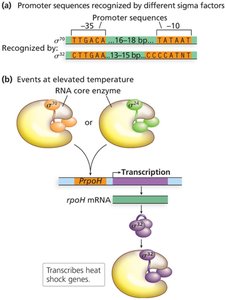
Sigma factors are subunits of bacterial RNA polymerase that direct the enzyme to specific promoter sequences. Alternative sigma factors allow bacteria to rapidly change gene expression in response to environmental changes (e.g., heat shock, stationary phase).
Gene Regulation in Eukaryotes: The GAL System
General Features of Eukaryotic Gene Regulation
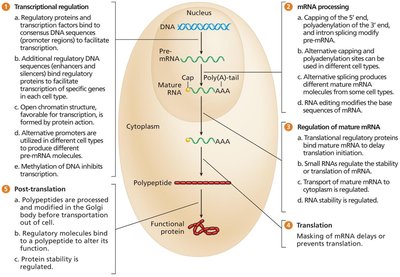
Eukaryotic gene regulation is more complex than in prokaryotes, involving multiple levels of control and a variety of regulatory elements and proteins.
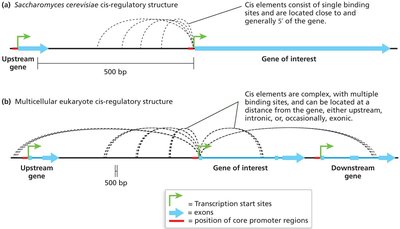
One promoter per gene: No operons; each gene is regulated individually.
Cis-acting elements: DNA sequences (e.g., enhancers, silencers) that regulate transcription.
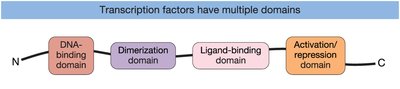
Trans-acting factors: Proteins (e.g., transcription factors) that bind cis-elements to modulate transcription.
Enhanceosomes: Protein complexes that bend DNA to facilitate RNA polymerase binding.
The GAL System in Yeast
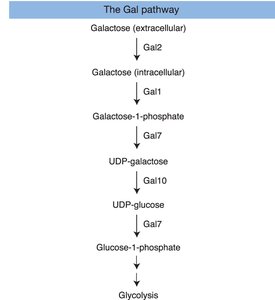
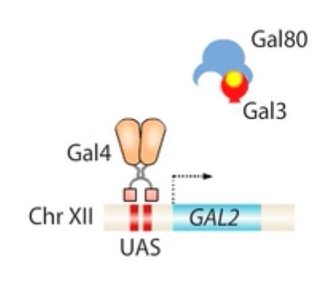
The GAL system in Saccharomyces cerevisiae regulates the utilization of galactose. It involves several genes (GAL1, GAL2, GAL7, GAL10) that encode enzymes for galactose import and metabolism.
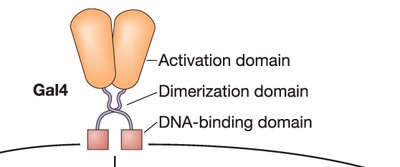
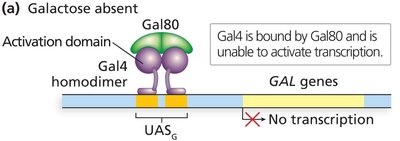
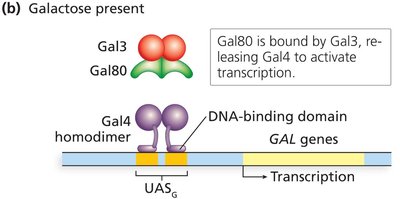
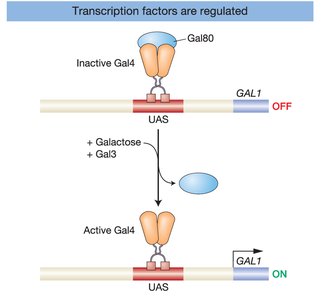
Gal4: Transcriptional activator that binds upstream activating sequences (UAS) to promote GAL gene expression.
Gal80: Repressor that binds Gal4, preventing activation in the absence of galactose.
Gal3: Sensor that binds galactose and Gal80, relieving repression and allowing Gal4 to activate transcription.
Comparison: GAL vs. Lac and Trp Systems
Similarity: All involve regulatory proteins that respond to environmental signals (sugar presence/absence).
Difference: GAL system uses separate regulatory proteins (Gal4, Gal80, Gal3) and acts on individual genes, not operons.
Repressor Proteins and Silencer Sequences in Eukaryotes
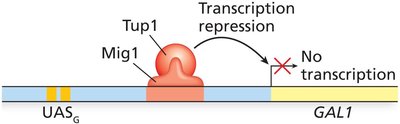
In eukaryotes, repressor proteins can bind silencer sequences to inhibit transcription. For example, Mig1 (produced in the presence of glucose) binds a silencer and recruits Tup1, forming a repressor complex that blocks GAL gene expression.
Summary Table: Regulation of the Lac, Trp, and GAL Systems
System | Type | Regulatory Protein | Inducer/Corepressor | Default State | Regulation Mechanism |
|---|---|---|---|---|---|
Lac Operon | Inducible (catabolic) | LacI, CAP | Lactose (inducer), cAMP (activator) | OFF | Inducer removes repressor; activator enhances transcription when glucose is low |
Trp Operon | Repressible (anabolic) | Trp repressor | Tryptophan (corepressor) | ON | Corepressor activates repressor to block transcription |
GAL System | Inducible (catabolic) | Gal4, Gal80, Gal3 | Galactose (inducer) | OFF | Inducer relieves repression, allowing activator to function |
Additional info: Eukaryotic gene regulation also involves chromatin remodeling, mRNA processing, and post-translational modifications, which add further layers of control not present in prokaryotes.
