 Back
BackCh 12 Gene Transcription and RNA Modification: Mechanisms and Regulation
Study Guide - Smart Notes
 Tailored notes based on your materials, expanded with key definitions, examples, and context.
Gene Expression and the Central Dogma
Overview of Gene Expression
Gene expression is the process by which the information encoded in a gene is used to direct the synthesis of a functional gene product, typically a protein or functional RNA. The central dogma of genetics describes the flow of genetic information from DNA to RNA to protein.
DNA replication: The process of copying DNA, ensuring genetic information is passed to daughter cells and offspring.
Transcription: The synthesis of an RNA molecule from a DNA template.
Translation: The process by which the information in mRNA is used to synthesize a polypeptide (protein).
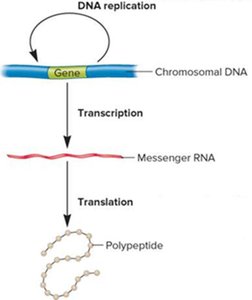
Transcription: The First Step in Gene Expression
Definition and Importance
Transcription is the process of synthesizing RNA from a DNA template. It is the first step in gene expression and is essential for the production of proteins and functional RNAs.
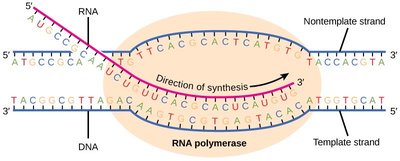
Only one DNA strand (the template strand) is transcribed into RNA.
The resulting RNA sequence is complementary to the DNA template strand.
The DNA coding (sense) strand has the same sequence as the RNA (except T is replaced by U).
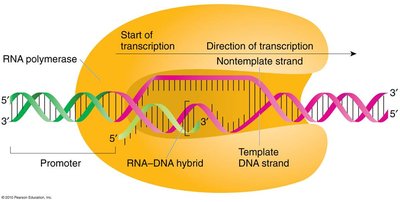
Gene Structure and Regulatory Elements
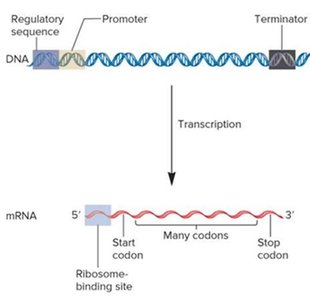
Genes contain specific sequences that define their boundaries and regulate their expression.
Regulatory sequences: Sites for binding regulatory proteins that influence transcription rate.
Promoter: DNA sequence where RNA polymerase binds to initiate transcription.
Terminator: Sequence signaling the end of transcription.
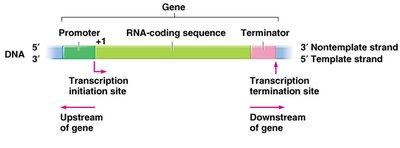
Stages of Transcription
Transcription occurs in three main stages, each involving specific protein-DNA interactions:
Initiation: RNA polymerase binds to the promoter, DNA unwinds to form an open complex.
Elongation: RNA polymerase synthesizes the RNA strand by adding nucleotides complementary to the DNA template.
Termination: RNA polymerase and the RNA transcript dissociate from the DNA.
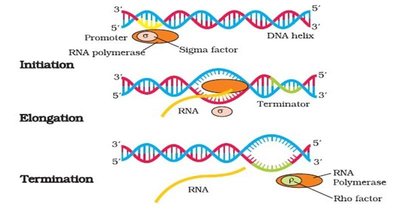
Transcription in Bacteria
Promoters and RNA Polymerase
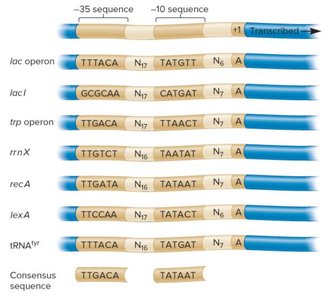
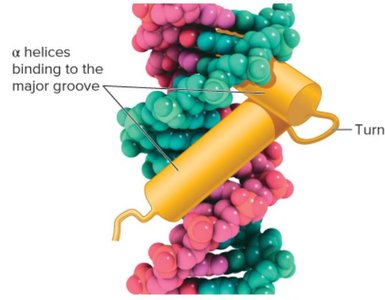
Bacterial promoters contain conserved sequences at the -35 and -10 positions relative to the transcription start site. RNA polymerase holoenzyme (core enzyme + sigma factor) recognizes these sequences to initiate transcription.
-35 and -10 regions: Consensus sequences recognized by sigma factor for promoter binding.
RNA polymerase holoenzyme: Composed of core enzyme (α2ββ'ω) and sigma factor (σ).
Initiation, Elongation, and Termination in Bacteria
During initiation, the sigma factor helps RNA polymerase bind to the promoter and form the open complex.
In elongation, RNA polymerase synthesizes RNA in the 5' to 3' direction, using nucleoside triphosphates as substrates.
Termination occurs via two mechanisms: rho-dependent (requires ρ protein) and rho-independent (involves a stem-loop structure and uracil-rich sequence).
Transcription in Eukaryotes
RNA Polymerases and Promoters
Eukaryotes have three main RNA polymerases, each responsible for transcribing different types of genes:
RNA polymerase I: rRNA genes
RNA polymerase II: mRNA and some snRNA genes
RNA polymerase III: tRNA and 5S rRNA genes
Eukaryotic promoters are more complex, often containing a TATA box and various regulatory elements (enhancers, silencers).
Transcription Factors and Mediator Complex
Transcription initiation in eukaryotes requires the assembly of general transcription factors (GTFs) and RNA polymerase II at the core promoter. The mediator complex facilitates interactions between regulatory proteins and RNA polymerase II, regulating the transition from initiation to elongation.
General transcription factors (GTFs): Required for basal transcription.
Mediator: Multi-subunit complex that regulates RNA polymerase II activity.
Enhancers and silencers: DNA elements that increase or repress transcription, respectively.
RNA Modification in Eukaryotes
RNA Processing Events
Eukaryotic pre-mRNAs undergo several modifications before becoming mature mRNAs:
5' Capping: Addition of a 7-methylguanosine cap to the 5' end, important for mRNA stability and translation initiation.
3' Polyadenylation: Addition of a poly(A) tail to the 3' end, enhancing mRNA stability and export from the nucleus.
RNA Splicing: Removal of non-coding introns and joining of exons by the spliceosome.
Splicing Mechanisms
Splicing can occur via self-splicing (Group I and II introns) or by the spliceosome (complex of snRNPs). Alternative splicing allows a single gene to produce multiple protein isoforms.
Constitutive exons: Always included in mature mRNA.
Alternative exons: May be included or excluded, generating protein diversity.
RNA Editing
RNA editing is a post-transcriptional process that alters nucleotide sequences of RNA molecules. It can involve base insertions, deletions, or conversions (e.g., C-to-U, A-to-I). This process increases the diversity of the transcriptome and proteome.
Organism | Type of Editing | Found in |
|---|---|---|
Trypanosomes (protozoa) | Additions/deletions of uracil | Mitochondrial mRNAs |
Slime mold | C additions | Mitochondrial mRNAs |
Plants | C-to-U conversion | Mitochondrial/chloroplast mRNAs, tRNAs, rRNAs |
Mammals | C-to-U, A-to-I conversion | Apolipoprotein B mRNA, glutamate receptor mRNA, tRNAs |
Drosophila | A-to-I conversion | Calcium/sodium channel mRNAs |
Processing of tRNA and rRNA
tRNA Processing
tRNAs are transcribed as large precursors and processed by cleavage at both ends and, in some cases, removal of introns. Exonucleases and endonucleases are involved in these processing steps.
rRNA Processing
Ribosomal RNAs are also transcribed as large precursors and processed into mature rRNAs. In eukaryotes, this occurs in the nucleolus and involves multiple cleavage and modification steps.
Summary Table: Key Steps and Components of Transcription and RNA Processing
Process | Key Enzyme/Complex | Major Steps | Regulatory Elements |
|---|---|---|---|
Transcription Initiation (Bacteria) | RNA polymerase + sigma factor | Promoter recognition, open complex formation | -35, -10 boxes |
Transcription Initiation (Eukaryotes) | RNA polymerase II + GTFs + mediator | Assembly at core promoter, transition to elongation | TATA box, enhancers, silencers |
Elongation | RNA polymerase | RNA synthesis 5'→3' | Template strand |
Termination (Bacteria) | RNA polymerase, rho factor (if dependent) | Release of RNA and polymerase | Terminator sequence |
RNA Processing (Eukaryotes) | Various enzymes, spliceosome | 5' capping, splicing, 3' polyadenylation | Splice sites, polyA signal |
