 Back
BackGene Transcription and RNA Modification: Structured Study Notes
Study Guide - Smart Notes
 Tailored notes based on your materials, expanded with key definitions, examples, and context.
Gene Expression and the Central Dogma
Overview of Gene Expression
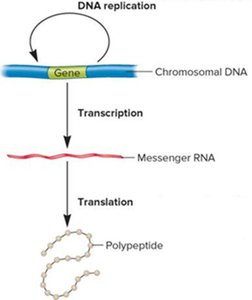
Gene expression is the process by which information from a gene is used to synthesize a functional product, typically a protein or RNA. The central dogma of genetics describes the flow of genetic information from DNA to RNA to protein.
Central Dogma: DNA is transcribed into RNA, which is then translated into protein.
Proteins: High molecular weight, nitrogen-containing organic compounds composed of polypeptides, which are chains of amino acids.
Polypeptide: Encoded by a gene; becomes part of a functional protein.
Traits: The synthesis of functional proteins determines an organism’s traits.
Transcription: The First Step in Gene Expression
Definition and Process
Transcription is the act of copying a DNA sequence into an RNA sequence. This process does not alter the DNA structure, allowing it to continue storing information.
Transcription: Produces an RNA copy of a gene.
Messenger RNA (mRNA): Temporary copy of a gene containing information to make a polypeptide.
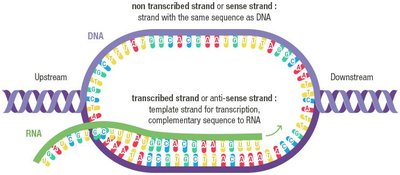
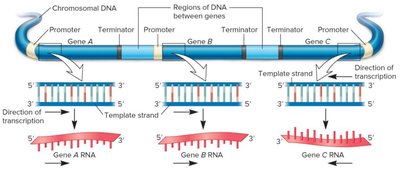
Only one DNA strand is transcribed into RNA.
Gene Regulatory Elements
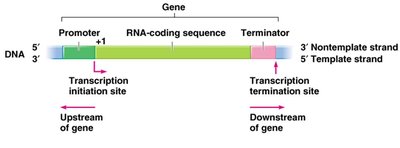
Gene regulatory elements are DNA sequences associated with each gene that regulate transcription.
Regulatory sequences: Sites for binding regulatory proteins, influencing transcription rate.
Promoter: Site for RNA polymerase binding; signals the beginning of transcription.
Terminator: Signals the end of transcription.
Organization of Bacterial Genes
Gene and mRNA Structure
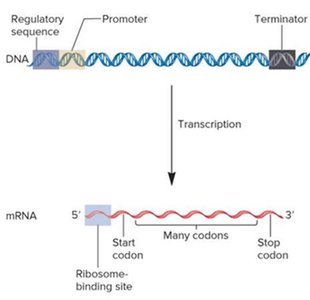
Bacterial genes are organized with regulatory sequences, promoters, and terminators. The mRNA transcript includes ribosome-binding sites, start codons, codons, and stop codons.
Start codon: Specifies the first amino acid (formylmethionine in bacteria, methionine in eukaryotes).
Codons: Three-nucleotide sequences specifying amino acids.
Stop codon: Specifies the end of polypeptide synthesis.
Polycistronic mRNA: Encodes two or more polypeptides.
Transcription Mechanism
Template and Coding Strands
Template strand: The DNA strand transcribed into RNA; RNA is complementary to this strand.
Coding strand: The opposite strand; its sequence is identical to the RNA transcript except for uracil replacing thymine.
Stages of Transcription
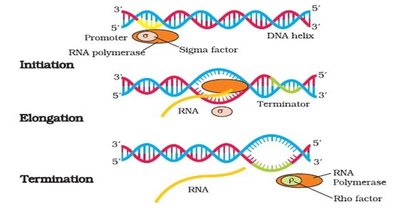
Transcription occurs in three stages: initiation, elongation, and termination.
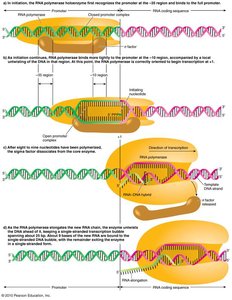
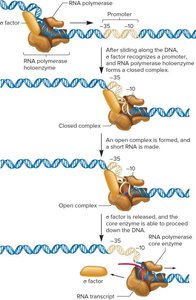
Initiation: Promoter functions as a recognition site for transcription factors, enabling RNA polymerase binding and DNA denaturation into an open complex.
Elongation: RNA polymerase slides along DNA, synthesizing RNA.
Termination: RNA polymerase and RNA transcript dissociate from DNA.
Transcription in Bacteria
Promoters and Initiation
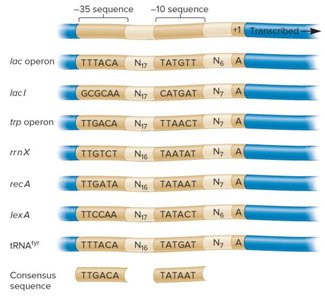
Promoters are DNA sequences that direct the location for transcription initiation. In E. coli, the RNA polymerase holoenzyme consists of a core enzyme and a sigma factor.
Core enzyme: Five subunits (α2ββ’ω).
Sigma factor: Recognizes -35 and -10 promoter regions; contains a helix-turn-helix structure for DNA binding.
Elongation and Uracil
Elongation: RNA polymerase synthesizes RNA using the template strand, moving in a 3’ to 5’ direction, while RNA is synthesized 5’ to 3’.
Uracil vs. Thymine: Uracil is used in RNA instead of thymine for energy conservation and to differentiate RNA from DNA.
Termination Mechanisms
Termination occurs when the RNA-DNA hybrid is forced to separate, releasing RNA and RNA polymerase. E. coli uses two mechanisms:
Rho-dependent termination: Requires the rho protein.
Rho-independent termination: Involves a uracil-rich sequence and a stem-loop structure.
Transcription in Eukaryotes
Eukaryotic RNA Polymerases
Eukaryotes have three main RNA polymerases:
RNA polymerase I: Synthesizes rRNA.
RNA polymerase II: Synthesizes mRNA and most other RNAs.
RNA polymerase III: Synthesizes tRNA and some other RNAs.
Promoter Structure and Regulatory Elements
Core promoter: Includes the TATA box and transcriptional start site; produces basal transcription.
Cis-acting elements: DNA sequences affecting gene activity on the same DNA molecule (e.g., TATA box, enhancers, silencers).
Trans-acting elements: Regulatory proteins binding to DNA sequences.
Transcription Factors and Mediator
General transcription factors (GTFs): Required for basal transcription.
Mediator: Multi-subunit complex mediating effects of regulatory transcription factors on RNA polymerase II.
Enhancers: Stimulate transcription; can be located upstream, downstream, or within the gene.
Silencers: Repress gene activation; less common than enhancers.
RNA Modification in Eukaryotes
RNA Processing and Splicing
Eukaryotic RNA transcripts undergo several modifications:
5’ Capping: Addition of 7-methylguanosine to the 5’ end of mRNA; important for stability, translation, and splicing.
Polyadenylation: Addition of a poly(A) tail to the 3’ end; enhances mRNA stability.
Splicing: Removal of introns and joining of exons; performed by the spliceosome (composed of snRNPs).
Alternative Splicing
Alternative splicing allows different polypeptides to be produced from the same gene, increasing protein diversity.
Constitutive exons: Always included in mature mRNA.
Alternative exons: Vary between cell types or developmental stages.
Splicing factors: Regulate alternative splicing (e.g., SR proteins).
RNA Editing
RNA editing involves posttranscriptional changes to RNA sequences, such as base conversions or insertions/deletions.
Examples: C-to-U conversion in apolipoprotein B mRNA; A-to-I conversion in glutamate receptor mRNA.
Organism | Type of Editing | Found in |
|---|---|---|
Trypanosomes | Additions/deletions of uracil | Mitochondrial mRNAs |
Slime mold | C additions | Mitochondrial mRNAs |
Plants | C-to-U conversion | Mitochondrial/chloroplast mRNAs, tRNAs, rRNAs |
Mammals | C-to-U conversion | Apolipoprotein B mRNA, NFI mRNA |
Mammals | A-to-I conversion | Glutamate receptor mRNA, tRNAs |
Drosophila | A-to-I conversion | Calcium/sodium channel mRNAs |
Processing of tRNA and rRNA
tRNA Processing
Transfer RNAs are made as large precursors and cleaved at both ends to produce mature tRNAs. Some tRNAs contain introns that are removed by specific endonucleases and ligated by RNA ligase.
rRNA Processing
Ribosomal RNAs are transcribed as large precursors and processed into mature rRNAs. In eukaryotes, this occurs in the nucleolus by RNA polymerase I.
Summary Table: Key Steps in Transcription and RNA Modification
Step | Description | Key Enzymes/Factors |
|---|---|---|
Initiation | RNA polymerase binds promoter, DNA unwinds | RNA polymerase, transcription factors |
Elongation | RNA polymerase synthesizes RNA | RNA polymerase |
Termination | RNA polymerase and RNA dissociate | Rho factor (bacteria), polyA signal (eukaryotes) |
5’ Capping | Addition of 7-methylguanosine to mRNA | Capping enzymes |
Polyadenylation | Addition of poly(A) tail to mRNA | Poly(A) polymerase |
Splicing | Removal of introns, joining of exons | Spliceosome, snRNPs |
RNA Editing | Posttranscriptional base changes | Editing enzymes |
