 Back
BackGene Transfer and Mapping in Bacteria and Bacteriophages
Study Guide - Smart Notes
 Tailored notes based on your materials, expanded with key definitions, examples, and context.
Gene Transfer in Bacteria
Overview of Gene Transfer Mechanisms
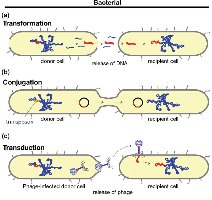
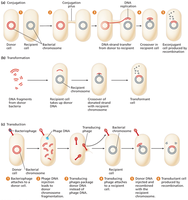
Bacteria can exchange genetic material through several mechanisms, which are essential for genetic diversity and adaptation. The three primary processes are conjugation, transformation, and transduction. Each process involves the transfer of DNA from a donor to a recipient cell, but the mechanisms and vectors involved differ.
Conjugation: Direct transfer of DNA via cell-to-cell contact, typically involving a pilus.
Transformation: Uptake of free DNA fragments from the environment by a competent recipient cell.
Transduction: Transfer of bacterial DNA by a bacteriophage (virus that infects bacteria).
Features of Bacteria Useful to Geneticists
Genomic and Experimental Advantages
Bacteria are model organisms in genetics due to their simple, haploid genomes, rapid generation times, and ease of cultivation. These features allow for the direct observation of mutations and efficient genetic analysis.
Genome simplicity: Fewer genes and smaller genome size compared to eukaryotes.
Haploid genotype: Mutations are directly observable; no dominance interactions.
Rapid growth: Generation times can be as short as 20 minutes.
Large progeny numbers: Enables detection of rare genetic events.
Ease of propagation: Simple and inexpensive laboratory culture.
Numerous heritable differences: Mutants are easily created and studied.
Bacterial Genomes and Plasmids
Structure and Function
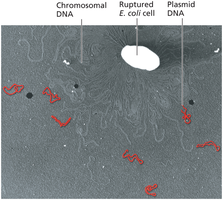
Bacterial genomes typically consist of a single, circular chromosome containing essential genes. Many bacteria also harbor plasmids, which are small, circular DNA molecules carrying non-essential but often advantageous genes, such as antibiotic resistance.
Chromosome: Covalently closed, double-stranded DNA; contains essential genes.
Plasmids: Extrachromosomal, independently replicating DNA; can carry genes for conjugation (F plasmid), antibiotic resistance (R plasmid), and other functions.
Conjugation
Discovery and Mechanism
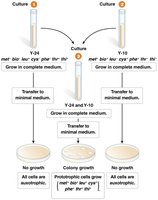
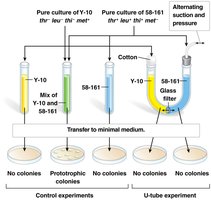
Conjugation was first demonstrated by Lederberg and Tatum in 1946 using auxotrophic strains of E. coli. Physical contact between cells is required for gene transfer, as shown by Davis's U-tube experiment.
Donor cells (F+): Possess the F (fertility) plasmid and can initiate conjugation.
Recipient cells (F−): Lack the F plasmid and receive DNA.
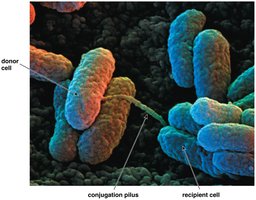
Conjugation pilus: Structure that connects donor and recipient cells for DNA transfer.
F Factor and Hfr Strains
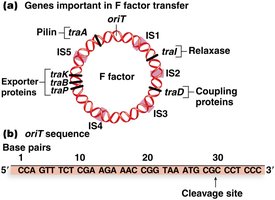
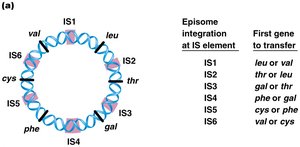
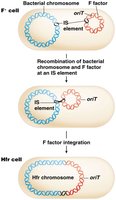
The F plasmid contains genes necessary for pilus formation and DNA transfer. Occasionally, the F plasmid integrates into the bacterial chromosome, creating a high-frequency recombination (Hfr) strain, which can transfer chromosomal genes to recipients.
F factor: ~100 kb, encodes ~40 genes for conjugation.
Hfr strains: F factor integrated into chromosome; can transfer chromosomal genes.
Episome: A genetic element (like F factor) that can exist as a plasmid or integrate into the chromosome.
Rolling Circle Replication
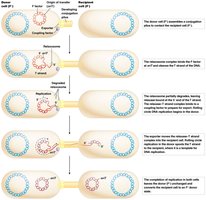
During conjugation, DNA is transferred via rolling circle replication. The donor cell replicates its plasmid as it transfers a single DNA strand to the recipient, which then synthesizes the complementary strand.
Rolling circle replication: Unidirectional transfer and simultaneous replication of DNA.
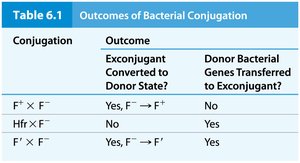
Outcomes of Bacterial Conjugation
Conjugation | Outcome | Donor Bacterial Genes Transferred? |
|---|---|---|
F+ × F− | F− becomes F+ | No |
Hfr × F− | F− remains F− | Yes |
F′ × F− | F− becomes F′ | Yes |
Mapping Genes by Interrupted Mating
Time-of-Entry Mapping
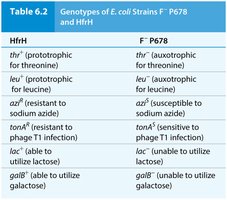
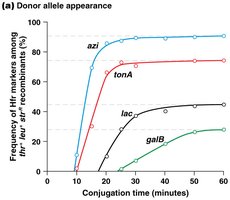
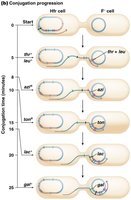
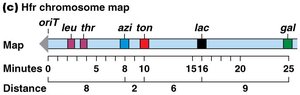
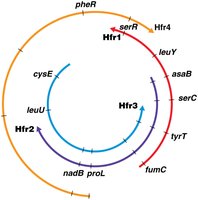
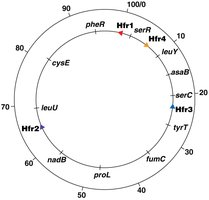
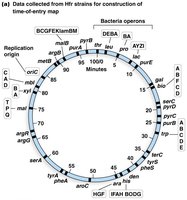
Interrupted mating experiments allow the mapping of gene order and distances on the bacterial chromosome. By stopping conjugation at various times, researchers can determine the sequence and timing of gene transfer from Hfr to F− cells.
Genes closest to oriT: Transferred first and most frequently.
Gene order: Determined by the time of first appearance in exconjugants.
Consolidated Circular Maps
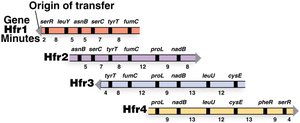
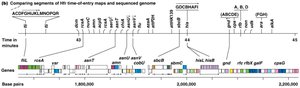
Data from multiple Hfr strains are combined to create a complete circular genetic map of the bacterial chromosome, showing gene order and relative distances.
F′ (F-prime) Factors and Partial Diploids
Formation and Use
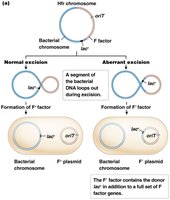
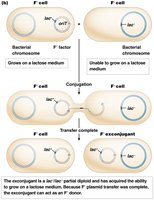
Imprecise excision of the F factor from the chromosome can result in an F′ plasmid, which carries additional bacterial genes. Conjugation with F′ cells produces partial diploids (merozygotes), useful for studying gene function and regulation.
F′ factor: F plasmid carrying extra chromosomal genes.
Partial diploid: Recipient cell contains two copies of certain genes (one on chromosome, one on F′).
Transformation
Mechanism and Applications
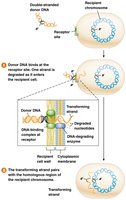
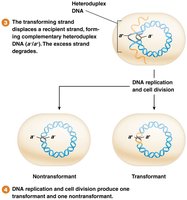
Transformation involves the uptake of free DNA from the environment by a competent bacterial cell. This process can lead to genetic recombination and is a valuable tool for gene mapping and genetic engineering.
Competence: The ability of a cell to take up DNA.
Transformant: A cell that has incorporated donor DNA into its genome.
Transduction
Bacteriophage-Mediated Gene Transfer
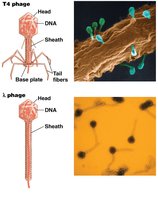
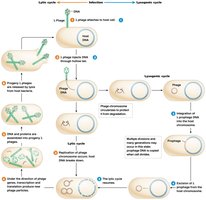
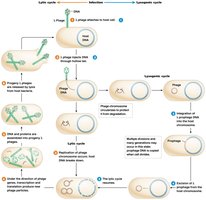
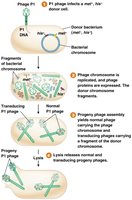
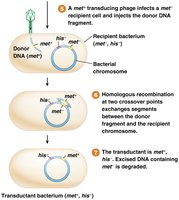
Transduction is the process by which bacteriophages transfer DNA from one bacterium to another. There are two main types: generalized and specialized transduction.
Generalized transduction: Any bacterial gene can be transferred; occurs during the lytic cycle when random bacterial DNA is packaged into phage heads.
Specialized transduction: Only specific bacterial genes near the prophage integration site are transferred; occurs during the lysogenic cycle due to aberrant excision of prophage DNA.
Cotransduction and Gene Mapping
The frequency with which two genes are cotransduced (transferred together) is inversely proportional to the distance between them. Cotransduction analysis is used to map the relative positions of genes on the bacterial chromosome.
Cotransduction frequency: Higher for genes that are closer together.
Gene order: Determined by analyzing cotransduction frequencies and required crossover events.
Essential Concepts
Bacterial gene transfer occurs via conjugation, transformation, and transduction, each with distinct mechanisms and genetic outcomes.
Genetic mapping in bacteria relies on the analysis of gene transfer events and recombination frequencies.
Lateral gene transfer is a major driver of bacterial evolution and adaptation.
