 Back
Genetic Analysis and Mapping in Bacteria and Bacteriophages: Study Notes
Study Guide - Smart Notes
 Tailored notes based on your materials, expanded with key definitions, examples, and context.
Genetic Analysis and Mapping in Bacteria and Bacteriophages
Specialized Methods for Genetic Analysis of Bacteria
Bacteria are invaluable to geneticists due to their simple genomes, rapid reproduction, and ease of manipulation. Their haploid nature allows direct observation of mutations, and their ability to produce large numbers of progeny facilitates the detection of rare genetic events.
Genome Simplicity: Bacterial genomes are less complex than eukaryotic genomes, containing fewer genes and base pairs.
Haploid Genomes: Each gene is present in a single copy, so mutations are immediately observable.
Short Generation Times: Bacteria can divide every 20–30 minutes, enabling rapid experimental cycles.
Large Numbers of Progeny: Enables statistical analysis and detection of rare events.
Ease of Propagation: Bacteria are easy and inexpensive to culture.
Numerous Heritable Differences: Mutants can be easily created, identified, and isolated.
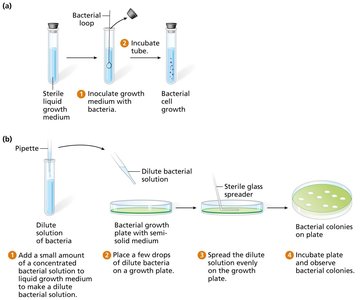
Bacterial Culture and Growth Analysis
Bacteria propagate by binary fission, resulting in colonies of genetically identical cells. Growth media provide essential nutrients, and the type of media used can distinguish between different bacterial genotypes.
Minimal Medium: Contains only essential nutrients (glucose, nitrogen, inorganic materials, water). Only prototrophs (wild-type bacteria) can grow.
Complete Medium: Contains all compounds required for growth, allowing auxotrophs (mutant bacteria lacking the ability to synthesize certain compounds) to grow.
Supplemented Minimal Medium: Minimal medium with specific compounds added to support auxotrophs.
Plating Bacteria and Replica Plating
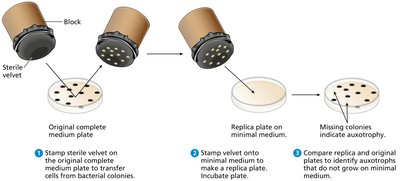
Different media are used to determine bacterial genotypes based on growth patterns. Replica plating is a technique for transferring cells from one plate to another to identify auxotrophs.
Auxotrophs: Mutants unable to grow on minimal medium due to specific nutritional requirements.
Replica Plating: Allows identification of colonies that fail to grow on minimal medium, indicating auxotrophy.
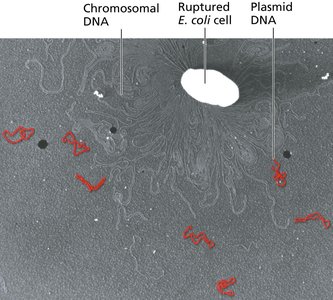
Characteristics of Bacterial Genomes and Plasmids
Bacterial genomes typically consist of a single, circular chromosome carrying essential genes. Many bacteria also harbor plasmids—small, circular DNA molecules with nonessential genes, such as antibiotic resistance or fertility factors.
Chromosome: Covalently closed, circular, double-stranded DNA.
Plasmids: Small, circular DNA molecules; can replicate independently (high-copy-number) or depend on the chromosome (low-copy-number).
Types of Plasmids: F (fertility) plasmid promotes gene transfer; R (resistance) plasmid confers antibiotic resistance.
Gene Transfer Mechanisms in Bacteria
Three Processes of Genetic Transfer
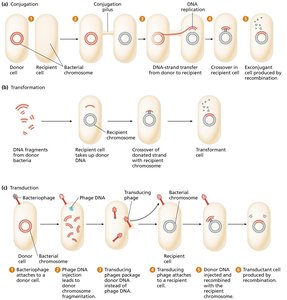
Bacteria transfer genes by three main processes: conjugation, transformation, and transduction. Each mechanism has distinct features and applications in genetic mapping.
Conjugation: Transfer of replicated DNA from a donor to a recipient via direct cell contact.
Transformation: Uptake of DNA from the environment by a recipient cell.
Transduction: Transfer of DNA from one bacterium to another via a bacteriophage (viral vector).
Conjugation: Discovery and Mechanism
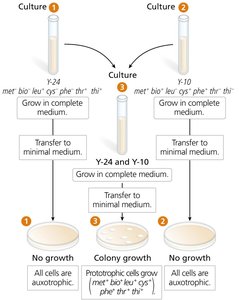
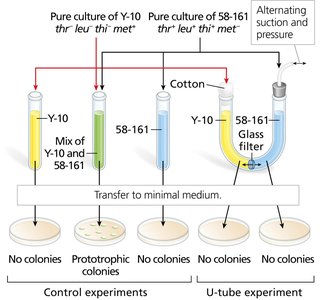
Conjugation was first identified by Lederberg and Tatum, who observed recombination between auxotrophic E. coli strains. Physical contact between cells is required for gene transfer, as demonstrated by Davis's U-tube experiment.
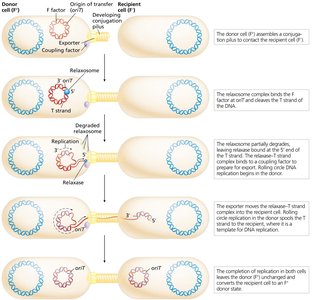
Donor Cells (F+): Possess the F factor and can transfer genetic material.
Recipient Cells (F−): Lack the F factor and receive DNA.
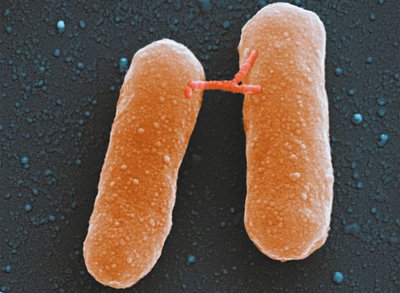
Conjugation Pilus: Hollow tube facilitating DNA transfer.
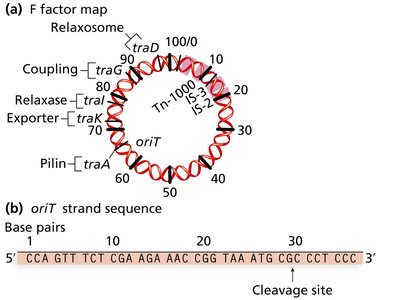
Relaxosome: Protein complex that initiates transfer by cleaving the F factor DNA at the origin of transfer (oriT).
Rolling Circle Replication: Mechanism for copying and transferring DNA.
F Factor and Hfr Chromosomes
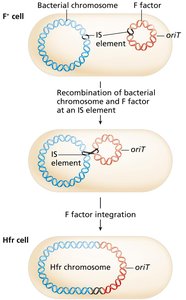
The F factor is a plasmid that enables conjugation. In Hfr (high-frequency recombination) strains, the F factor integrates into the bacterial chromosome, allowing transfer of chromosomal genes during conjugation.
F+ × F− Conjugation: Transfers F factor only; recipient becomes F+.
Hfr × F− Conjugation: Transfers chromosomal genes; recipient remains F− but acquires donor alleles.
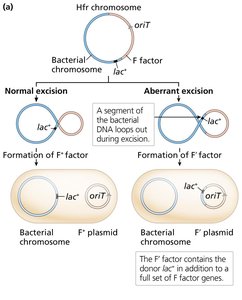
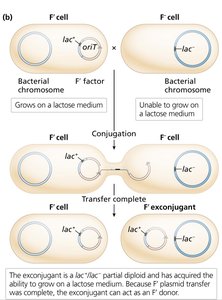
F' (F prime) Factor: Contains F factor plus a segment of chromosomal DNA; produces partial diploids.
Mapping Genes by Interrupted Mating
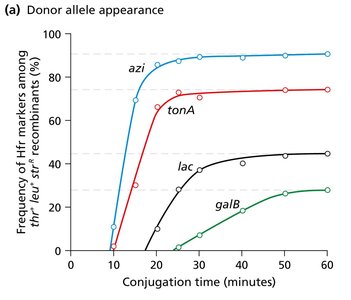
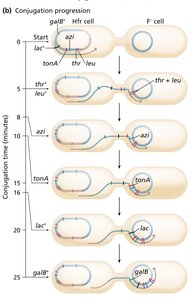
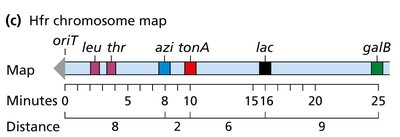
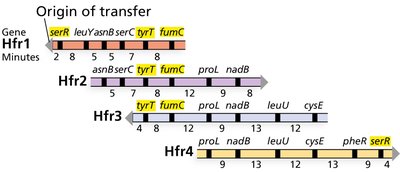
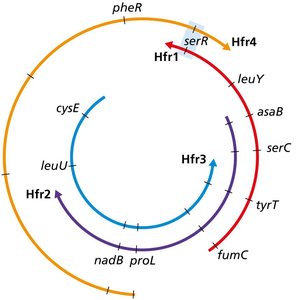
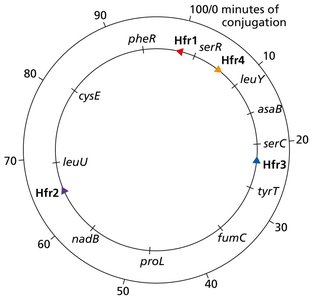
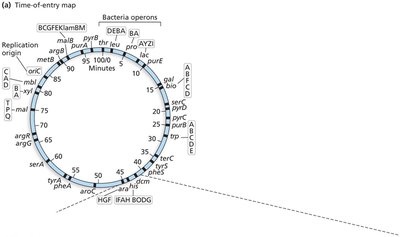
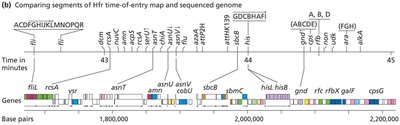
Interrupted mating experiments break the conjugation pilus at timed intervals, allowing determination of gene order and distance based on the time of entry into recipient cells. Multiple Hfr strains are used to construct comprehensive genetic maps.
Time-of-Entry Mapping: Genes closest to oriT transfer first; time of appearance reflects distance.
Consolidated Maps: Overlapping linear maps from different Hfr strains are combined to form a circular chromosome map.
Partial Diploids and F' Factor Mating
F' factors result from imperfect excision of the F factor from an Hfr chromosome, carrying both F factor genes and a segment of chromosomal DNA. Exconjugants with F' factors are partial diploids, useful for studying gene regulation.
Partial Diploids: Cells with two copies of certain genes—one on the chromosome, one on the F' factor.
Applications: Used to analyze gene function and regulation in bacteria.
Bacterial Transformation and Transduction
Bacterial Transformation
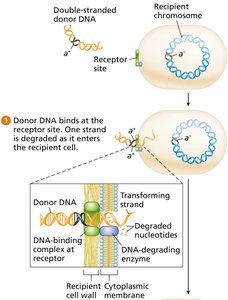
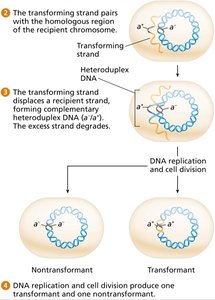
Transformation is the uptake of DNA fragments from the environment by a recipient cell, leading to genetic recombination. It is a four-step process involving DNA binding, strand degradation, alignment, and heteroduplex formation.
Lysis: Donor cell breaks, releasing DNA fragments.
DNA Uptake: Recipient cell binds and internalizes DNA; one strand is degraded.
Heteroduplex Formation: Donor DNA aligns with recipient chromosome, replacing a strand.
Transformant: After replication and cell division, one daughter cell is genetically transformed.
Mapping by Transformation
Transformation is useful for mapping closely linked genes, as only short DNA fragments are typically transferred. Cotransformation occurs when two or more genes are transferred together, indicating close linkage.
Bacterial Transduction
Transduction is the transfer of genetic material via bacteriophages. Integration of donor DNA into the recipient chromosome by homologous recombination produces a transductant.
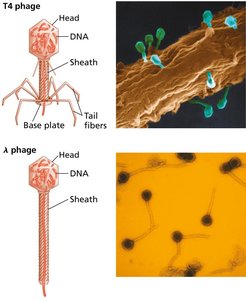
Bacteriophage Structure: Composed of a head, sheath, and tail fibers; contains a single chromosome.
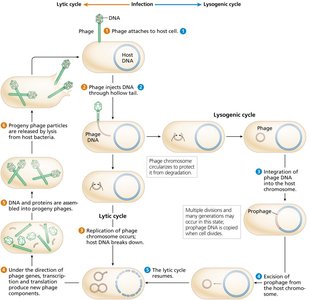
Lytic Cycle: Phage infects host, replicates, assembles progeny, and lyses the cell.
Lysogenic Cycle: Phage DNA integrates into host chromosome as a prophage, persisting until triggered to enter the lytic cycle.
Generalized Transduction
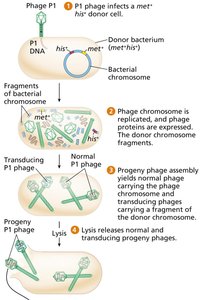
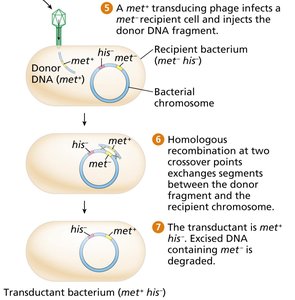
Generalized transducing phages package random fragments of donor bacterial DNA, which can be transferred to recipient cells. Homologous recombination in the recipient produces stable transductants.
Phage P1: Well-studied generalized transducing phage for E. coli.
Steps: Phage infects donor, packages host DNA, lyses cell, infects recipient, and recombination occurs.
Summary Table: Outcomes of Bacterial Conjugation
Conjugation Cross | Exconjugant Converted to Donor State? | Donor Bacterial Genes Transferred? |
|---|---|---|
F+ × F− | Yes, F− becomes F+ | No |
Hfr × F− | No | Yes |
F' × F− | Yes, F− becomes F' | Yes |
Conclusion
Bacterial genetics provides powerful tools for gene mapping and analysis. Conjugation, transformation, and transduction each offer unique mechanisms for gene transfer, enabling detailed study of genetic linkage, recombination, and regulation in prokaryotes.
