 Back
BackGenetic Analysis and Mapping in Bacteria and Bacteriophages – Study Notes
Study Guide - Smart Notes
 Tailored notes based on your materials, expanded with key definitions, examples, and context.
Genetic Analysis and Mapping in Bacteria and Bacteriophages
Introduction
This chapter explores the specialized genetic methods used to analyze and map genes in bacteria and bacteriophages. Bacteria serve as powerful model organisms due to their simple genomes, rapid growth, and ease of genetic manipulation. Understanding gene transfer mechanisms in bacteria is fundamental for mapping genes, studying recombination, and exploring genome evolution.
Bacterial Genetics: Fundamental Concepts
Advantages of Bacteria in Genetic Studies
Genome simplicity: Bacteria have fewer genes and smaller genomes than eukaryotes, simplifying genetic analysis.
Haploid genomes: Mutations are directly observable since only one gene copy is present.
Short generation times: Bacteria can double in minutes, allowing rapid experimental cycles.
Large numbers of progeny: Enables detection of rare genetic events.
Ease of propagation: Culturing bacteria is inexpensive and space-efficient.
Numerous heritable differences: Mutants are easily created, identified, and isolated.
Bacterial Culture and Growth Analysis
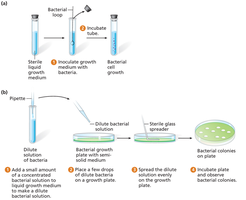
Bacteria reproduce by binary fission, producing genetically identical progeny. Cultures can be grown in liquid or on solid media, which must supply carbon, nitrogen, water, and essential elements.
Types of Media
Minimal medium: Contains only essential nutrients (e.g., glucose, nitrogen, salts, water). Prototrophs can grow here, as they synthesize all required compounds.
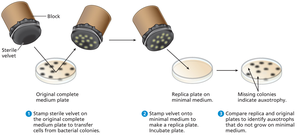
Auxotrophs: Mutant bacteria unable to synthesize a required compound; require complete medium (minimal medium plus all necessary nutrients) or supplemented minimal medium (minimal medium plus the missing compound).
Plating and Replica Plating
Different media are used to distinguish bacterial genotypes by their growth patterns. Replica plating allows transfer of colonies to new plates to test for specific nutritional requirements.
Bacterial Genomes and Plasmids
Chromosomal and Plasmid DNA
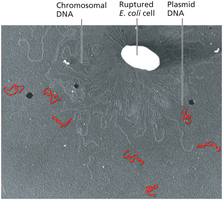
Bacterial chromosome: Usually a single, covalently closed circular double-stranded DNA molecule, containing essential genes.
Plasmids: Small, circular, double-stranded DNA molecules carrying nonessential genes. Plasmids can be present in multiple copies and are easily manipulated in genetic engineering.
Types of Plasmids
F (fertility) plasmid: Encodes genes for its own transfer between cells.
R (resistance) plasmid: Carries antibiotic resistance genes.
High-copy-number plasmids: Replicate independently, present in many copies per cell.
Low-copy-number plasmids: Usually one or two copies per cell, often integrated with the chromosome.
Gene Transfer Mechanisms in Bacteria
Overview of Gene Transfer
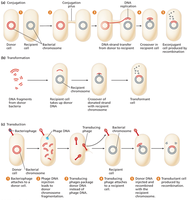
Bacteria exchange genetic material via three main processes:
Conjugation: Direct transfer of DNA from donor to recipient via cell-to-cell contact.
Transformation: Uptake of free DNA from the environment.
Transduction: Transfer of DNA by bacteriophages (viruses that infect bacteria).
Bacterial Conjugation
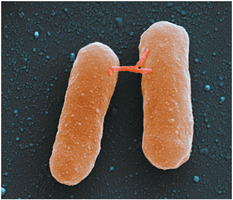
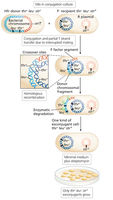
Conjugation involves the transfer of DNA (often the F plasmid) from an F+ (donor) to an F− (recipient) cell. The process is mediated by the F factor, which encodes genes for pilus formation and DNA transfer.
F Factor and IS Elements
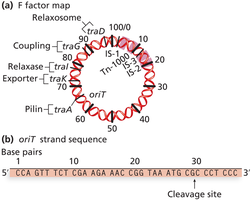
F factor: ~100 kb plasmid with ~40 genes for conjugation.
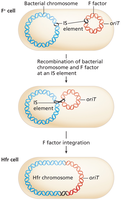
IS (insertion sequence) elements: Shared sequences between F plasmid and chromosome, allowing recombination and integration.
Mechanism of Conjugation
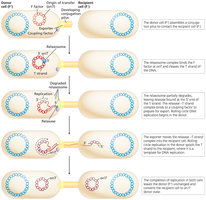
Formation of a conjugation pilus between donor and recipient.
Relaxosome binds to oriT, cleaves one DNA strand (T strand), and initiates rolling circle replication.
T strand is transferred to recipient, where it is replicated to form a double-stranded F factor.
Hfr Strains and Chromosome Transfer
Hfr (high frequency recombination) strains: F factor integrates into the bacterial chromosome, allowing transfer of chromosomal genes during conjugation.
Gene transfer occurs in a specific order, starting from the integration site (oriT).
Complete transfer of the chromosome is rare; only genes near oriT are frequently transferred.
Selection and Mapping by Interrupted Mating
Selection: Exconjugants are identified by growth on selective media (e.g., antibiotic resistance or nutritional markers).
Interrupted mating: Conjugation is stopped at intervals to map gene order and distance based on time of entry into the recipient.
Transformation and Genetic Mapping
Bacterial Transformation
Transformation is the uptake of free DNA fragments from the environment by a competent bacterial cell. The process involves integration of donor DNA into the recipient genome by homologous recombination, producing a transformant.
Transformation is used to map closely linked genes (cotransformation).
Only genes close together on the same DNA fragment are likely to be cotransformed.
Transduction: Gene Transfer by Bacteriophages
Bacteriophage Life Cycles
Lytic cycle: Phage infects, replicates, and lyses the host cell, releasing progeny.
Lysogenic cycle: Phage integrates into host genome as a prophage, replicating with the host until induced to enter the lytic cycle.
Generalized and Specialized Transduction
Generalized transduction: Random bacterial DNA is packaged into phage heads and transferred to new hosts.
Specialized transduction: Only specific bacterial genes adjacent to the prophage integration site are transferred due to aberrant excision.
Cotransduction and Gene Mapping
Genes close together are more likely to be cotransduced.
Cotransduction frequency is used to determine gene order and distance.
Lateral Gene Transfer and Genome Evolution
Lateral Gene Transfer (LGT)
LGT is the transfer of genetic material between unrelated organisms, contributing to genome diversity and evolution.
Genomic islands, regions with distinct sequence features, often result from LGT.
LGT can confer new traits, such as antibiotic resistance or pathogenicity, with significant medical implications.
Summary Table: Types of Bacterial Gene Transfer
Process | Mechanism | Genetic Material Transferred | Key Features |
|---|---|---|---|
Conjugation | Direct cell-to-cell contact | Plasmid or chromosomal DNA | Requires F factor; can map gene order by interrupted mating |
Transformation | Uptake of free DNA | DNA fragments | Requires competence; used for mapping closely linked genes |
Transduction | Phage-mediated | Bacterial DNA (random or specific) | Generalized or specialized; used for gene mapping |
