 Back
BackGenetic Analysis and Mapping in Bacteria: Prokaryotic Genetics Study Guide
Study Guide - Smart Notes
 Tailored notes based on your materials, expanded with key definitions, examples, and context.
Genetic Analysis and Mapping in Bacteria
Introduction to Bacterial Genetics
Bacterial genetics focuses on the mechanisms by which bacteria exchange and recombine genetic material. Unlike eukaryotes, bacteria utilize horizontal gene transfer to acquire new genes, which can occur between different species. This process is fundamental for understanding genetic mapping, antibiotic resistance, and metabolic diversity in prokaryotes.
Mechanisms of Genetic Transfer in Bacteria
Conjugation, Transduction, and Transformation
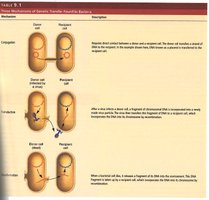
Bacteria can transfer genetic material through three primary mechanisms:
Conjugation: Direct transfer of DNA from a donor to a recipient cell via cell-to-cell contact, often mediated by a pilus.
Transduction: Transfer of DNA from one bacterium to another via bacteriophages (viruses).
Transformation: Uptake of free, "naked" DNA from the environment by a bacterial cell.
Auxotrophy and Prototrophy
Definitions and Applications
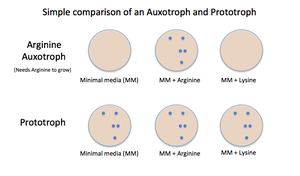
Auxotrophy and prototrophy describe the nutritional requirements of bacterial strains:
Auxotroph: An organism unable to synthesize a required compound for growth; must be supplied with that compound.
Prototroph: An organism capable of synthesizing all compounds needed for growth; can grow on minimal medium.
Replica plating is used to distinguish auxotrophs from prototrophs by comparing growth on different media.
Bacterial Conjugation and the F Factor
Mechanism of Conjugation
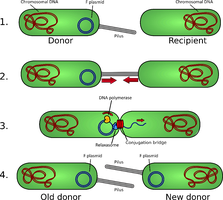
Bacterial conjugation involves the transfer of genetic material, typically plasmids, from an F+ (fertile) donor to an F- (recipient) cell. The F factor is a plasmid that encodes genes necessary for pilus formation and DNA transfer.
F+ cells: Contain the F plasmid and can donate genetic material.
F- cells: Lack the F plasmid and act as recipients.
Hfr Strains and Chromosomal Gene Transfer
Hfr (high-frequency recombination) strains arise when the F factor integrates into the bacterial chromosome. During conjugation, Hfr strains can transfer chromosomal genes to F- cells, starting at the origin of transfer and proceeding linearly.
Interrupted Mating Experiments
Principle and Application
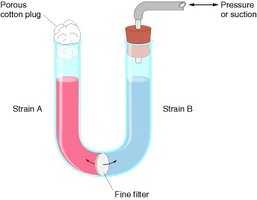
Interrupted mating experiments are used to map the order and relative distances of genes on the bacterial chromosome. By allowing Hfr and F- cells to conjugate for specific time intervals and then interrupting the process, researchers can determine which genes are transferred first.
Genes closest to the origin of transfer are transferred earliest.
Gene order can be deduced from the timing of their appearance in recipient cells.
Example: Order of Gene Transfer in Hfr Strains
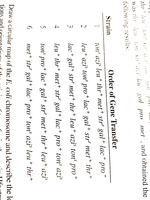
The following table summarizes the order of gene transfer for six different Hfr strains, each with a unique origin and direction of transfer:
Strain | Order of Gene Transfer |
|---|---|
1 | met, azi, leu, thr, met, gal, lac, pro |
2 | lac, gal, str, met, thr, leu, azi, pro |
3 | leu, azi, ton, pro, lac, gal, str, met, thr |
4 | leu, thr, met, gal, lac, pro, azi, ton, str |
5 | lac, gal, leu, thr, met, pro, azi, ton, str |
6 | met, gal, lac, pro, thr, azi, leu |
Mapping the E. coli Chromosome
Genetic Map and Time Units
The E. coli chromosome is circular and genetic distances are measured in minutes, reflecting the time required for genes to be transferred during conjugation. The order and timing of gene transfer can be used to construct a genetic map.
Case Study: Wollman and Jacob's Interrupted Mating Experiment
Experimental Design and Results
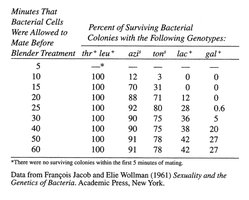
Wollman and Jacob used interrupted mating to determine the order of gene transfer. By sampling at different time points and plating on selective media, they observed the sequential appearance of transferred genes.
Minutes That Bacterial Cells Were Allowed to Mate Before Blender Treatment | thr* leu* | azir | tonr | lac* | gal* |
|---|---|---|---|---|---|
5 | -- | -- | -- | -- | -- |
10 | 100 | 12 | 3 | 0 | 0 |
15 | 100 | 70 | 31 | 0 | 0 |
20 | 100 | 88 | 71 | 13 | 0 |
25 | 100 | 91 | 78 | 42 | 6 |
30 | 100 | 91 | 78 | 42 | 27 |
40 | 100 | 91 | 78 | 42 | 27 |
50 | 100 | 91 | 78 | 42 | 27 |
Interpretation: Genes are transferred in the order thr, leu, azi, ton, lac, gal. The time at which each gene appears reflects its position relative to the origin of transfer.
Genetic Mapping Problem Example
Mapping Genes Using Interrupted Mating
In an interrupted mating experiment, the number of colonies growing on selective media at different time points can be used to infer gene order and relative distances. The use of selective agents (e.g., antibiotics) ensures only recombinant cells are counted.
Time of Interruption | Nutrients A and B | Nutrients B and C | Nutrients A and C |
|---|---|---|---|
5 min | 0 | 0 | 0 |
10 min | 0 | 0 | 25 |
15 min | 0 | 21 | 41 |
20 min | 21 | 41 | 52 |
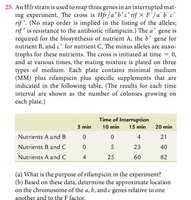
Interpretation: The gene order can be deduced based on the timing of colony appearance on each selective medium.
Summary Table: Mechanisms of Genetic Transfer
Comparison of Conjugation, Transduction, and Transformation
Mechanism | Donor Cell | Recipient Cell | Description |
|---|---|---|---|
Conjugation | Donor cell | Recipient cell | Requires direct contact; DNA transferred via pilus. |
Transduction | Donor cell | Recipient cell | DNA transferred by bacteriophage. |
Transformation | Donor cell | Recipient cell | Recipient takes up free DNA from environment. |
Genetic Mapping Units: Minutes vs. CentiMorgans
Prokaryotic vs. Eukaryotic Mapping
In prokaryotes, genetic distances are measured in minutes, reflecting the time required for gene transfer during conjugation. In eukaryotes, distances are measured in centiMorgans (cM), where 1 cM equals 1% recombination frequency during meiosis.
Summary
Bacterial genetics provides powerful tools for mapping genes and understanding genetic exchange. Interrupted mating experiments, the use of Hfr strains, and the measurement of gene transfer times are central to constructing genetic maps in bacteria. These concepts are foundational for advanced studies in genetics, molecular biology, and biotechnology.
