 Back
Genetic Code and Transcription: Structure, Function, and Regulation
Study Guide - Smart Notes
 Tailored notes based on your materials, expanded with key definitions, examples, and context.
Genetic Code & Transcription
Central Dogma of Molecular Biology
The central dogma describes the flow of genetic information in cells: DNA is transcribed into RNA, which is then translated into protein. This process is fundamental to gene expression and the synthesis of proteins necessary for life.
DNA stores genetic information.
Gene expression refers to accessing DNA to make proteins.
Structural genes code for proteins with various functions.
Proteins influence cellular traits and functions.
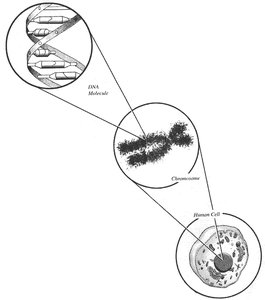
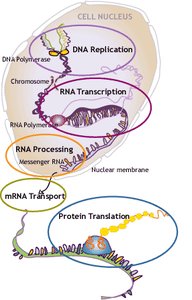
DNA Stores Information for Synthesis of Proteins and RNA
Humans possess between 20,000 and 30,000 genes, each coding for a unique protein. Not all proteins are produced in every cell; cell-specific proteins are synthesized as needed.
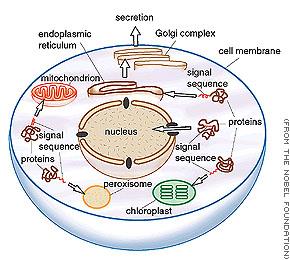
Proteins are made in the appropriate cell type (e.g., eye-specific proteins in eye cells).
Gene Expression: From DNA to Protein
Gene expression involves accessing genetic material in DNA to produce proteins or, in some cases, functional RNAs. The process includes transcription and translation.
The Genetic Code
Properties of the Genetic Code
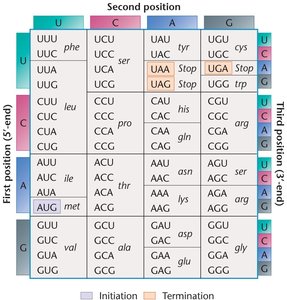
The genetic code is the set of rules by which information encoded in mRNA is translated into proteins. It is characterized by several key properties:
Unambiguous: Each codon specifies only one amino acid.
Degenerate: Multiple codons can code for the same amino acid.
Commales: Codons are read sequentially without gaps.
Nonoverlapping: Each nucleotide is part of only one codon.
Nearly universal: The code is conserved across most organisms.
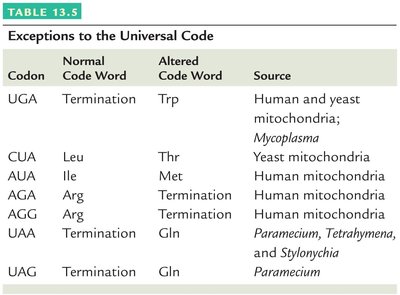
Exceptions to the Universal Genetic Code
Although the genetic code is nearly universal, some exceptions exist, particularly in mitochondria and certain protozoa.
Codon | Normal Code Word | Altered Code Word | Source |
|---|---|---|---|
UGA | Termination | Trp | Human and yeast mitochondria; Mycoplasma |
CUA | Leu | Thr | Yeast mitochondria |
AUA | Ile | Met | Human mitochondria |
AGA | Arg | Termination | Human mitochondria |
AGG | Arg | Termination | Human mitochondria |
UAA | Termination | Gln | Paramecium, Tetrahymena, and Stylonychia |
UAG | Termination | Gln | Paramecium |
Gene Expression: Transcription
Parts of a Bacterial Gene and Transcript
Bacterial genes contain specific sequences that regulate transcription and translation:
Promoter: Site for RNA polymerase binding; signals transcription start.
Regulatory sequences: Bind regulatory proteins to influence transcription rate.
Coding sequence (Open Reading Frame): Codes for the protein.
Terminator: Signals transcription end.
Bacterial mRNA may be polycistronic, encoding multiple polypeptides.
Transcription Process
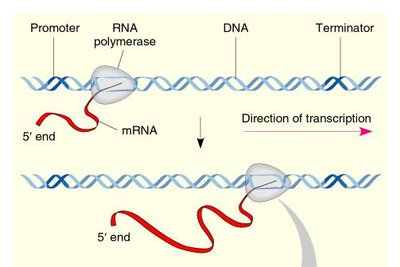
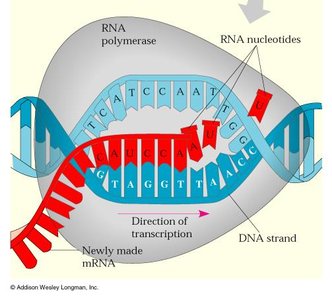
Transcription is the process by which RNA polymerase synthesizes an RNA copy from the DNA template. The transcript is complementary to the template strand and similar to the coding strand (with U replacing T).
Transcription proceeds from the 5’ to 3’ end of the RNA.
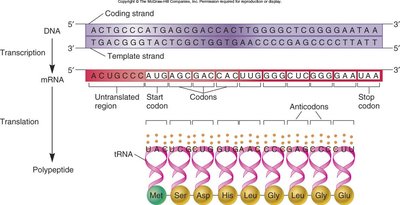
The start codon sets the reading frame for translation.
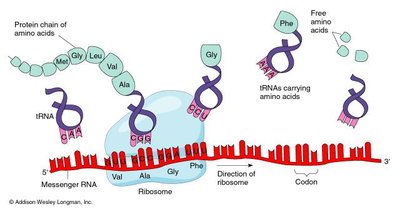
Translation: Ribosome Reads mRNA
The ribosome reads the mRNA sequence in codons (three nucleotides at a time) to synthesize a polypeptide. The sequence of codons determines the sequence of amino acids in the protein.
Transcriptional Stages
Initiation, Elongation, and Termination
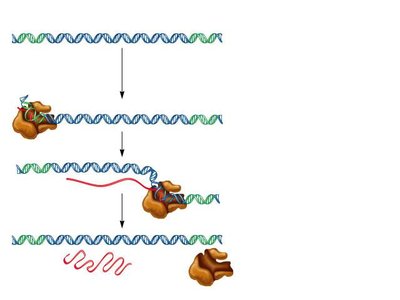
Transcription occurs in three main stages:
Initiation: RNA polymerase binds to the promoter, forming an open complex.
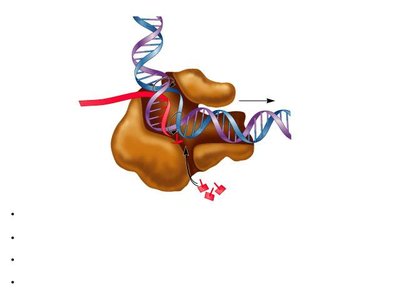
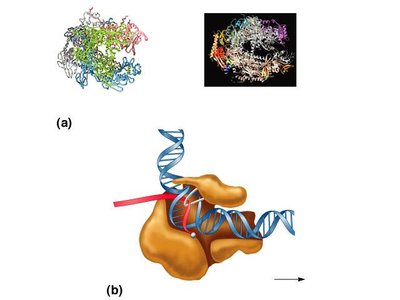
Elongation: RNA polymerase synthesizes RNA by moving along the DNA template.
Termination: A termination signal causes RNA polymerase and the transcript to dissociate.
Functions of RNA Molecules
mRNA: Encodes protein sequence.
tRNA: Brings amino acids to the ribosome.
rRNA: Structural and functional component of ribosomes.
Other small RNAs: Various regulatory and processing functions.
Transcriptional Initiation in Prokaryotes
Promoter Structure and Sigma Factor
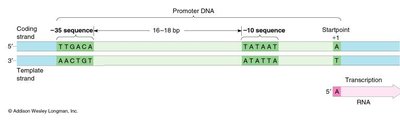
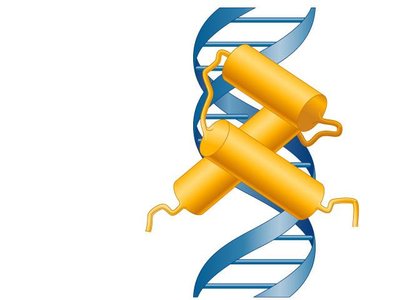
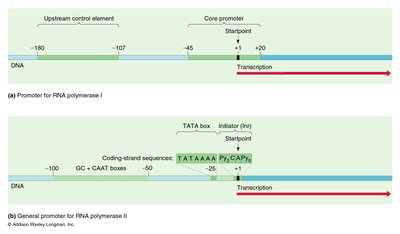
The promoter contains conserved sequences (e.g., -35 and -10 regions) recognized by the sigma factor, which directs RNA polymerase to the correct initiation site.
RNA Polymerase Complexes
Core enzyme: Synthesizes RNA transcript.
Sigma factor: Directs core enzyme to promoter.
Holoenzyme: Core enzyme plus sigma factor.
Transcriptional Elongation
RNA polymerase synthesizes RNA in the 5’ to 3’ direction, using ribonucleoside triphosphates. The template strand is used for complementary base pairing, with U replacing T in RNA.
Transcriptional Termination
Rho-Dependent and Rho-Independent Termination
Termination occurs when the RNA-DNA hybrid is destabilized, either by the action of the Rho protein (Rho-dependent) or by the formation of a hairpin loop and U-rich sequence (Rho-independent).
Rho protein: Functions as an RNA-DNA helicase.
Rho-dependent: Requires Rho and a hairpin loop.
Rho-independent: Requires a hairpin loop and poly-U sequence; NusA stabilizes the pause.
Transcription in Eukaryotes
RNA Polymerases
Eukaryotes have three main RNA polymerases:
RNA polymerase I: Synthesizes rRNA (except 5s).
RNA polymerase II: Synthesizes mRNA and some snRNA.
RNA polymerase III: Synthesizes tRNA and 5s rRNA.
Eukaryotic Promoters and Transcription Initiation
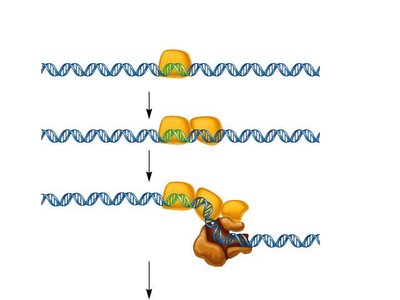
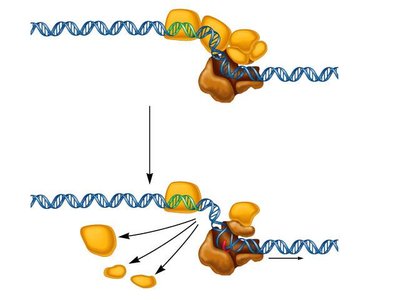
Promoters in eukaryotes contain elements such as the TATA box. General transcription factors (GTFs) assemble at the promoter to recruit RNA polymerase II and initiate transcription.
Chromatin Structure and Transcription
Nucleosome Modification and Remodeling
Chromatin structure can inhibit transcription by restricting access to DNA. Nucleosomes can be covalently modified (e.g., acetylation, methylation) or remodeled (e.g., moved or loosened) to enhance transcription.
Acetylation: Loosens histone-DNA interaction.
ATP-dependent remodeling: Uses energy to alter nucleosome structure.
RNA Modification in Eukaryotes
Common RNA Modifications
Eukaryotic RNA undergoes several modifications to become functional:
Modification | Description |
|---|---|
Trimming/Processing | Removal of part of 5’ and/or 3’ end; cleavage of long transcript |
Splicing | Cleavage and rejoining of RNA molecules |
5’ capping | Cap added to 5’ end for ribosome recognition and protection |
3’ tailing | Poly A added to 3’ end for protection |
RNA editing | Bases changed, added, or deleted |
Base modification | Covalent modifications, often in tRNAs |
RNA Splicing
Splicing removes introns from pre-mRNA and covalently joins exons. There are three main types:
Group I: Self-splicing ribozymes (e.g., rRNA in Tetrahymena).
Group II: Self-splicing ribozymes (found in organelles and some bacteria).
Group III: Requires spliceosome (multiunit complex in eukaryotic nuclear genes).
Alternative Splicing
Alternative splicing allows different exons to be used in various tissues, producing multiple proteins from a single gene. This increases genetic diversity and protein complexity.
5’ Capping and 3’ Tailing
A 7-methylguanosine cap is added to the 5’ end of mRNA for protection and ribosome recognition. Poly-A tailing at the 3’ end increases stability and translation efficiency.
RNA Editing
RNA editing changes the nucleotide sequence of RNA, affecting the protein produced. For example, Apolipoprotein B mRNA is edited in the intestine, resulting in a shorter protein due to a C-to-U change (CAA to UAA stop codon).
Base Modification
Covalent modifications to RNA bases, especially in tRNAs, enhance their function and stability.
Summary Table: Modifications to Eukaryotic RNA
Type | Description |
|---|---|
Trimming/Processing | Large becomes smaller |
5’ Capping | Protects, tells ribosome where to begin translation |
3’ Tailing | Protection |
Splicing | Removes introns |
Editing | Changes sequence of base(s) |
Base Modification | Covalent changes, for tRNA function |
Key Equations and Concepts
Transcription direction: RNA is synthesized 5’ to 3’.
Complementarity rule: AT/GC rule, with U replacing T in RNA.
Reading frame: Set by the start codon (AUG).
Example: The mRNA sequence 5’-AUG-GCU-AAA-3’ codes for the amino acids Met-Ala-Lys.
Formula:
Additional info: Alternative splicing and RNA editing significantly increase the diversity of proteins produced from a single gene, contributing to cellular complexity and adaptability.
