 Back
BackGenetic Code and Transcription: Structure, Function, and Mechanisms
Study Guide - Smart Notes
 Tailored notes based on your materials, expanded with key definitions, examples, and context.
Genetic Code and Transcription
Overview
This study guide covers the fundamental principles of the genetic code and the process of transcription, focusing on how genetic information is encoded, transferred, and expressed in living organisms. The content is structured to provide a comprehensive understanding suitable for college-level genetics students.
The Genetic Code
Features of the Genetic Code
The genetic code is the set of rules by which information encoded in genetic material (DNA or RNA sequences) is translated into proteins by living cells.
Linear Form: The code is written in a linear sequence using ribonucleotide bases (A, U, G, C) in mRNA.
Triplet Code: Each amino acid is specified by a sequence of three nucleotides, called a codon.
Codon: A triplet of nucleotides in mRNA that specifies a particular amino acid.
Unambiguous: Each codon specifies only one amino acid.
Degenerate: Most amino acids are encoded by more than one codon.
Comma-less: Codons are read sequentially without gaps.
Nonoverlapping: Each nucleotide is part of only one codon in a given reading frame.
Colinear: The sequence of codons in mRNA determines the sequence of amino acids in the protein.
Nearly Universal: The code is conserved across most organisms, with a few exceptions.
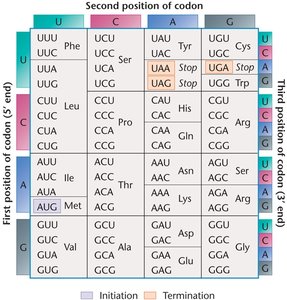
Triplet Nature of the Code
The genetic code is based on triplets of nucleotides, which was revealed by studies of frameshift mutations. Insertion or deletion of one or two nucleotides shifts the reading frame, altering downstream codons, while insertion or deletion of three nucleotides restores the reading frame.
Reading Frame: The way nucleotides are grouped into codons for translation.
Frameshift Mutation: Insertions or deletions that change the reading frame, often resulting in nonfunctional proteins.
Degeneracy and Wobble Hypothesis
Degeneracy means that multiple codons can specify the same amino acid. The third base of the codon is often less critical, allowing for 'wobble' in base pairing between codon and anticodon.
Wobble Hypothesis: The first two bases of the codon are most important for tRNA recognition; the third base can often vary without changing the amino acid.
Anticodon: A triplet sequence in tRNA that pairs with the codon in mRNA.
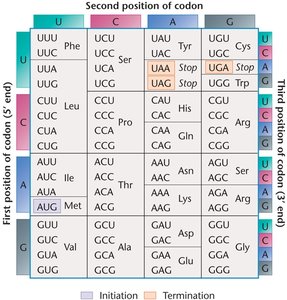
Order and Punctuation in the Genetic Code
The genetic code contains start and stop signals to regulate translation.
Start Codon: AUG (methionine) is the primary initiation codon; in bacteria, it codes for N-formylmethionine.
Stop Codons: UAA, UAG, and UGA signal termination of translation and do not code for amino acids.
Nonsense Mutation: A mutation that introduces a premature stop codon, resulting in truncated proteins.
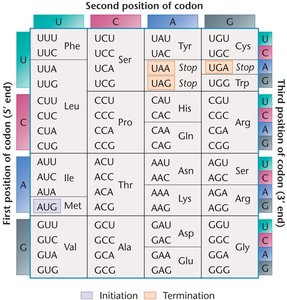
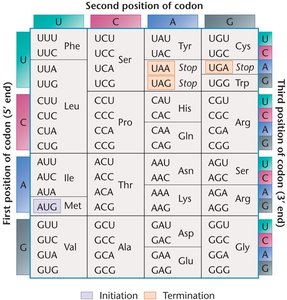
Universality and Exceptions
The genetic code is nearly universal, but some exceptions exist, particularly in mitochondrial genomes and certain unicellular organisms.
Codon | Normal Code Word | Altered Code Word | Source |
|---|---|---|---|
UGA | Termination | Trp | Human & yeast mitochondria; Mycoplasma |
CUA | Leu | Thr | Yeast mitochondria |
AUA | Ile | Met | Human mitochondria |
AGA | Arg | Termination | Human mitochondria |
AGG | Arg | Termination | Human mitochondria |
UAA | Termination | Gln | Paramecium, Tetrahymena, Stylonychia |
UAG | Termination | Gln | Paramecium |
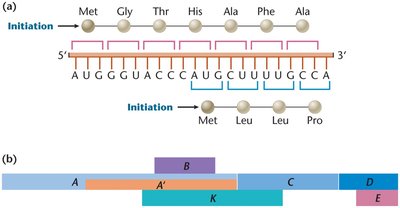
Overlapping Genes and Open Reading Frames (ORFs)
While the genetic code is nonoverlapping, a single mRNA can have multiple initiation points, creating overlapping reading frames and allowing for the production of multiple polypeptides from the same sequence.
Open Reading Frame (ORF): A DNA sequence that can be transcribed and translated into a functional protein, containing both start and stop codons.
Overlapping Genes: Multiple proteins can be encoded by the same stretch of DNA if translation is initiated at different start codons.
Advantage: Maximizes coding potential of limited genetic material.
Disadvantage: Mutations may affect more than one protein.
Transcription
Overview of Transcription
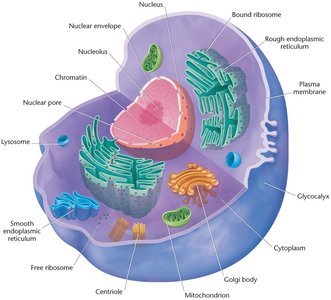
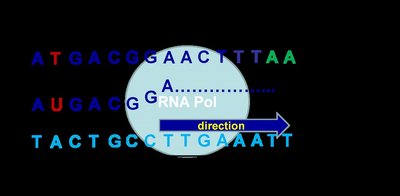
Transcription is the process by which genetic information stored in DNA is transferred to RNA. The resulting mRNA is complementary to the DNA template strand and serves as the template for protein synthesis.
Template Strand: The DNA strand that is transcribed by RNA polymerase.
Coding Strand: The DNA strand with the same sequence as the mRNA (except T is replaced by U).
RNA Polymerase: The enzyme that synthesizes RNA from a DNA template, using nucleoside triphosphates (NTPs) as substrates.
No Primer Required: RNA polymerase can initiate synthesis de novo.
Mechanism of Transcription
Initiation: RNA polymerase binds to the promoter region of DNA, unwinds the double helix, and begins RNA synthesis.
Elongation: RNA polymerase moves along the DNA, synthesizing RNA in the 5' to 3' direction by adding ribonucleotides.
Termination: Transcription ends when RNA polymerase encounters a termination sequence, releasing the newly formed RNA.
Promoters and Initiation in Bacteria
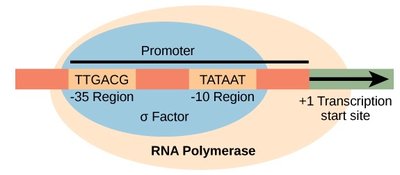
Promoters are DNA sequences upstream of the coding region that regulate the initiation of transcription. In bacteria, two consensus sequences are critical:
-10 Region (Pribnow Box): TATAAT
-35 Region: TTGACA
Sigma Factor (σ): A protein that provides specificity to RNA polymerase, recognizing promoter sequences and facilitating binding.
Chain Elongation and Termination
Elongation: After initiation, the sigma factor dissociates, and the core enzyme continues RNA synthesis.
Proofreading: RNA polymerase can recognize and correct mismatches.
Intrinsic Termination: Involves the formation of a hairpin structure in the RNA, causing RNA polymerase to stall and dissociate.
Rho-dependent Termination: The Rho protein binds to the RNA and helps dissociate the transcription complex.
Coupled Transcription and Translation in Bacteria
In prokaryotes, transcription and translation are coupled, meaning ribosomes can begin translating mRNA while it is still being synthesized.
Polyribosomes: Multiple ribosomes translating a single mRNA simultaneously.
Summary Table: Key Features of the Genetic Code
Feature | Description |
|---|---|
Triplet | Three nucleotides per codon |
Unambiguous | Each codon specifies one amino acid |
Degenerate | Most amino acids have multiple codons |
Comma-less | No breaks between codons |
Nonoverlapping | Each nucleotide is part of only one codon |
Colinear | Order of codons matches order of amino acids |
Nearly Universal | Conserved across most organisms |
