 Back
Genetic Code and Transcription: Structure, Mechanisms, and Regulation
Study Guide - Smart Notes
 Tailored notes based on your materials, expanded with key definitions, examples, and context.
Genetic Code and Transcription
Central Dogma of Molecular Biology
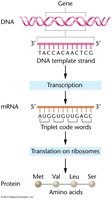
The central dogma describes the flow of genetic information within a biological system: DNA is transcribed into RNA, which is then translated into protein. This process is fundamental to gene expression and cellular function.
DNA stores genetic information.
Transcription produces messenger RNA (mRNA) from DNA.
Translation synthesizes proteins from mRNA on ribosomes.
Triplet code: Each set of three nucleotides (codon) in mRNA specifies an amino acid.
Example: The sequence AUG codes for methionine (Met).
Transcription: Overview and Significance
Transcription is the process by which RNA is synthesized from a DNA template. It is essential for transferring genetic information from DNA to RNA, which then directs protein synthesis.
RNA polymerase catalyzes the synthesis of RNA.
mRNA serves as the intermediate between DNA and protein synthesis.
Biological significance: Enables gene expression and regulation.
Transcription in Prokaryotes vs. Eukaryotes
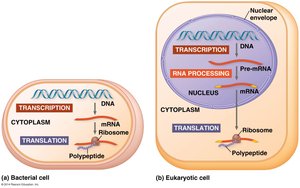
Transcription differs between prokaryotic and eukaryotic cells in location, complexity, and regulation.
Prokaryotes: Transcription and translation occur in the cytoplasm; mRNA is polycistronic and does not require processing.
Eukaryotes: Transcription occurs in the nucleus; mRNA is monocistronic and undergoes extensive processing before translation.
Chromatin remodeling is required in eukaryotes to make DNA accessible.
RNA Structure and Synthesis
Ribonucleotide Structure
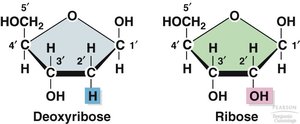
Ribonucleotides are the building blocks of RNA, differing from deoxyribonucleotides by the presence of a hydroxyl group at the 2' carbon of ribose.
Ribose sugar contains an OH group at the 2' position.
Deoxyribose lacks the 2' OH group.
Ribonucleotides are used in RNA synthesis.
RNA Polymerase and Subunits
RNA polymerase is a multi-subunit enzyme responsible for RNA synthesis. In E. coli, it consists of several subunits, each with specific functions.
Subunits: α, β, β', σ
Holoenzyme: Active form containing all subunits (α2, β, β', σ).
β and β': Catalytic activity and active site.
σ subunit: Regulatory, recognizes promoter sequences.
Apoenzyme: Inactive form without cofactors.
Promoters, Template Binding, and the Sigma (σ) Subunit
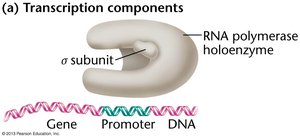
Transcription initiation begins when RNA polymerase binds to promoter sequences, facilitated by the σ subunit.
Promoter: Specific DNA sequence upstream of the transcription start site.
Consensus sequences: TTGACA (-35) and TATAAT (Pribnow box, -10) in E. coli.
σ subunit: Recognizes and binds to promoter, providing specificity.
Transcription start site: Where RNA synthesis begins.
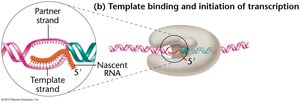
Transcription Steps in E. coli
Transcription proceeds through initiation, elongation, and termination.
Initiation: RNA polymerase binds promoter, inserts first ribonucleotide (no primer needed).
Elongation: After synthesis of 8–9 nucleotides, σ dissociates; core enzyme continues RNA synthesis in 5'–3' direction.
Termination: RNA polymerase encounters termination sequence; transcript folds into hairpin structure or uses rho (ρ) factor for release.
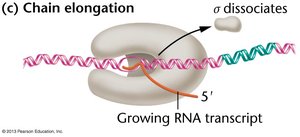
Transcription in Eukaryotes
RNA Polymerases in Eukaryotes
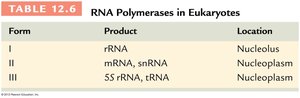
Eukaryotic cells possess three distinct RNA polymerases, each responsible for synthesizing different types of RNA.
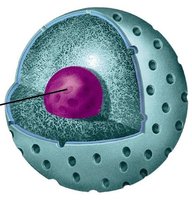
RNA Polymerase I: Synthesizes rRNA in the nucleolus.
RNA Polymerase II: Synthesizes mRNA and snRNA in the nucleoplasm.
RNA Polymerase III: Synthesizes 5S rRNA and tRNA in the nucleoplasm.
Form | Product | Location |
|---|---|---|
I | rRNA | Nucleolus |
II | mRNA, snRNA | Nucleoplasm |
III | 5S rRNA, tRNA | Nucleoplasm |
Promoters and Transcription Factors in Eukaryotes
Transcription in eukaryotes is regulated by promoter elements and transcription factors.
TATA box: Core promoter element where RNA polymerase II binds.
Transcription factors (TFs): Proteins that facilitate binding and initiation.
Enhancers and silencers: Regulatory sequences that modulate transcription.
Chromatin remodeling: DNA must be accessible for transcription.
Post-Transcriptional Modifications in Eukaryotes
mRNA Processing
Eukaryotic mRNAs undergo several modifications to become mature and functional.
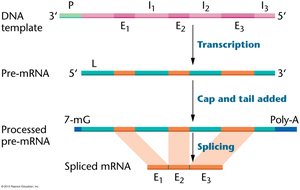
5' cap: Addition of 7-methylguanosine (7mG) to protect mRNA and aid transport.
Poly-A tail: Addition of up to 250 adenylic acids at the 3' end for stability and export.
Splicing: Removal of introns and joining of exons.
Introns and Exons
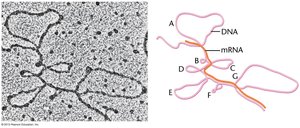
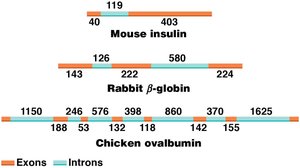
Introns are non-coding regions removed from pre-mRNA, while exons are coding regions retained in mature mRNA.
Introns: Intervening sequences not expressed in protein.
Exons: Expressed sequences joined together after splicing.
Prokaryotic mRNA: Does not contain introns.
Splicing Mechanisms
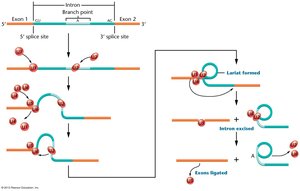
Splicing removes introns from pre-mRNA through enzymatic or self-splicing mechanisms.
Endonuclease: Cuts intron ends; RNA ligase joins exons.
Ribozymes: RNAs capable of self-splicing.
Spliceosome: Complex of snRNPs and snRNAs that excises introns by forming a lariat structure.
snRNPs (snurps): Essential components found only in the nucleus.
Key Definitions
Promoter: DNA sequence where transcription begins.
σ subunit: RNA polymerase subunit recognizing promoter.
Pribnow box: Prokaryotic promoter consensus sequence (-10).
Consensus sequence: Conserved DNA sequence recognized by proteins.
TATA Box: Eukaryotic core promoter element.
Apoenzyme: Inactive enzyme form.
Holoenzyme: Active enzyme form with all subunits.
Ribozyme: RNA molecule with catalytic activity.
Spliceosome: Complex responsible for intron removal.
snurps: Small nuclear ribonucleoproteins (snRNPs).
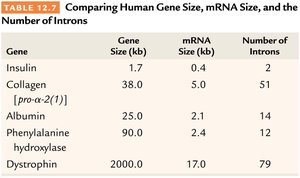
Summary Table: Comparing Human Gene Size, mRNA Size, and Number of Introns
Gene | Gene Size (kb) | mRNA Size (kb) | Number of Introns |
|---|---|---|---|
Insulin | 1.7 | 0.4 | 2 |
Collagen | 38.0 | 5.0 | 51 |
Albumin | 25.0 | 2.1 | 14 |
Phenylalanine hydroxylase | 90.0 | 2.4 | 12 |
Dystrophin | 2000.0 | 17.0 | 79 |
Review Questions
What is the ‘Central Dogma of Molecular Biology’?
What is the biological significance of the transcription process in cells?
How is transcription different in prokaryotes (bacteria) and eukaryotes?
Describe the structure of a ribonucleotide.
What are the subunits of E. coli RNA polymerase? What are their functions?
Define the terms: promoter, σ subunit, Pribnow box, consensus sequence, TATA Box, apoenzyme, holoenzyme, ribozyme, spliceosome, snurps
What reaction is catalyzed by RNA polymerase? What are its requirements?
Describe the transcription steps in E. coli.
List the products of 3 forms of RNA polymerases.
What are the post-transcriptional modifications seen in eukaryotic mRNA?
How are introns removed in eukaryotes?
Describe the process of introns splicing by the spliceosome.
