 Back
Genetic Code, Transcription, and CRISPR-Cas Genome Editing: Study Notes for Genetics Students
Study Guide - Smart Notes
 Tailored notes based on your materials, expanded with key definitions, examples, and context.
The Genetic Code
Characteristics of the Genetic Code
The genetic code is the set of rules by which information encoded in mRNA is translated into proteins. It is fundamental to understanding gene expression and inheritance.
Linear sequence: mRNA is synthesized from a DNA template, forming a linear sequence of ribonucleotides.
Codons: Each codon consists of three nucleotides (triplet code) and specifies a single amino acid.
Unambiguous: Each codon specifies only one amino acid.
Degenerate: Multiple codons can code for the same amino acid.
Start and stop codons: Initiate and terminate translation.
Commaless: Codons are read sequentially without breaks.
Non-overlapping: Each nucleotide is part of only one codon.
Nearly universal: The code is conserved across most organisms.
Mutations and the Genetic Code
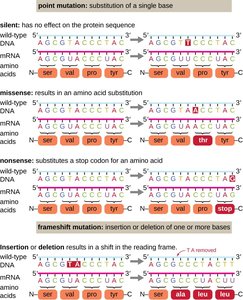
Mutations can alter the genetic code, affecting protein synthesis and function. Frameshift mutations revealed the triplet nature of the code and its degeneracy.
Frameshift mutations: Insertions or deletions shift the reading frame, often resulting in nonfunctional proteins.
Point mutations: Single base changes can be silent, missense, or nonsense.
Transcription in Prokaryotes
RNA Polymerase and Promoter Recognition
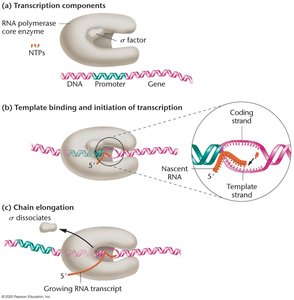
Transcription is the process by which RNA is synthesized from a DNA template. In prokaryotes, RNA polymerase and its sigma factor play key roles in recognizing promoters and initiating transcription.
RNA polymerase: Enzyme responsible for RNA synthesis.
Sigma factor: Recognizes and binds to promoter regions upstream of genes.
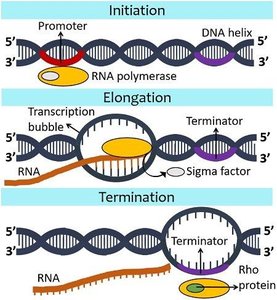
Promoter regions: Conserved sequences (e.g., TATAAT at -10 bp, TTGACA at -35 bp) facilitate binding.
Transcription initiation: Local unwinding of DNA, formation of open complex, and start of RNA synthesis.
Chain elongation: Sigma factor dissociates, RNA chain grows until termination sequence is reached.
Polycistronic mRNA
Prokaryotic mRNA can be polycistronic, meaning a single transcript encodes multiple proteins. This enhances cellular efficiency and allows coordinated expression of related genes.
Termination sequences: Separate different genes within the transcript.
Gene clusters: Genes encoding interacting products are often clustered.
Cistron: An old term for a gene.
Transcription in Eukaryotes
Key Differences from Prokaryotes
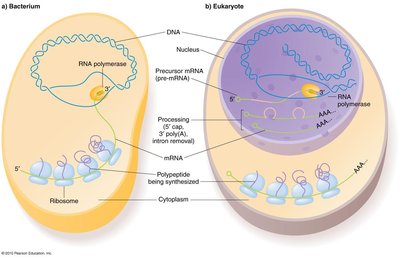
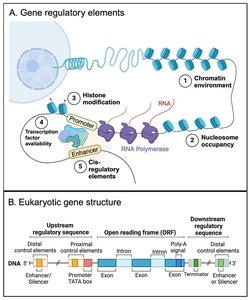
Eukaryotic transcription occurs in the nucleus and involves additional regulatory mechanisms and chromatin remodeling.
Chromatin remodeling: DNA is compacted by histones and must be uncoiled for transcription.
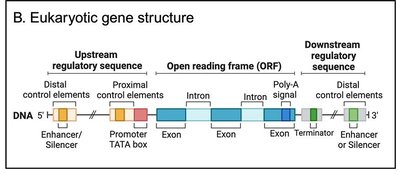
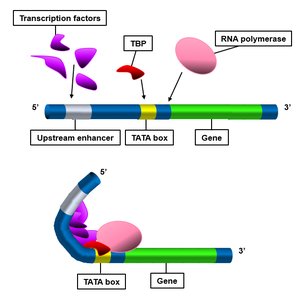
Enhancers and silencers: Regulate transcription initiation and efficiency.
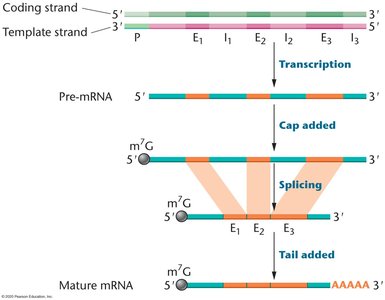
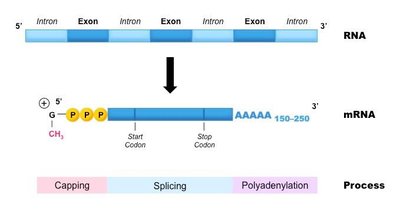
mRNA processing: Includes capping, splicing, and polyadenylation before mRNA exits the nucleus.
Cis-acting and Trans-acting Elements
Transcription regulation in eukaryotes involves cis-acting DNA elements and trans-acting factors.
Cis-acting elements: DNA sequences adjacent to the gene (e.g., promoters, enhancers, silencers).
Trans-acting factors: Proteins that bind to cis-acting elements to influence gene expression.
Post-transcriptional Modification
After transcription, eukaryotic pre-mRNA undergoes several modifications to become mature mRNA.
Splicing: Removal of introns (noncoding sequences) and joining of exons (coding sequences).
5' capping: Addition of a methylated guanine cap to the 5' end.
3' polyadenylation: Addition of a poly-A tail to the 3' end.
Alternative Splicing
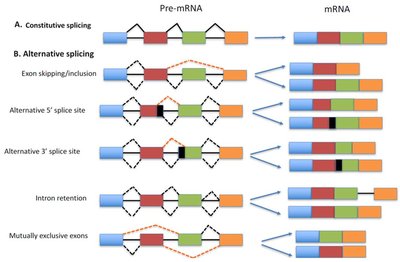
Alternative splicing allows a single gene to produce multiple protein variants, greatly increasing proteomic diversity.
Exon skipping/inclusion: Different exons can be included or excluded.
Alternative splice sites: Use of different 5' or 3' splice sites.
Intron retention: Some introns may be retained in the mature mRNA.
Mutually exclusive exons: Only one of several possible exons is included.
Example: 20,000 protein-coding genes can generate ~100,000 different proteins in humans.
Recombinant DNA Technology and CRISPR-Cas Genome Editing
CRISPR-Cas System
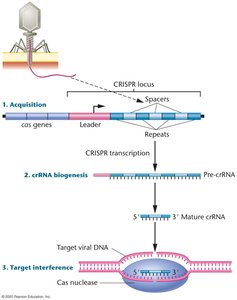
CRISPR-Cas is a bacterial adaptive immune system that has been repurposed for genome editing in living cells.
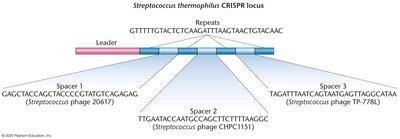
CRISPR locus: Clustered regularly interspaced short palindromic repeats in bacterial genomes.
Cas proteins: Nucleases associated with CRISPR that destroy foreign DNA.
crRNA: Guide RNA that directs Cas proteins to target DNA.
Genome editing: CRISPR-Cas can remove, add, or change specific DNA sequences.

CRISPR-Cas9 Mechanism
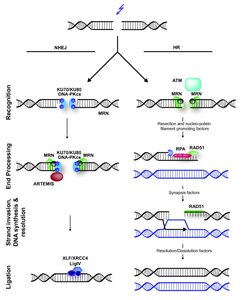
CRISPR-Cas9 uses a single guide RNA (sgRNA) to direct the Cas9 nuclease to a specific DNA sequence, creating a double-stranded break. Repair can occur via non-homologous end joining (NHEJ) or homologous donor repair (HDR).
PAM sequence: Protospacer adjacent motif required for Cas9 binding and cutting.
NHEJ: Error-prone repair that can introduce indels (insertions/deletions).
HDR: Precise repair using a donor template for specific edits.
sgRNA specificity: 20nt sequence ensures targeting of a single site in the human genome.
Applications: Sickle Cell Disease Therapy
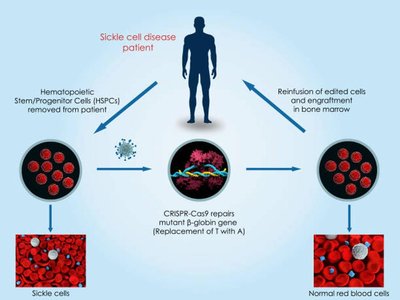
CRISPR-Cas9 can be used to repair genetic mutations, such as the sickle cell mutation in the β-globin gene. Edited hematopoietic stem cells are reinfused into patients, restoring normal red blood cell function.
Mutation repair: Replacement of a single nucleotide (T with A) in the β-globin gene.
Therapeutic potential: Genome editing offers a promising approach for treating genetic diseases.
Probability of Sequence Occurrence
Calculating Sequence Probability
The probability of a specific nucleotide sequence occurring in a genome can be calculated using the formula:
Formula: where n is the length of the sequence.
Application: For a 20nt sequence, probability is , ensuring high specificity in genome targeting.
Sequence | Length | Probability | Predicted Occurrence (Human Genome) |
|---|---|---|---|
A | 1 | 0.25 | 808,707,500 |
AC | 2 | 0.0625 | 202,176,875 |
GAATTC (EcoRI) | 6 | 2.44 x 10⁻⁴ | 789,753 |
n | n | (1/4)n | (1/4)n * 3,234,830,000 |
Additional info: This calculation is critical for designing sgRNAs for CRISPR-Cas9 genome editing, ensuring specificity and minimizing off-target effects.
