 Back
BackGenetic Linkage and Chromosome Mapping: Study Notes
Study Guide - Smart Notes
 Tailored notes based on your materials, expanded with key definitions, examples, and context.
Genetic Linkage and Chromosome Mapping
Introduction to Genetic Linkage
Genetic linkage refers to the tendency of genes located close together on the same chromosome to be inherited together during meiosis. This concept is fundamental to understanding how traits are passed from one generation to the next and is a key topic in classical and molecular genetics.
Linked genes do not assort independently, unlike genes located on different chromosomes.
Linkage can be measured and mapped using recombination frequencies between gene loci.
Centimorgan (cM) and Genetic Distance
The centimorgan (cM) is a unit of genetic distance that represents a 1% recombination frequency between two loci. It is a probabilistic measure, not a physical distance, and is widely used in chromosome mapping.
1 cM = 1% chance of recombination (1 recombinant gamete per 100 gametes).
Genetic distance is not directly convertible to base pairs (bp) due to variation in recombination rates across the genome.
Low recombination frequency indicates close proximity of genes; high frequency suggests greater distance.
Recombination Probability and Genetic Distance
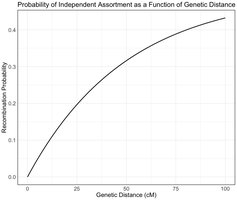
There is a nonlinear relationship between genetic distance (in cM) and recombination probability. As the genetic distance increases, the probability of recombination also increases, but not in a strictly linear fashion. This relationship is important for interpreting genetic maps and understanding the limits of mapping accuracy.
At large distances, the probability of recombination approaches but does not exceed 50% (independent assortment).
Genes far apart on the same chromosome may appear to assort independently due to multiple crossovers.
Key Definitions
Genetic linkage: The tendency of genes close together on a chromosome to be inherited together.
Centimorgan (cM): A unit of genetic distance corresponding to a 1% recombination frequency.
Recombination frequency: The proportion of recombinant offspring produced in a genetic cross.
Independent assortment: The random distribution of different genes during gamete formation, typically observed when genes are on different chromosomes or far apart on the same chromosome.
Important Concepts in Chromosome Mapping
Chromosome mapping involves determining the relative positions of genes on a chromosome based on recombination frequencies. This process is essential for understanding genetic inheritance and for identifying genes associated with specific traits or diseases.
Genetic maps are constructed using data from genetic crosses and recombination frequencies.
Physical maps (measured in base pairs) and genetic maps (measured in cM) may not always align due to variable recombination rates.
Mapping accuracy decreases as the distance between genes increases due to the possibility of multiple crossovers.
Summary Table: Genetic Distance and Recombination
Genetic Distance (cM) | Recombination Probability | Interpretation |
|---|---|---|
0 cM | 0 | No recombination; genes are very close |
10 cM | 0.09 | Low recombination; genes are linked |
50 cM | 0.33 | Genes assort independently |
100 cM | 0.5 | Maximum recombination; independent assortment |
Additional info: Table values are illustrative; actual recombination probabilities are calculated using mapping functions such as Haldane or Kosambi.
Key Equations
Recombination frequency (r):
Genetic distance (in cM):
Applications
Genetic linkage analysis is used in mapping disease genes in humans and model organisms.
Understanding recombination frequencies aids in plant and animal breeding programs.
