 Back
BackGenetic Linkage and Tetrad Analysis in Fungi
Study Guide - Smart Notes
 Tailored notes based on your materials, expanded with key definitions, examples, and context.
Genetic Linkage in Haploid Eukaryotes: Tetrad Analysis
Introduction to Fungal Genetics
Fungi such as Neurospora crassa and Saccharomyces cerevisiae are model organisms for studying genetic linkage due to their unique life cycles. These organisms are generally haploid but can form diploid cells under certain conditions, allowing for direct analysis of meiotic products.
Ascomycetes: A group of fungi that includes bread molds and yeast, notable for their ability to form ascospores within a sac-like structure called an ascus.
Haploid and Diploid Phases: Most of the life cycle is haploid, but diploid cells can form and undergo meiosis to produce haploid spores.
Tetrad Analysis: The process of dissecting and analyzing the four ascospores (tetrad) produced from a single meiotic event to determine their genotypes.
Life Cycle and Tetrad Formation in Fungi
During the fungal life cycle, two haploid cells fuse to form a diploid meiocyte, which undergoes meiosis to produce four haploid nuclei. In S. cerevisiae, these are packaged as an unordered tetrad, while in Neurospora crassa, a post-meiotic mitotic division produces an ordered octad.
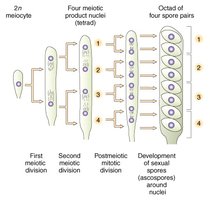
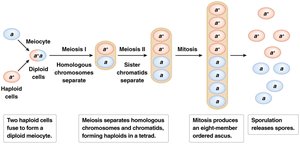
Ascus: The sac containing ascospores; in yeast, it contains four spores (tetrad), and in Neurospora, eight spores (octad).
Ordered vs. Unordered Tetrads: In yeast, spores are unordered; in Neurospora, the arrangement reflects the meiotic divisions.
Types of Tetrads and Genetic Linkage
Parental Ditype (PD), Tetratype (TT), and Nonparental Ditype (NPD)
Tetrad analysis distinguishes between three types of tetrads based on the combination of alleles present in the ascospores:
Parental Ditype (PD): Contains only parental combinations of alleles.
Tetratype (TT): Contains all four possible combinations (two parental, two recombinant).
Nonparental Ditype (NPD): Contains only recombinant combinations, not found in the parents.
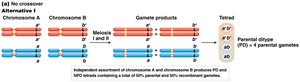
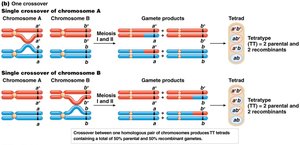
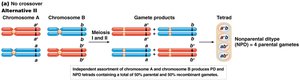
Mechanisms Producing Different Tetrad Types
The formation of PD, TT, and NPD tetrads depends on the arrangement of chromosomes and the occurrence of crossovers during meiosis:
PD: Produced by independent assortment (no crossover) or double crossovers involving the same chromatids.
TT: Produced by single crossovers or three-strand double crossovers.
NPD: Produced only by four-strand double crossovers (rare for linked genes).
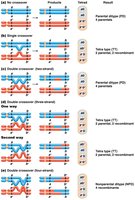
Recombination Frequency in Tetrad Analysis
Calculating Recombination Frequency
Recombination frequency is a measure of genetic distance between two loci. In tetrad analysis, only half of the spores in TT asci are recombinant, while all spores in NPD asci are recombinant. The formula is:
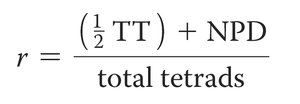
TT: Number of tetratype tetrads
NPD: Number of nonparental ditype tetrads
Total tetrads: Total number of tetrads analyzed
Ordered Ascus Analysis in Neurospora crassa
Ordered Octads and Gene Mapping
In Neurospora crassa, the ordered arrangement of ascospores allows for the mapping of genes relative to each other and to the centromere. After meiosis, a mitotic division produces eight spores in a linear order, reflecting the segregation of alleles.
First-Division Segregation: No crossover between gene and centromere; alleles segregate at meiosis I, resulting in a 4:4 arrangement.
Second-Division Segregation: Crossover between gene and centromere; alleles segregate at meiosis II, resulting in patterns such as 2:2:2:2 or 2:4:2.
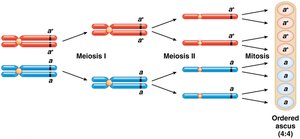
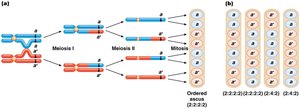
Calculating Gene-to-Centromere Distance
The distance between a gene and its centromere is calculated using the proportion of second-division segregation asci. Only half of the spores in these asci are recombinant. The formula is:

Example: Mapping Genes in Neurospora crassa
Consider a cross between wild-type (buff, normal growth) and mutant (orange, fluffy) strains. The following table summarizes the results and calculations for gene-to-centromere distances:
P (phenotype) | F1 (phenotype) | Trait | First Division (D1) | Second Division (D2) | Combined (D1+D2) | Distance from Centromere to Trait [D2/(D1+D2) x 1/2 x 100 = cM] | Gene Map |
|---|---|---|---|---|---|---|---|
C+g+ | Cg/cg | Color (c) | 73 | 36 | 109 | 16.5 | 16.5 cM |
C+g+ | Cg/cg | Growth (g) | 62 | 47 | 109 | 30.7 | 30.7 cM |
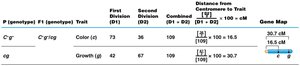
Interpretation: The color gene is 16.5 cM from the centromere, and the growth-habit gene is 30.7 cM from the centromere.
Summary Table: Tetrad Types and Their Genetic Implications
Type of Crossover | Products | Tetrad Type | Result |
|---|---|---|---|
No crossover | Parental only | PD | 4 parental |
Single crossover | 2 parental, 2 recombinant | TT | 2 parental, 2 recombinant |
Double crossover (2-strand) | Parental only | PD | 4 parental |
Double crossover (3-strand) | 3 parental, 1 recombinant | TT | 2 parental, 2 recombinant |
Double crossover (4-strand) | Recombinant only | NPD | 4 recombinant |
Additional info: Tetrad analysis is a powerful tool for mapping genes and understanding recombination in eukaryotic microorganisms, especially fungi. The ordered arrangement of spores in Neurospora allows for precise mapping of gene-centromere distances, which is not possible in unordered tetrads like those of yeast.
