 Back
BackGenetic Linkage, Crossing Over, and Recombination Mapping
Study Guide - Smart Notes
 Tailored notes based on your materials, expanded with key definitions, examples, and context.
Genetic Linkage and Recombination Mapping
Introduction to Genetic Linkage
Genetic linkage refers to the tendency of genes located close together on the same chromosome to be inherited together during meiosis. The study of linkage and recombination frequencies is fundamental for constructing genetic maps and understanding chromosome behavior during cell division.
Crossing Over and the Synaptonemal Complex
Mechanism of Crossing Over
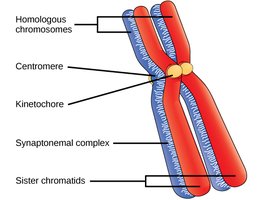
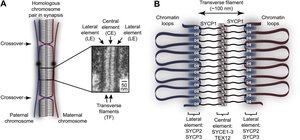
Crossing over is the exchange of genetic material between homologous chromosomes during prophase I of meiosis. This process occurs at specific sites called recombination nodules, which are established along the synaptonemal complex—a protein structure that aligns homologous chromosomes.
Synaptonemal Complex: A tripartite protein structure essential for synapsis and recombination.
Recombination Nodules: Protein assemblies where crossing over occurs.
Homologous Chromosomes: Chromosome pairs, one from each parent, that carry the same genes.
Structure and Function of the Synaptonemal Complex
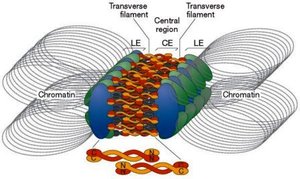
The synaptonemal complex is a highly organized structure of filaments seen between synapsed chromosomes during zygotene and pachytene stages of prophase I. It consists of two lateral elements and a central element, joined by transverse filaments. This structure is essential for the formation of chiasmata and the occurrence of crossing over.
Functions:
Maintains synapsis for crossing over to occur.
Provides a structural framework for segment exchange.
Segregates recombination DNA from other chromosomal DNA.
Recombination Frequency and Genetic Distance
Relationship Between Gene Distance and Recombination
The frequency of recombination between two genes is proportional to the physical distance separating them. Genes that are close together are less likely to have a crossover event between them compared to genes that are farther apart.
Recombination Frequency (RF): The proportion of recombinant offspring produced in a cross, used to estimate genetic distance.
Map Unit (centiMorgan, cM): One map unit corresponds to a 1% recombination frequency.
Types of Crossing Over and Gamete Outcomes
Crossing over can occur as single or double events, affecting the types and proportions of gametes produced.
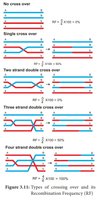
Single Crossover: Involves one chromatid from each homolog, producing 50% parental and 50% recombinant gametes.
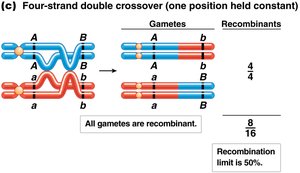
Double Crossover: Can involve two, three, or four chromatids, with varying proportions of parental and recombinant gametes.
Upper Limit to Recombinant Gametes
The maximum proportion of recombinant gametes that can be produced is 50%. When genes are far enough apart, recombination frequency reaches this upper limit, and the pattern of segregation is indistinguishable from independent assortment.
Independent Assortment: Occurs when genes are unlinked or far apart, resulting in a 50% recombination frequency.
Detection and Analysis of Crossovers
Single and Double Crossovers
Single crossovers are detected when recombinant gametes are produced. However, some crossovers, especially double crossovers involving only two chromatids, may not be detected because they yield only parental allele combinations.
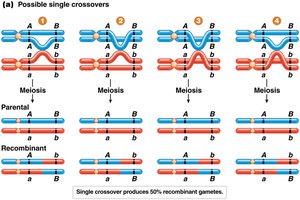
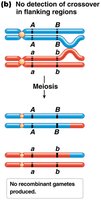
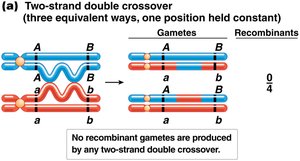
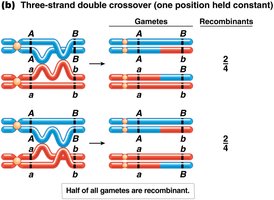
Intragenic Recombination
Recombination Within Genes
Intragenic recombination is a rare event where crossing over occurs within a single gene. This phenomenon was first reported in the Drosophila lozenge gene, where two different mutant alleles recombined to produce a wild-type allele.
Example: Recombination between lzBS and lzg alleles in Drosophila.

Factors Affecting Recombination Frequency
Biological and Environmental Influences
Several factors can affect the accuracy of genetic maps created by recombination frequencies, including age, diet, environment, and sex. For example, in female fruit flies, increased age decreases recombination frequency, and temperature deviations from the optimal can alter crossover rates.
Sex Differences: The heterogametic sex (e.g., XY males) generally has a lower recombination rate than the homogametic sex (e.g., XX females). In male fruit flies, there is no crossing over at all.
Recombination Hotspots and Coldspots
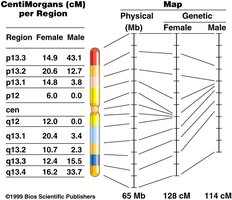
Recombination is not uniformly distributed across the genome. Hotspots are regions with high recombination rates, while coldspots have low rates. These variations can cause discrepancies between genetic and physical maps.
Hotspots: Regions where crossing over is more likely to occur.
Coldspots: Regions, such as those near centromeres, where crossing over is less likely.
Correction of Genetic Map Distances
Limitations of Recombination Frequency as a Distance Measure
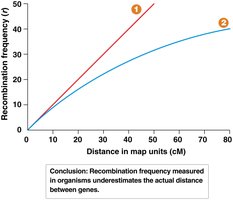
Map distances calculated from recombination frequencies often underestimate the actual physical distance between genes, especially as the distance increases. This is because not all crossovers are detected, particularly multiple crossovers between the same gene pair.
Mapping Functions
To correct for the underestimation, mapping functions have been developed. The Haldane mapping function correlates map distance and recombination frequency, while the Kosambi function accounts for crossover interference. These mathematical models help refine genetic maps.
Haldane Mapping Function: Assumes no interference between crossovers.
Kosambi Mapping Function: Adjusts for crossover interference.
Equation (Haldane):
where d is the map distance in Morgans and r is the recombination frequency.
Equation (Kosambi):
where d is the map distance in Morgans and r is the recombination frequency.
Summary Table: Types of Crossovers and Gamete Outcomes
Type of Crossover | Gamete Types | Proportion Recombinant |
|---|---|---|
No crossover | All parental | 0% |
Single crossover | 2 parental, 2 recombinant | 50% |
Two-strand double crossover | All parental | 0% |
Three-strand double crossover | 2 parental, 2 recombinant | 50% |
Four-strand double crossover | All recombinant | 100% |
Key Takeaways
Genetic linkage and recombination frequencies are essential for constructing genetic maps.
Crossing over occurs at the synaptonemal complex during meiosis and is influenced by biological and environmental factors.
Recombination frequency has an upper limit of 50%, beyond which genes assort independently.
Mapping functions correct for the underestimation of genetic distances due to undetected crossovers.
