 Back
BackGenetic Mapping and Gene Transfer in Prokaryotes: Study Notes
Study Guide - Smart Notes
 Tailored notes based on your materials, expanded with key definitions, examples, and context.
Genetic Mapping in Prokaryotes
Introduction to Bacterial and Bacteriophage Genetics
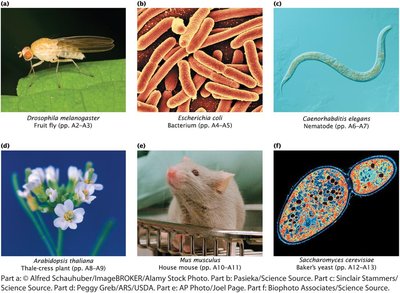
Genetic mapping in prokaryotes, particularly bacteria and their viruses (bacteriophages), is essential for understanding gene organization, transfer, and recombination. Bacteria serve as model organisms due to their simple genomes, rapid reproduction, and ease of genetic manipulation.
Prokaryotic genetics focuses on gene transfer, recombination, and mapping in bacteria and phages.
Key gene transfer mechanisms: conjugation, transformation, and transduction.
Genetic mapping allows determination of gene order and distance on bacterial chromosomes.
Bacterial Genome Organization
Chromosomes and Plasmids
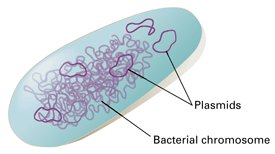
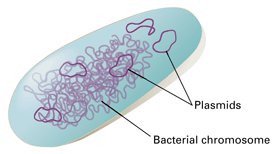
Bacteria typically possess a single, circular chromosome and may contain additional small, circular DNA molecules called plasmids. Plasmids often carry genes that confer selective advantages, such as antibiotic resistance.
Bacterial chromosome: Usually a single, circular DNA molecule containing essential genes.
Plasmids: Extra-chromosomal, double-stranded DNA circles; replicate independently; may integrate into the chromosome (e.g., F factor).
Plasmids are widely used as vectors in genetic engineering.
Gene Transfer Mechanisms in Bacteria
Conjugation
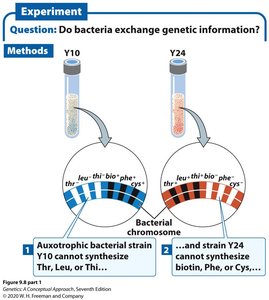
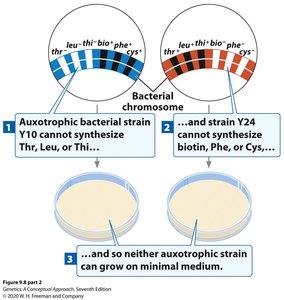
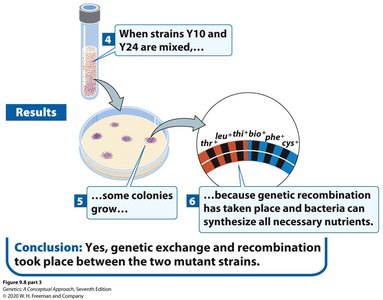
Conjugation is the direct transfer of DNA from one bacterium (donor) to another (recipient) via cell-to-cell contact. This process is mediated by the F (fertility) factor, which can exist as a plasmid or integrate into the chromosome.
F+ cells: Contain the F plasmid; act as donors.
F− cells: Lack the F plasmid; act as recipients.
Hfr cells: F factor integrated into the chromosome; high-frequency recombination donors.
F' cells: F plasmid excises from the chromosome, carrying some bacterial genes; can create partial diploids (merozygotes).
Gene transfer is unidirectional (donor to recipient).
Summary Table: E. coli F Factor Types
Type | F Factor Characteristics | Role in Conjugation |
|---|---|---|
F+ | Present as separate circular plasmid | Donor |
F− | Absent | Recipient |
Hfr | Present, integrated into chromosome | High-frequency donor |
F' | Present as plasmid carrying bacterial genes | Donor |
Genetic Mapping by Interrupted Mating
The interrupted mating technique uses Hfr × F− crosses to determine gene order and distance on the bacterial chromosome. By stopping conjugation at various intervals, the sequence and timing of gene transfer can be mapped.
Genes closer to the origin of transfer enter the recipient cell earlier.
Gene order is deduced from the appearance of recombinant phenotypes at different times.
Transformation
Transformation involves the uptake of free DNA from the environment by a bacterial cell. If the DNA is integrated into the chromosome, genetic recombination occurs.
Competent cells: Capable of taking up DNA.
Transformants: Cells that have incorporated new genetic material.
Cotransformation: Simultaneous uptake of two or more genes; frequency indicates gene proximity.
Key Point: Genes that are physically closer are more likely to be cotransformed.
Transduction
Transduction is the transfer of bacterial genes by bacteriophages (viruses that infect bacteria). There are two main cycles: lytic and lysogenic.
Lytic cycle: Phage replicates and lyses the host cell, releasing progeny phages.
Lysogenic cycle: Phage DNA integrates into the host genome as a prophage; can later enter the lytic cycle.
During transduction, a phage may package host DNA and transfer it to another bacterium, where recombination can occur.
Transductant: Recipient cell that has acquired new DNA via transduction.
Cotransduction frequency is inversely proportional to the distance between genes.
DNA Replication in Bacteria
Theta Replication
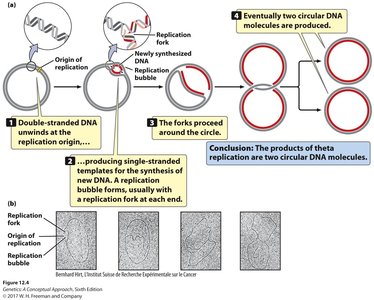
Theta replication is a common mechanism for circular DNA molecules, such as bacterial chromosomes and some plasmids. Replication begins at a single origin and proceeds bidirectionally, producing two circular DNA molecules.
Replication bubble forms at the origin.
Two replication forks move in opposite directions.
Rolling-Circle Replication
Rolling-circle replication is used by some plasmids and viruses. It involves the unidirectional synthesis of a new DNA strand, displacing the old strand, which can then be used as a template for complementary strand synthesis.
Initiated by a single-strand break.
Produces multiple circular DNA molecules.
Applications and Importance
Bacterial gene transfer mechanisms are foundational for genetic engineering, biotechnology, and understanding microbial evolution.
Plasmids are essential tools for cloning, gene expression, and production of pharmaceuticals (e.g., recombinant insulin).
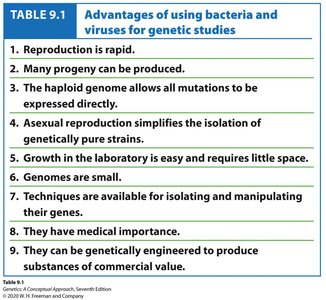
Summary Table: Advantages of Using Bacteria and Viruses for Genetic Studies
# | Advantage |
|---|---|
1 | Rapid reproduction |
2 | Many progeny produced |
3 | Haploid genome allows direct expression of mutations |
4 | Asexual reproduction simplifies isolation of pure strains |
5 | Easy laboratory growth |
6 | Small genomes |
7 | Techniques for gene isolation and manipulation |
8 | Medical importance |
9 | Genetic engineering for commercial products |
Additional info: These mechanisms of gene transfer and mapping are central to Chapters 6 and 10–12 of a typical genetics curriculum, and are foundational for advanced topics such as CRISPR/Cas9 genome editing.
