 Back
BackGenetic Mapping, CRISPR-Cas Systems, and Chromosome Mutations: Advanced Genetics Study Notes
Study Guide - Smart Notes
 Tailored notes based on your materials, expanded with key definitions, examples, and context.
Genetic Mapping in Prokaryotes and Eukaryotes
Overview of Genetic Mapping
Genetic mapping is a fundamental technique in genetics that determines the relative positions of genes on a chromosome. In both eukaryotes and prokaryotes, mapping is essential for understanding gene linkage, inheritance patterns, and the mechanisms of genetic recombination.
Genetic mapping in eukaryotes often uses recombination frequencies from controlled crosses.
In prokaryotes, mapping relies on gene transfer mechanisms such as conjugation, transformation, and transduction.
Example: Mapping genes in Escherichia coli using Hfr conjugation experiments.
Bacterial Gene Transfer and Recombination
Mechanisms of Gene Transfer
Bacteria can exchange genetic material through several mechanisms, which are crucial for genetic diversity and adaptation.
Conjugation: Direct transfer of DNA between two bacterial cells via a pilus.
Transformation: Uptake of free DNA from the environment by a bacterial cell.
Transduction: Transfer of bacterial genes by bacteriophages (viruses that infect bacteria).
Example: The classic Lederberg and Tatum experiment demonstrated conjugation in E. coli.
CRISPR-Cas Systems and Genome Editing
Introduction to CRISPR-Cas
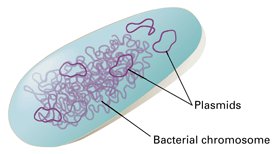
The CRISPR-Cas system is an adaptive immune mechanism in bacteria and archaea, providing sequence-specific defense against invading genetic elements such as viruses and plasmids. It has been adapted as a powerful tool for genome editing in various organisms.
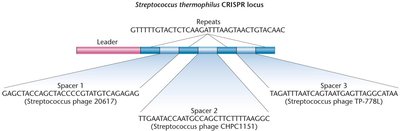
CRISPR: Clustered Regularly Interspaced Short Palindromic Repeats—genomic loci containing short, repeated sequences interspaced with 'spacer' DNA derived from previous invaders.
Cas proteins: CRISPR-associated proteins, including nucleases like Cas9, that mediate the defense response.
Mechanism of CRISPR-Cas Immunity
The CRISPR-Cas system operates in three main stages:
Spacer Acquisition: Fragments of invading DNA (protospacers) are integrated into the CRISPR locus as new spacers.
crRNA Biogenesis: The CRISPR locus is transcribed and processed into short CRISPR RNAs (crRNAs), each containing a unique spacer sequence.
Target Interference: crRNAs guide Cas nucleases to complementary sequences in invading DNA, leading to cleavage and neutralization of the threat.
Genome Editing with CRISPR-Cas9
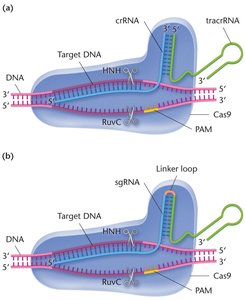
CRISPR-Cas9 has revolutionized genome editing due to its simplicity and programmability. The system requires only two components: the Cas9 nuclease and a guide RNA (sgRNA) that directs Cas9 to a specific DNA sequence adjacent to a PAM (Protospacer Adjacent Motif).
PAM sequence: A short DNA motif required for Cas9 recognition and cleavage; present in target DNA but not in the bacterial CRISPR locus.
sgRNA: Single guide RNA engineered to combine crRNA and tracrRNA functions, directing Cas9 to the target site.
DNA Repair Pathways after CRISPR-Induced Breaks
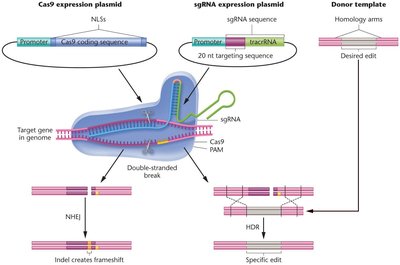
After Cas9-induced double-strand breaks, cells repair DNA via two main pathways:
Nonhomologous End-Joining (NHEJ): Error-prone repair that can introduce insertions or deletions (indels), often used to disrupt gene function.
Homology-Directed Repair (HDR): High-fidelity repair using a homologous template, allowing precise edits, insertions, or corrections.
Chromosome Mutations and Human Disease
Types of Chromosome Mutations
Chromosome mutations can alter the structure or number of chromosomes, leading to genetic disorders and disease susceptibility.
Structural abnormalities: Deletions, duplications, inversions, and translocations.
Numerical abnormalities (Aneuploidy): Loss or gain of individual chromosomes (e.g., monosomy, trisomy).
Polyploidy: Addition of one or more complete sets of chromosomes.
Effects of Deletions and Duplications
Deletions and duplications can cause gene dosage imbalances, leading to developmental and physiological abnormalities.
Deletions: Loss of genetic material; can cause pseudodominance and haploinsufficiency.
Duplications: Extra copies of genes; can disrupt normal development and metabolism.
Inversions and Translocations
Inversions reverse the orientation of a chromosome segment, while translocations move segments between nonhomologous chromosomes. Both can disrupt gene function and regulation.
Paracentric inversion: Does not include the centromere.
Pericentric inversion: Includes the centromere.
Reciprocal translocation: Exchange of segments between two chromosomes.
Nonreciprocal translocation: Segment moves to another chromosome without reciprocal exchange.
Robertsonian translocation: Fusion of two acrocentric chromosomes at the centromere.
Aneuploidy and Human Disease
Aneuploidy refers to the presence of an abnormal number of chromosomes, often resulting from nondisjunction during meiosis or mitosis. Common examples include Down syndrome (trisomy 21).
Nullisomy: 2n – 2 (loss of both members of a homologous pair)
Monosomy: 2n – 1 (loss of a single chromosome)
Trisomy: 2n + 1 (gain of a single chromosome)
Tetrasomy: 2n + 2 (gain of two homologous chromosomes)
Example: Down syndrome is most often caused by trisomy 21 due to nondisjunction.
Summary Table: Types of Chromosome Mutations
Type | Description | Potential Effects |
|---|---|---|
Deletion | Loss of a chromosome segment | Gene dosage imbalance, pseudodominance, haploinsufficiency |
Duplication | Extra copy of a chromosome segment | Gene dosage imbalance, developmental defects |
Inversion | Reversal of a chromosome segment | Disruption of genes/regulation, unbalanced gametes |
Translocation | Movement of segment to another chromosome | Gene disruption, position effects, cancer risk |
Aneuploidy | Abnormal chromosome number | Developmental disorders (e.g., Down syndrome) |
Key Terms and Concepts
Gene dosage: The number of copies of a gene present in a cell or nucleus.
Pseudodominance: Expression of a recessive allele due to deletion of the dominant allele.
Haploinsufficiency: When a single functional copy of a gene is insufficient for normal function.
Position effect: Altered gene expression due to relocation within the genome.
Nondisjunction: Failure of chromosomes to separate properly during cell division.
Additional info: The CRISPR-Cas9 system's adaptation for genome editing has enabled targeted gene knockouts, insertions, and corrections in a wide range of organisms, revolutionizing genetic research and biotechnology.
