 Back
BackGenetic Material: Structure, Chemistry, and Replication
Study Guide - Smart Notes
 Tailored notes based on your materials, expanded with key definitions, examples, and context.
Characteristics of Genetic Material
Essential Properties of Genetic Material
Genetic material must fulfill several critical roles to ensure the continuity and variability of life. These properties are foundational to understanding molecular genetics.
Replication: The genetic material must be able to make exact copies of itself, ensuring genetic continuity during cell division.
Storage of Information: It must act as a repository for genetic information, encoding instructions for cellular structure and function.
Expression of Information: The information stored must be accessible for cellular processes, allowing for the flow of genetic information within the cell.
Variation by Mutation: The chemical composition of the genetic material must be capable of change, providing the basis for genetic diversity and evolution.
Historical Milestones in Genetics
Key Discoveries in the Identification of Genetic Material
The identification of DNA as the genetic material was a cumulative process involving many landmark experiments and discoveries:
1865: Gregor Mendel publishes his work on plant hybridization, laying the foundation for genetics.
1866: Ernst Haeckel proposes that the cell nucleus contains hereditary factors.
1869: Friedrich Miescher isolates "nuclein" (DNA) from cell nuclei, noting its high phosphorus content.
1928: Frederick Griffith demonstrates the existence of a "transforming principle" in bacteria.
1944: Avery, MacLeod, and McCarty show that DNA is the transforming principle in bacteria.
1952: Hershey and Chase confirm DNA as the genetic material using bacteriophages.
1953: Watson and Crick publish the double helix structure of DNA.
1958: Meselson and Stahl provide evidence for semiconservative DNA replication.
1963–1970: Further studies elucidate the mechanisms of DNA replication and structure.
Avery-MacLeod-McCarty Experiment
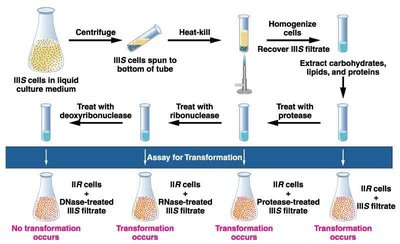
This experiment demonstrated that DNA is the substance responsible for bacterial transformation. By selectively destroying DNA, RNA, or protein in bacterial extracts, only the destruction of DNA prevented transformation, proving DNA's role as genetic material.
Hershey-Chase Experiment
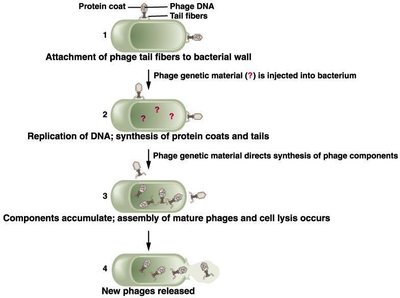
This experiment used bacteriophages to show that DNA, not protein, is the genetic material injected into bacteria to direct viral replication.
Nucleic Acid Chemistry
Nucleotides: The Building Blocks of Nucleic Acids
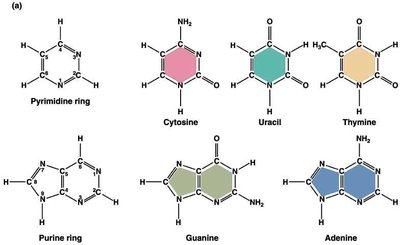
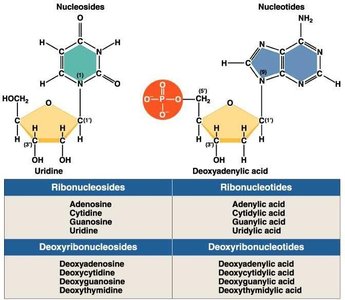
Nucleic acids (DNA and RNA) are polymers of nucleotides. Each nucleotide consists of three components:
Nitrogenous Base: Two types—purines (adenine, guanine) and pyrimidines (cytosine, thymine, uracil).
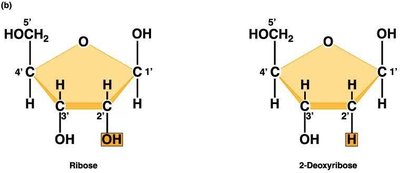
Pentose Sugar: Ribose in RNA, deoxyribose in DNA.
Phosphate Group: Links nucleotides together via phosphodiester bonds.
Formation of Nucleic Acid Polymers
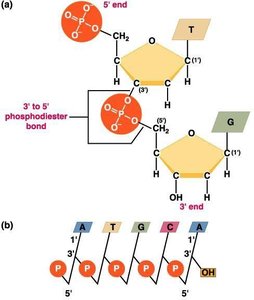
Nucleotides are joined by phosphodiester bonds between the 3' hydroxyl group of one sugar and the 5' phosphate of the next. This forms the sugar-phosphate backbone of DNA and RNA.
The Watson–Crick Model of DNA Structure
Double Helix Structure
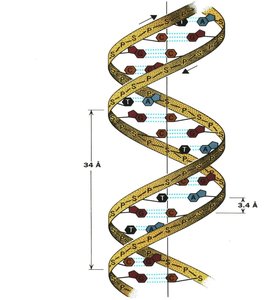
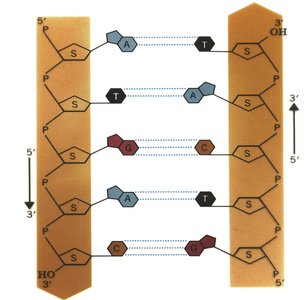
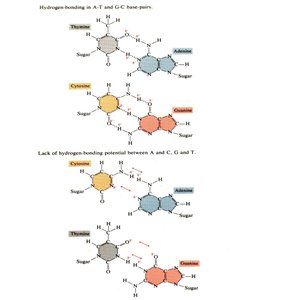
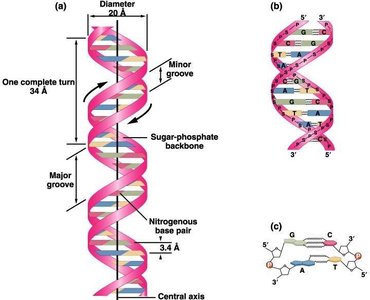
Watson and Crick proposed that DNA is a double helix composed of two antiparallel strands. The sugar-phosphate backbones are on the outside, and the nitrogenous bases pair in the interior via hydrogen bonds.
Base Pairing: Adenine pairs with thymine (A–T), and guanine pairs with cytosine (G–C).
Antiparallel Orientation: One strand runs 5' to 3', the other 3' to 5'.
Major and Minor Grooves: The helix has alternating wide (major) and narrow (minor) grooves, important for protein binding.
DNA Replication
Semiconservative Replication
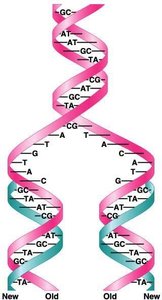
DNA replication is essential for genetic continuity. The semiconservative model states that each new DNA molecule consists of one old (parental) and one new (daughter) strand.
Replication Fork: The site where DNA unwinds and new strands are synthesized.
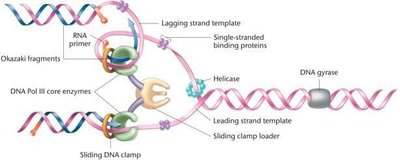
Enzymes Involved: Helicase, gyrase, single-strand binding proteins, DNA polymerases, primase, and ligase.
Mechanism of DNA Replication
Replication involves several coordinated steps and enzymes:
Helicase: Unwinds the DNA double helix using ATP.
Gyrase: Relieves supercoiling ahead of the replication fork.
Single-Strand Binding Proteins: Stabilize unwound DNA.
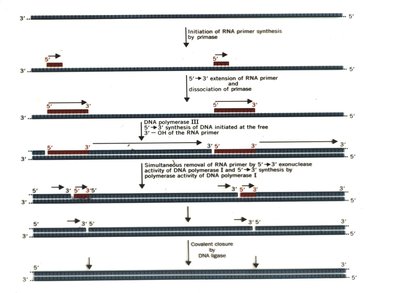
Primase: Synthesizes short RNA primers to initiate DNA synthesis.
DNA Polymerase: Extends the new DNA strand from the primer in the 5' to 3' direction.
Ligase: Seals nicks between Okazaki fragments on the lagging strand.
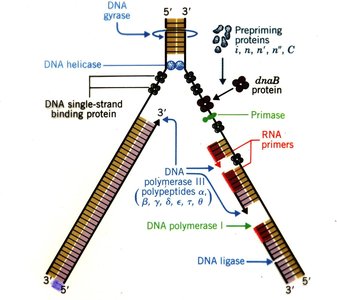

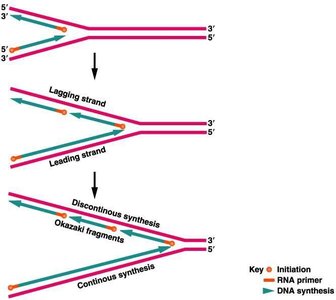
Leading and Lagging Strand Synthesis
DNA synthesis is continuous on the leading strand and discontinuous on the lagging strand, producing short Okazaki fragments that are later joined by DNA ligase.
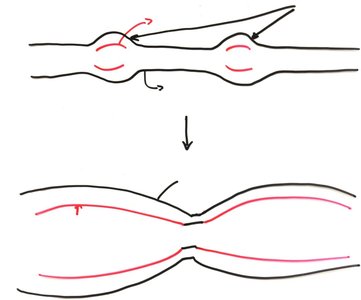
Multiple Origins of Replication in Eukaryotes
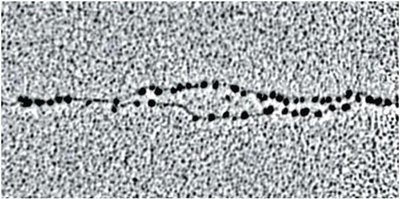
Eukaryotic chromosomes have multiple origins of replication to ensure the entire genome is copied efficiently. Replication bubbles form at each origin, and synthesis proceeds bidirectionally.
Summary Table: Key Enzymes and Proteins in DNA Replication
Enzyme/Protein | Function |
|---|---|
Helicase | Unwinds the DNA double helix |
Gyrase | Relieves supercoiling ahead of the fork |
Single-strand binding protein | Stabilizes unwound DNA |
Primase | Synthesizes RNA primers |
DNA polymerase | Synthesizes new DNA strands |
Ligase | Joins Okazaki fragments |
Additional info: The notes above integrate foundational concepts from Chapters 1, 9, and 10 of a typical genetics curriculum, covering the nature, chemistry, and replication of genetic material.
