Back
Week 4
Study Guide - Smart Notes
 Tailored notes based on your materials, expanded with key definitions, examples, and context.
Genetic Analysis and Mapping in Bacteria and Bacteriophages
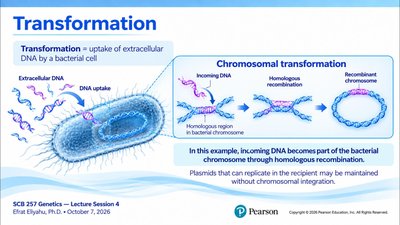
Transformation
Transformation is a process by which a bacterial cell takes up extracellular DNA from its environment. This DNA can integrate into the bacterial chromosome through homologous recombination, resulting in a recombinant chromosome.
Definition: Uptake of extracellular DNA by a bacterial cell.
Mechanism: Incoming DNA aligns with a homologous region in the host chromosome and is incorporated via recombination.
Application: Used in genetic engineering and mapping bacterial genes.
Example: Plasmids can be maintained without chromosomal integration.
Transduction
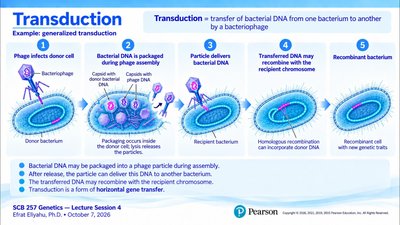
Transduction is the transfer of bacterial DNA from one bacterium to another via a bacteriophage. This process can be generalized or specialized, depending on the phage and the DNA transferred.
Definition: Transfer of bacterial DNA by a bacteriophage.
Steps:
Phage infects donor cell.
Bacterial DNA is packaged during phage assembly.
Phage particle delivers DNA to recipient cell.
Transferred DNA may recombine with recipient chromosome.
Result: Recombinant bacterium.
Key Point: Transduction is a form of horizontal gene transfer.
Generalized Transduction
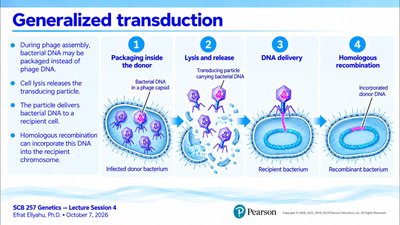
Generalized transduction occurs when bacterial DNA is randomly packaged into a phage during assembly. The phage then delivers this DNA to another bacterium, where it can be incorporated into the chromosome via homologous recombination.
Steps:
Packaging inside the donor: Bacterial DNA is packaged in a phage capsid.
Lysis and release: Transducing particle is released.
DNA delivery: Particle delivers DNA to recipient bacterium.
Homologous recombination: DNA is incorporated into recipient chromosome.
Sex Determination and Sex Chromosomes
Human Chromosomes
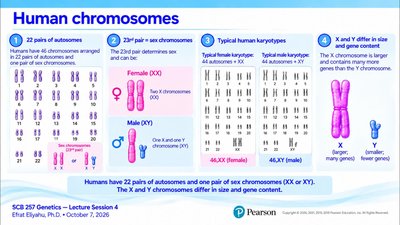
Humans have 22 pairs of autosomes and one pair of sex chromosomes (XX or XY). The X and Y chromosomes differ in size and gene content.
Autosomes: 22 pairs, arranged in decreasing size.
Sex Chromosomes: 1 pair (XX in females, XY in males).
Karyotype: Typical human karyotypes show 46 chromosomes (44 autosomes + 2 sex chromosomes).
X and Y Differences: X chromosome is larger and contains more genes than the Y chromosome.
Chromosome Mutations: Variation in Number and Arrangement
Nondisjunction
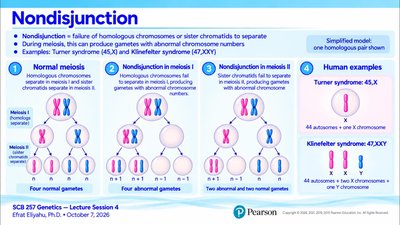
Nondisjunction is the failure of homologous chromosomes or sister chromatids to separate during meiosis, resulting in gametes with abnormal chromosome numbers. This can lead to genetic disorders such as Turner syndrome (45,X) and Klinefelter syndrome (47,XXY).
Normal Meiosis: Produces four normal gametes.
Nondisjunction in Meiosis I: Produces gametes with abnormal chromosome numbers.
Nondisjunction in Meiosis II: Also produces abnormal gametes.
Human Examples:
Turner syndrome: 45,X (one X chromosome, no Y)
Klinefelter syndrome: 47,XXY (extra X chromosome)
Sex Determination and Environmental Influence
Temperature-dependent Sex Determination
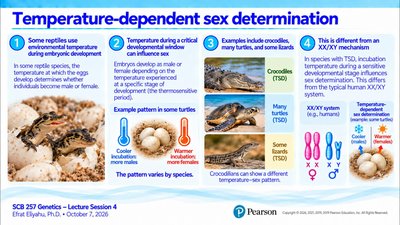
Some reptiles use environmental temperature during embryonic development to determine sex. This mechanism differs from the XX/XY system found in mammals.
Species: Includes crocodiles, turtles, and some lizards.
Critical Developmental Window: Temperature during this period influences sex.
Pattern: Varies by species; warmer incubation can produce males or females depending on the species.
Difference from XX/XY: TSD is not based on chromosomes but on environmental factors.
Apply It: Mechanisms in Genetics
Identifying Genetic Mechanisms
Understanding the mechanism behind genetic phenomena is crucial for interpreting experimental results and genetic mapping.
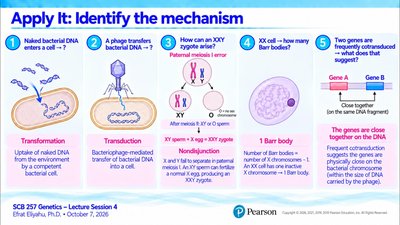
Transformation: Uptake of naked bacterial DNA.
Transduction: Bacteriophage-mediated transfer of DNA.
Nondisjunction: Error in chromosome separation, leading to abnormal karyotypes.
Barr Body: Inactivated X chromosome in female cells.
Gene Mapping: Genes frequently co-transduced are close together on the DNA.
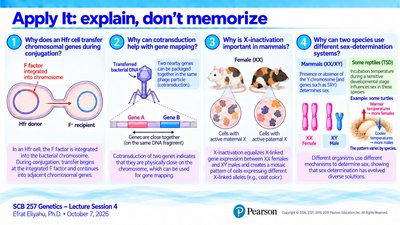
Apply It: Explain, Don't Memorize
Conceptual Understanding in Genetics
Genetic concepts are best understood through explanation rather than memorization. Key questions help clarify mechanisms and their implications.
Hfr Transfer: Hfr cells transfer chromosomal genes during conjugation due to integrated F factor.
Gene Mapping: Cotransduction helps map genes by showing which genes are transferred together.
X-inactivation: In mammals, one X chromosome is inactivated in females, forming a Barr body.
Sex Determination: Different species use different mechanisms, such as XX/XY or temperature-dependent systems.
Review and Summary
Key Questions in Genetics
Reviewing key questions helps reinforce understanding of genetic mechanisms and their applications.
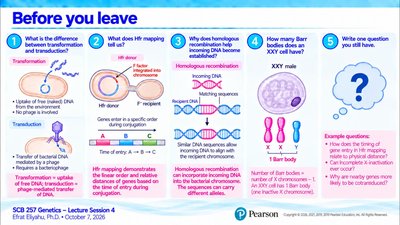
Transformation vs. Transduction: Transformation involves uptake of free DNA; transduction involves phage-mediated transfer.
Hfr Mapping: Demonstrates gene order and distance by transferring genes in a specific sequence.
Homologous Recombination: Incorporates incoming DNA into the chromosome.
Barr Bodies: Number of Barr bodies equals the number of X chromosomes minus one.
Practice: Formulate questions to test understanding.