 Back
BackGenetically Modified Organisms: Plants and Animals – Mechanisms, Applications, and Societal Impacts
Study Guide - Smart Notes
 Tailored notes based on your materials, expanded with key definitions, examples, and context.
Genetically Modified Organisms (GMOs)
Definition and Purposes
Genetically Modified Organisms (GMOs) are organisms whose genomes have been altered by human intervention. These modifications are performed for a variety of purposes:
Production of proteins or drugs: Large quantities of proteins or pharmaceuticals can be produced in bacteria, animals, or plants.
Phenotype modification: Altering the traits of plants or animals for agricultural or research purposes.
Disease treatment: Genetic modifications can be used to treat diseases in humans.
Gene function analysis: Knocking out or modifying genes to study their normal function in cells or organisms.
Reporter constructs: Creating constructs to study gene expression patterns.
Genetically Modified Animals: Case Study of AquaBounty Salmon
Genetic Engineering of Salmon
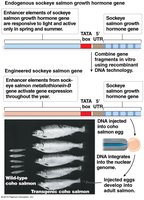
One of the most prominent examples of genetically modified animals is the AquaBounty salmon. The genetic modification involves replacing the normal enhancer elements upstream of the growth hormone gene with enhancers that are activated by low levels of metal, allowing growth hormone production year-round.
Wild type salmon: Growth hormone is produced only in spring and summer.
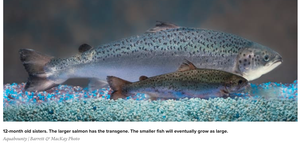
AquaBounty salmon: Growth hormone is produced all year, resulting in 4-6 times faster growth and halving the time to market (1.5 years vs. 3 years).
Regulatory history: Created in 1989, approved for production in Canada (2013) and the US (2016), with ongoing legal and societal debates.
Genetically Modified Plants: Mechanisms and Applications
Agrobacterium tumefaciens and the Ti Plasmid
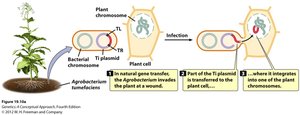
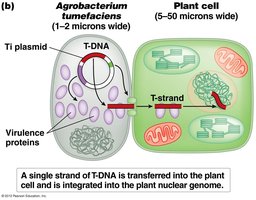
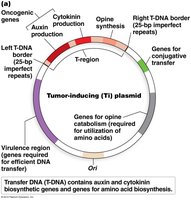
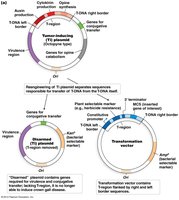
One of the main methods for creating transgenic plants utilizes the Ti (tumor-inducing) plasmid from Agrobacterium tumefaciens, a bacterium that naturally transfers DNA into plant cells, causing crown gall disease.
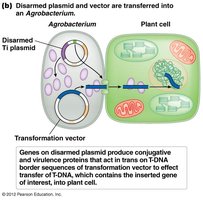
Natural infection: The bacterium attaches to plant cell walls and transfers a segment of the Ti plasmid (T-DNA) into the plant genome, causing uncontrolled cell growth (gall formation).
Disarmed Ti plasmid: Scientists have modified the Ti plasmid to remove tumor-inducing genes, creating a vector for introducing genes of interest into plants.
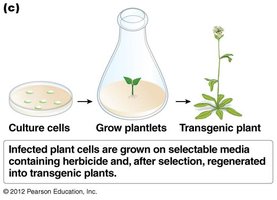
Plant regeneration: Plant cells that receive foreign DNA are grown in tissue culture and can regenerate into whole plants.

Bt-Expressing Plants: Insect Resistance
Bacillus thuringiensis (Bt) is a soil bacterium that produces a protein toxic to insects. The gene encoding Bt protein has been inserted into many crop plants, making them resistant to insect damage.
First use: 1996; now over 90% of soybeans and 80% of corn in the US are Bt-modified.
Advantages: Reduced need for chemical insecticides.
Concerns: Potential harm to non-target insects, development of insect resistance, and societal opposition to GM foods.
Crop | % GM (2015) |
|---|---|
Soybean | 51% |
Corn | 31% |
Cotton | 13% |
Canola | 5% |
About 12% of the world’s usable land is planted with transgenic plants (2015 data).
‘Roundup Ready’ Plants: Herbicide Resistance
‘Roundup Ready’ crops are engineered to resist glyphosate, the active ingredient in the herbicide Roundup. Glyphosate inhibits the ESPS enzyme in the chloroplast, blocking amino acid synthesis and killing plants. A bacterial ESPS enzyme resistant to glyphosate is introduced into crop plants, allowing them to survive herbicide application.
Advantages: Reduced tilling (less soil erosion), potential for reduced herbicide use.
Concerns: Increased herbicide use due to resistant weeds, legal and health controversies, and requirement for farmers to buy new seeds annually.
Golden Rice: Nutritional Enhancement
Genetic Engineering for Nutrient Content
Golden Rice is engineered to address vitamin A and iron deficiencies prevalent in populations relying on rice as a staple food. Six foreign genes were introduced:
Beta-carotene synthesis: Four genes (two from daffodil, two from bacteria) enable rice to produce beta-carotene, a precursor to vitamin A.
Iron bioavailability: One bacterial gene destroys phytate (which binds iron), and a bean protein gene enhances iron absorption.
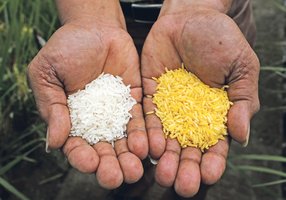
Benefits: Golden Rice produces grains with a yellowish color due to beta-carotene. It is distributed free to subsistence farmers.
Challenges: Large quantities must be consumed to meet vitamin A needs, cultural preference for white rice, and significant opposition in some regions. Approved for use in several countries as of 2021.
Societal and Environmental Considerations
Public Perception and Regulation
There is significant societal opposition to GM crops in Europe, Southeast Asia, and Africa.
Legal battles and regulatory hurdles have shaped the adoption of GMOs, as seen with AquaBounty salmon and Roundup Ready crops.
Concerns include environmental impact, food safety, corporate control of seeds, and ethical considerations.
Summary Table: Major Types of Genetic Modifications in Crops
Modification | Purpose | Example Crop | Main Benefit | Main Concern |
|---|---|---|---|---|
Bt expression | Insect resistance | Corn, Soybean | Reduced insecticide use | Resistance, non-target effects |
Herbicide resistance | Weed control | Soybean, Corn | Efficient weed management | Herbicide overuse, resistant weeds |
Golden Rice | Nutritional enhancement | Rice | Vitamin A, iron supplementation | Acceptance, efficacy, opposition |
Conclusion
Genetically modified plants and animals represent a major advancement in biotechnology, with significant implications for agriculture, nutrition, medicine, and society. While the benefits are substantial, ongoing research, regulation, and public dialogue are essential to address the challenges and concerns associated with GMOs.
