 Back
BackGenetics Exam 1 Study Guide: Step-by-Step Guidance
Study Guide - Smart Notes
 Tailored notes based on your materials, expanded with key definitions, examples, and context.
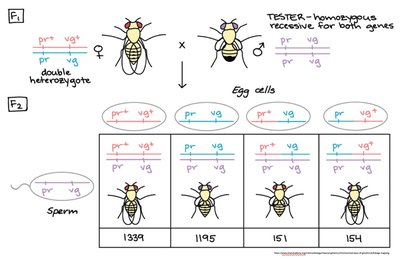
Q13. A fruit fly cross is made as shown below. In this example, are the pr and vg genes linked? Can you show this statistically? If the genes are linked, how far apart are they (in cM units)?
Background
Topic: Linkage and Genetic Mapping
This question tests your understanding of gene linkage, recombination, and how to use offspring counts to calculate genetic distance between two genes. It also requires you to interpret a genetic cross and apply statistical reasoning to determine linkage.
Key Terms and Formulas
Linked genes: Genes located close together on the same chromosome, often inherited together.
Recombinant offspring: Offspring with new combinations of traits not found in either parent, due to crossing over.
Parental offspring: Offspring with trait combinations identical to the parents.
Recombination frequency (RF):
Centimorgan (cM): A unit of genetic distance; 1 cM = 1% recombination frequency.
Step-by-Step Guidance
Examine the cross: A double heterozygote female (pr+ vg+ / pr vg) is crossed with a tester male (pr vg / pr vg), which is homozygous recessive for both genes.
Identify the possible gametes produced by the double heterozygote female. These will include both parental and recombinant types.
Classify the F2 offspring into parental and recombinant categories based on their phenotypes and the counts provided in the diagram.
Calculate the recombination frequency using the formula above. This will help you determine if the genes are linked and estimate the genetic distance between them.
Interpret the recombination frequency: If the frequency is significantly less than 50%, the genes are likely linked. Convert the recombination frequency to centimorgans (cM) to estimate the distance between the genes.
Try solving on your own before revealing the answer!
Final Answer:
The pr and vg genes are linked, as shown by the lower recombination frequency. The genetic distance between them is approximately 17 cM, calculated using the recombination frequency formula.
We classified the offspring, calculated the recombination frequency, and converted it to centimorgans to estimate the distance.
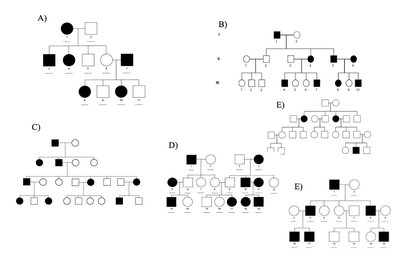
Q14. Identify the probable mode of inheritance in each of the following pedigrees:
Background
Topic: Pedigree Analysis and Modes of Inheritance
This question tests your ability to interpret pedigrees and determine the mode of inheritance (autosomal dominant, autosomal recessive, X-linked, etc.) based on family patterns.
Key Terms and Concepts
Pedigree: A diagram showing the inheritance of traits across generations.
Autosomal dominant: Trait appears in every generation; affected individuals have at least one affected parent.
Autosomal recessive: Trait may skip generations; affected individuals can have unaffected parents.
X-linked: Trait often affects males more than females; can be dominant or recessive.
Step-by-Step Guidance
Examine each pedigree diagram and note the affected and unaffected individuals across generations.
Look for patterns: Does the trait appear in every generation (suggesting dominance), or does it skip generations (suggesting recessiveness)?
Consider the sex of affected individuals: If mostly males are affected, consider X-linked inheritance.
Analyze whether affected individuals have affected parents or can have unaffected parents.
Use these clues to hypothesize the mode of inheritance for each pedigree, but stop before stating the final answer for each.
Try solving on your own before revealing the answer!
Final Answer:
Each pedigree can be classified as autosomal dominant, autosomal recessive, or X-linked based on the patterns observed. For example, pedigree A shows autosomal dominant inheritance, while pedigree B is autosomal recessive.
The key is to look for generational patterns and the sex of affected individuals to determine the mode of inheritance.
