 Back
BackGenetics Exam 2 Review: Transmission Genetics, Cell Division, and Sex Determination
Study Guide - Smart Notes
 Tailored notes based on your materials, expanded with key definitions, examples, and context.
Transmission Genetics and Pedigree Analysis
Autosomal Inheritance and Mendelian Principles
Autosomal inheritance refers to the transmission of genes located on autosomes, which are chromosomes found in both males and females. Mendelian principles, such as the laws of segregation and independent assortment, can be applied to the inheritance of certain traits in humans and other organisms. These principles help predict the transmission of genetic traits across generations.
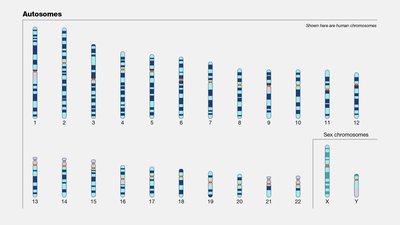
Autosomes: Humans have 22 pairs of autosomes and one pair of sex chromosomes (X and Y).
Law of Segregation: Each individual has two alleles for each gene, which segregate during gamete formation.
Law of Independent Assortment: Genes on different chromosomes assort independently during meiosis.
Pedigree Analysis
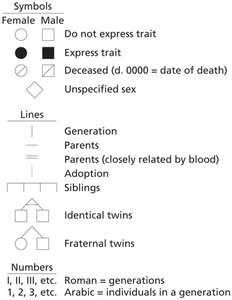
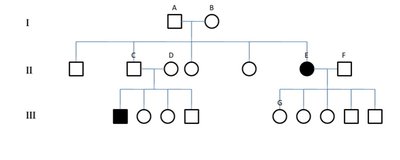
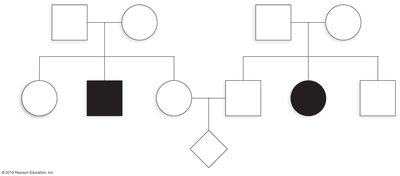
Pedigrees are diagrams that trace the inheritance of traits through generations in families. Standard symbols are used to represent individuals, their relationships, and the presence or absence of specific traits.
Generations: Indicated by Roman numerals (I, II, III, etc.).
Individuals: Indicated by Arabic numerals within each generation.
Symbols: Squares represent males, circles represent females, shaded symbols indicate affected individuals.
Autosomal Dominant Inheritance
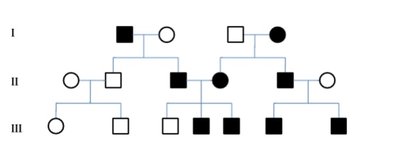
Autosomal dominant traits are expressed when at least one dominant allele is present. These traits have distinct patterns in pedigrees:
Males and females are affected equally.
Every affected individual has at least one affected parent.
Trait can be transmitted by either parent to offspring of either sex.
If neither parent is affected, none of their children will be affected.
If the trait is rare, affected individuals are likely heterozygous; about half the offspring of an affected (heterozygous) and unaffected parent will be affected.
Two affected (heterozygous) parents may have unaffected children.
Autosomal Recessive Inheritance
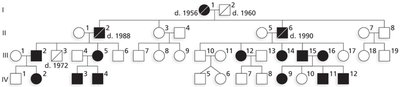
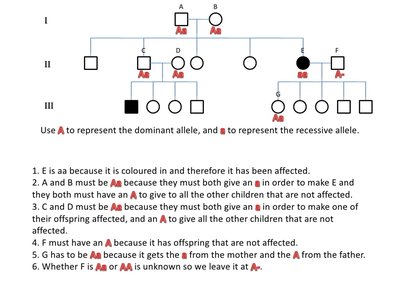
Autosomal recessive traits are expressed only when two recessive alleles are present. Key features include:
Males and females are affected equally.
Affected individuals are often born to unaffected (heterozygous carrier) parents.
If both parents are affected, all children will be affected.
The trait often skips generations and appears among siblings.
Solving Pedigree Problems
To analyze pedigrees and determine inheritance patterns:
Make an initial hypothesis (dominant or recessive) and check for consistency with the pedigree.
Assign genotypes to individuals based on phenotype and inheritance rules.
Check for inconsistencies and revise as needed.
Use all available information (parent and offspring genotypes/phenotypes) to calculate probabilities.
Cell Division: Mitosis and Meiosis
The Cell Cycle
The cell cycle is the sequence of events that cells undergo as they grow and divide. It consists of interphase (cell growth and DNA replication) and M phase (mitosis or meiosis and cytokinesis).
Interphase: G1 (growth), S (DNA synthesis), G2 (preparation for division).
M Phase: Includes mitosis (nuclear division) and cytokinesis (cytoplasmic division).

Mitosis
Mitosis is the process by which somatic cells divide to produce two genetically identical daughter cells. It ensures equal distribution of chromosomes to each daughter cell.
Phases of Mitosis: Prophase, Prometaphase, Metaphase, Anaphase, Telophase.
Centromeres and Kinetochores: Specialized regions where sister chromatids are joined and spindle fibers attach.
Product: Two diploid (2n) cells identical to the parent cell.
Meiosis
Meiosis is the process by which germ-line cells divide to produce gametes (sperm and eggs) with half the chromosome number of the original cell. It introduces genetic variation through recombination and independent assortment.
Two Rounds of Division: Meiosis I (homologous chromosomes separate) and Meiosis II (sister chromatids separate).
Product: Four genetically unique haploid (n) cells.
Genetic Variation: Crossing over during prophase I and independent assortment during metaphase I.
Comparison of Mitosis and Meiosis
Characteristic | Mitosis | Meiosis |
|---|---|---|
Purpose | Growth, maintenance (identical cells) | Gamete production (genetically different cells) |
Location | Somatic cells | Germ-line cells |
Divisions | One | Two |
Product | 2 diploid cells | 4 haploid cells |
Genetic Variation | None | Yes (crossing over, independent assortment) |
Sex Determination
Chromosomal and Genetic Sex Determination
Sex determination is the process by which organisms develop as male or female. It can be controlled by chromosomal, genetic, or environmental factors.
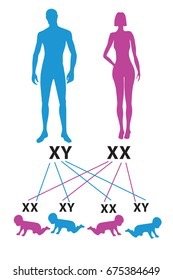
Chromosomal Sex: Determined at fertilization by the combination of sex chromosomes (e.g., XX for female, XY for male in humans).
Phenotypic Sex: Determined by gene expression and hormone production, leading to development of secondary sex characteristics.

Sex Determination in Drosophila and Mammals
Different species use different systems for sex determination:
Drosophila: Females are XX, males are XY, XYY, or XO. XXX and YO are rare or nonviable.
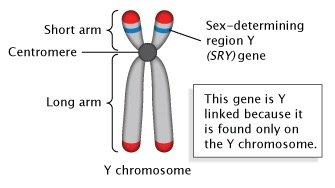
Mammals: Females are XX, males are XY. The presence of the SRY gene on the Y chromosome triggers male development.
The SRY Gene and Mammalian Sex Determination
The SRY (Sex-determining Region Y) gene is a critical factor in mammalian sex determination. It encodes a transcription factor that initiates testis development in embryos with a Y chromosome. In the absence of SRY, the default pathway leads to ovary development.
SRY Expression: Initiates testicular development in undifferentiated gonads.
Absence of SRY: Leads to ovarian development and female phenotype.
Diversity of Sex Determination Systems
Other organisms use different chromosomal systems for sex determination:
ZW System: Used by birds, some reptiles, fish, butterflies, and moths. Females are ZW, males are ZZ.
Platypus: Has five pairs of sex chromosomes (males: five XY pairs, females: five XX pairs).
