 Back
BackGenetics Final Review: Mendelian Inheritance, Chromosome Structure, and Molecular Genetics
Study Guide - Smart Notes
 Tailored notes based on your materials, expanded with key definitions, examples, and context.
Mendelian Inheritance and Laws
Law of Segregation and Law of Independent Assortment
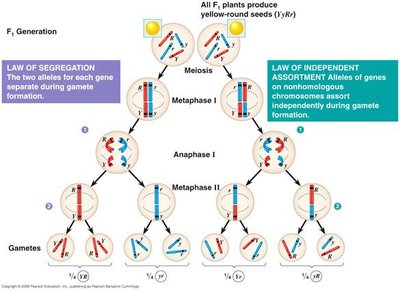
Mendel’s laws form the foundation of classical genetics, describing how traits are inherited from one generation to the next. The Law of Segregation states that each individual possesses two alleles for each gene, which segregate during gamete formation so that each gamete receives only one allele. The Law of Independent Assortment states that alleles of different genes assort independently of one another during gamete formation, leading to genetic variation.
Monohybrid cross: Involves one gene; predicts a 3:1 phenotypic ratio in the F2 generation if one allele is dominant.
Dihybrid cross: Involves two genes; predicts a 9:3:3:1 phenotypic ratio in the F2 generation if genes assort independently.
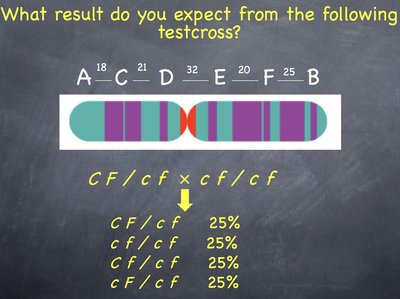
Testcross: Used to determine the genotype of an individual with a dominant phenotype by crossing with a homozygous recessive individual.
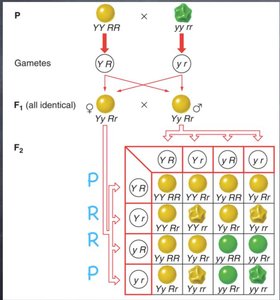
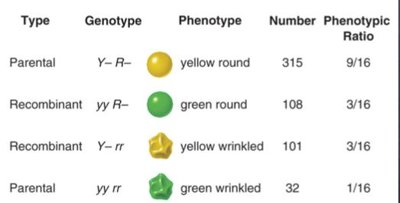
Key Terms: P (parental), F1 (first filial), F2 (second filial), homozygous, heterozygous, dominant, recessive, genotype, phenotype, somatic cell, gamete, fertilization, zygote.
Analyzing Inheritance Patterns
Dominant vs. Recessive Traits in Pedigrees
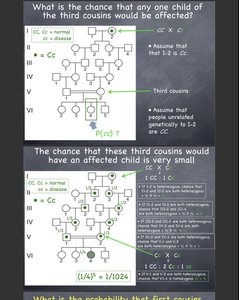
Pedigree analysis helps determine the mode of inheritance for genetic traits. Dominant traits typically appear in every generation (vertical pattern), while recessive traits may skip generations (horizontal pattern).
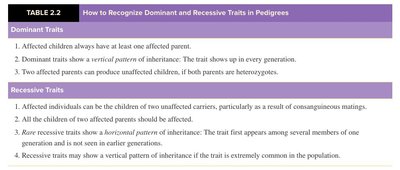
Dominant: Affected children have at least one affected parent; appears in every generation.
Recessive: Affected individuals can be born to unaffected parents; may skip generations.
Molecular Basis of Dominance and Disease
Dominant alleles often produce functional proteins, while recessive alleles may be nonfunctional. Some diseases, such as Huntington’s disease, are caused by dominant alleles due to the production of abnormal proteins that damage cells even in the presence of a normal allele.

Types of Dominance and Allele Interactions
Complete, Incomplete, and Codominance
Allele interactions can vary:
Complete dominance: Heterozygote resembles one parent.
Incomplete dominance: Heterozygote has an intermediate phenotype (e.g., red x white flowers produce pink).
Codominance: Both alleles are expressed in the heterozygote (e.g., AB blood type).
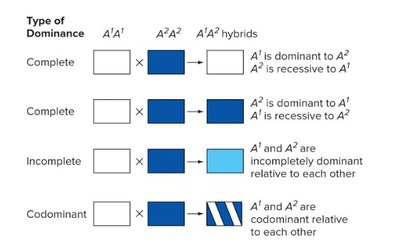
F2 ratios for incomplete and codominance are typically 1:2:1.
Gene Interactions and Epistasis
Epistasis, Redundancy, and Complementation
Gene interactions can modify Mendelian ratios. Epistasis occurs when one gene masks the effect of another. Redundancy means either of two genes can provide the same function. Complementation occurs when two mutations in different genes restore the wild-type phenotype when combined.
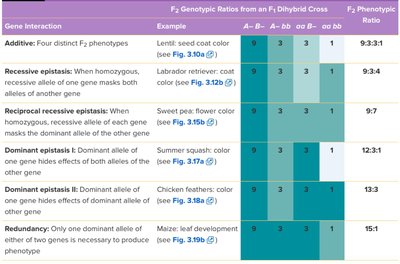
Additive: 9:3:3:1 ratio
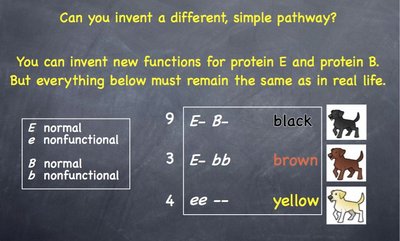
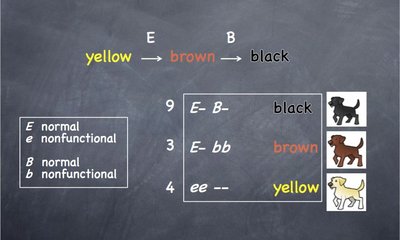
Recessive epistasis: 9:3:4 ratio
Dominant epistasis: 12:3:1 ratio
Redundancy: 15:1 ratio
Chromosome Structure and Behavior
Homologous and Nonhomologous Chromosomes
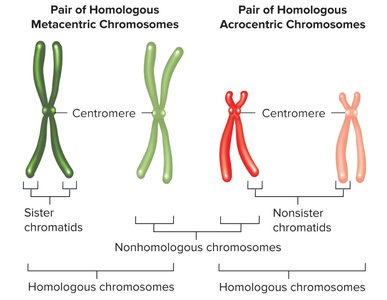
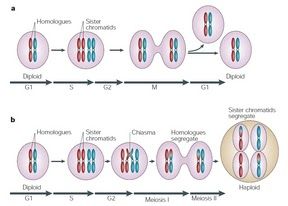
Chromosomes exist as homologous pairs in diploid organisms. Each homolog consists of two sister chromatids after DNA replication. Nonhomologous chromosomes do not pair during meiosis and have different genetic content.
Mitosis vs. Meiosis
Mitosis produces two identical diploid cells, while meiosis produces four nonidentical haploid gametes. Meiosis involves two rounds of division and includes crossing over, which increases genetic diversity.
Chromosome Behavior and Mendel’s Laws
The behavior of chromosomes during meiosis explains Mendel’s laws. Homologous chromosomes segregate during meiosis I (law of segregation), and different chromosome pairs assort independently (law of independent assortment).
Sex Determination and Sex Chromosomes
Sex Chromosome Composition and Sex Reversal
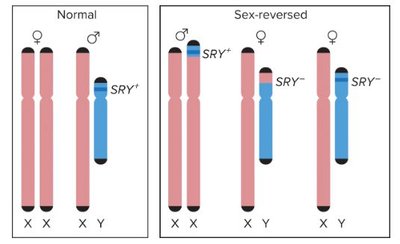
Sex is determined by the presence or absence of specific sex chromosomes (X and Y). The SRY gene on the Y chromosome is critical for male development. Sex reversal can occur if the SRY gene is translocated or deleted.
Genetic Linkage and Mapping
Linkage and Recombination
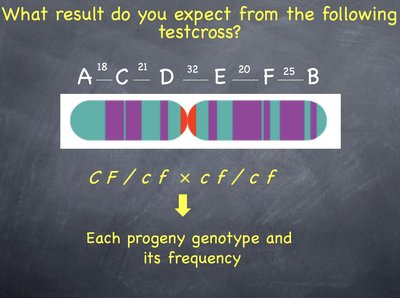
Genes located close together on the same chromosome are linked and tend to be inherited together. Recombination frequency is used to estimate the distance between genes (measured in map units or centimorgans).
Parental gametes: Same allele combinations as parents.
Recombinant gametes: New allele combinations due to crossing over.
Recombination frequency formula:
Molecular Mechanisms: DNA Structure and Replication
DNA Replication
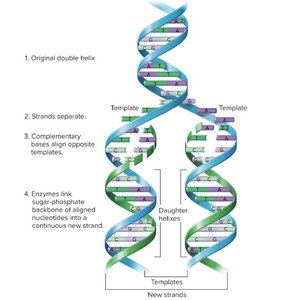
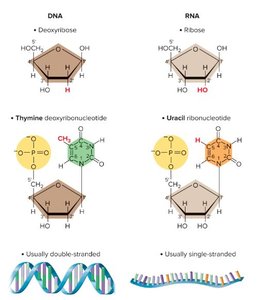
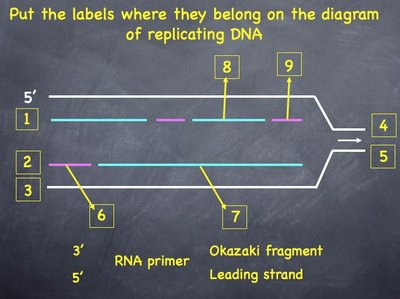
DNA replication is semiconservative, meaning each new DNA molecule consists of one old and one new strand. Key enzymes include helicase, DNA polymerase, and primase. Replication proceeds in the 5’ to 3’ direction, with leading and lagging strands (Okazaki fragments).
Mutation and DNA Repair
Types of Mutations and Detection
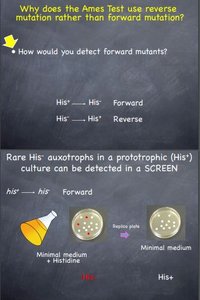
Mutations can be substitutions, deletions, or insertions. The Ames test is used to detect mutagens by measuring the rate of reverse mutations in bacteria.
Gene Function and Complementation
Complementation Testing
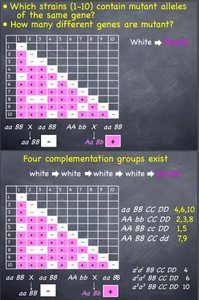
Complementation tests determine whether mutations causing a similar phenotype are in the same or different genes. If two mutants complement, they are in different genes; if not, they are in the same gene.
The Genetic Code and Translation
Deciphering the Genetic Code
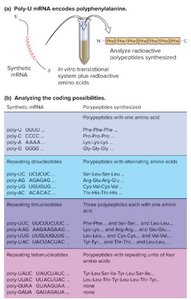
The genetic code is read in triplets (codons), each specifying an amino acid. Synthetic mRNAs were used to determine codon assignments for amino acids.
Summary Table: Key Genetic Ratios and Interactions
Gene Interaction | Example | F2 Phenotypic Ratio |
|---|---|---|
Additive | Lentil seed coat color | 9:3:3:1 |
Recessive epistasis | Labrador retriever coat color | 9:3:4 |
Reciprocal recessive epistasis | Sweet pea flower color | 9:7 |
Dominant epistasis | Summer squash color | 12:3:1 |
Redundancy | Maize leaf development | 15:1 |
Additional info: This guide covers foundational topics in genetics, including Mendelian inheritance, chromosome structure, gene interactions, molecular genetics, and mutation. It is suitable for exam preparation in a college-level genetics course.
