 Back
BackGenetics Study Guide: Foundations, DNA Structure, Replication, and Expression
Study Guide - Smart Notes
 Tailored notes based on your materials, expanded with key definitions, examples, and context.
Introduction to Genetics
Definition and Scope
Genetics is the branch of biology concerned with the study of inherited variation. It specifically examines the origin, transmission, and expression of genetic information within organisms.
Inherited Variation: Refers to differences in genetic traits passed from parents to offspring.
Genetic Information: Includes DNA, genes, chromosomes, and genomes.
Historical Understandings of Genetics
Early theories about inheritance have been disproven by scientific experiments.
Spontaneous Generation: The belief that living organisms arise from nonliving matter. Disproved by Pasteur's experiments, which showed that life comes from existing life (biogenesis).
Blending Theory of Inheritance: The idea that parental traits permanently blend in offspring. Mendel's experiments demonstrated that traits are particulate and genes remain intact across generations.
Relationship Between DNA, Genes, Chromosomes, and Genomes
The genetic material in an organism is organized hierarchically:
Genome: All genetic material in an organism.
Chromosomes: Organized packages of DNA.
DNA: Long double-helix molecule.
Genes: Specific DNA segments with instructions for traits.
Prokaryotes vs. Eukaryotes
Prokaryotes and eukaryotes differ in cellular structure and complexity.
Feature | Prokaryotes | Eukaryotes |
|---|---|---|
Nucleus | No | Yes |
DNA Location | Cytoplasm | Nucleus |
Organelles | None | Many |
Size | Small | Large |
Example | Bacteria | Animal/Plant |
Similarities: Both contain DNA, have a plasma membrane, and use ATP.
Location of DNA in Cells
DNA is found in different organelles depending on cell type:
Animal Cell: Nucleus, chromatin, mitochondria.
Plant Cell: Nucleus, mitochondria, chloroplasts.
Genes, Alleles, and Phenotypes
A single gene can have multiple alleles, resulting in different phenotypes.
Gene: A singular instruction for a trait.
Allele: Different versions of a gene.
Mutation: Main source of genetic variation.
DNA and Chromosome Structure
Nucleotide Structure
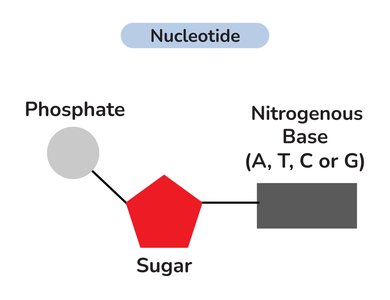
Nucleotides are the building blocks of DNA and RNA, consisting of three components:
Phosphate group
Sugar (deoxyribose in DNA, ribose in RNA)
Nitrogenous base (A, T, C, G in DNA; A, U, C, G in RNA)
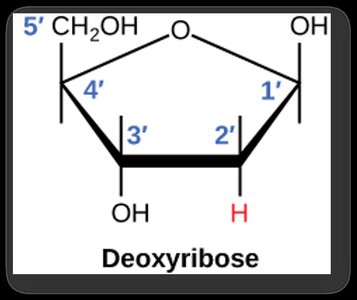
Deoxyribose Sugar Numbering
The carbons in deoxyribose are numbered to indicate the positions of attachments for bases and phosphates.
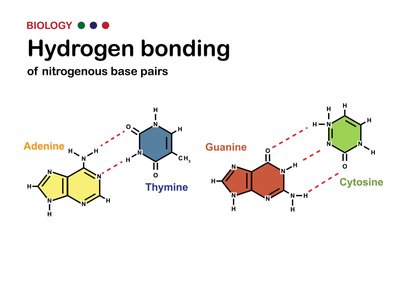
Purines vs. Pyrimidines
Purines: Double-ring structure; examples are adenine (A) and guanine (G).
Pyrimidines: Single-ring structure; examples are cytosine (C), thymine (T), and uracil (U).
Hydrogen Bonding Between Base Pairs
Base pairs are held together by hydrogen bonds:
A-T: 2 hydrogen bonds
G-C: 3 hydrogen bonds
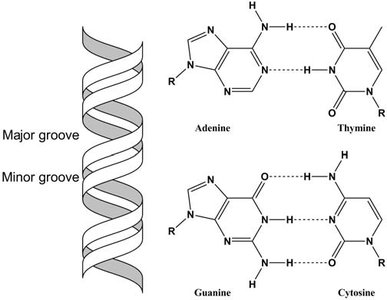
Major and Minor Grooves of DNA
The DNA double helix has major and minor grooves, which are important for protein binding and regulation.
Antiparallel Structure of DNA
DNA strands run in opposite directions (5' to 3' and 3' to 5'), which is essential for replication and base pairing.
Example: DNA double helix is antiparallel.
Complementary DNA Sequences
Each DNA strand has a complementary sequence:
Original: 5’ – A T G C C A – 3’
Complementary: 3’ – T A C G G T – 5’
DNA Replication
Requirements for Genetic Material
Replication: Ability to make exact copies.
Storage: Store information for cell function.
Expression: Direct synthesis of proteins.
Variation: Capable of mutation for diversity.
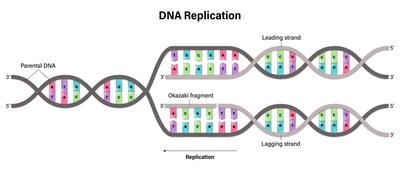
DNA Replication Steps
DNA replication is a multi-step process:
Initiation: DNA unwinds at the origin.
Unwinding: Helicase separates strands.
Priming: Primase synthesizes RNA primers.
Elongation: DNA polymerase adds nucleotides.
Joining: DNA ligase seals gaps.
Termination: Replication ends.
Key Proteins in DNA Replication
Helicase: Unwinds DNA.
Primase: Synthesizes RNA primers.
DNA Polymerase: Adds nucleotides.
DNA Ligase: Joins Okazaki fragments.
SSBs: Stabilize single-stranded DNA.
Topoisomerase: Relieves tension ahead of fork.
Lagging Strand Necessity
DNA polymerase synthesizes DNA only in the 5′→3′ direction, requiring the lagging strand to be copied in short fragments (Okazaki fragments).
Gene Expression: Transcription and Translation
Central Dogma of Molecular Biology
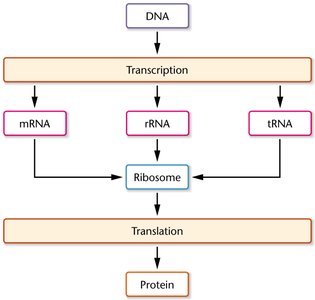
The central dogma describes the flow of genetic information from DNA to RNA to protein.
Transcription: DNA is transcribed into mRNA, rRNA, and tRNA.
Translation: mRNA is translated into protein at the ribosome.
RNA vs. DNA
Sugar: RNA contains ribose; DNA contains deoxyribose.
Bases: RNA uses uracil (U) instead of thymine (T).
Transcription Steps
Initiation: RNA polymerase binds to promoter.
Elongation: RNA polymerase synthesizes RNA.
Termination: RNA polymerase releases RNA.
mRNA Sequence Transcription
DNA template: 3'-TACGGT-5'
mRNA: 5'-AUGCCA-3'
Translation Steps
Initiation: Ribosome assembles at start codon (AUG).
Elongation: tRNAs bring amino acids; ribosome links them.
Termination: Stop codon triggers release of polypeptide.
Genetic Code and Protein Synthesis
Codons: Groups of three mRNA nucleotides.
Start Codon: AUG (methionine).
Stop Codons: UAA, UAG, UGA.
Anticodon: tRNA sequence complementary to mRNA codon.
RNA as the First Genetic Material
Dual Function: Stores information and catalyzes reactions.
Simplicity: Chemically simpler than DNA/proteins.
Self-Replication: Some RNA molecules can replicate themselves.
Experimental Evidence: RNA nucleotides can form under prebiotic conditions.
Molecular Genetic Tools
Polymerase Chain Reaction (PCR)
PCR is used to amplify specific DNA segments.
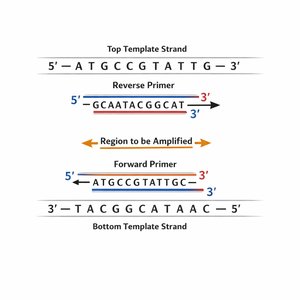
Denaturation: Heat separates DNA strands.
Annealing: Primers bind to DNA.
Extension: DNA polymerase synthesizes new DNA.
Repeated for 20–40 cycles for exponential amplification.
Bacterial Plasmids in Molecular Genetics
Bacterial plasmids are used as vectors for gene cloning, such as producing human insulin in bacteria.
FISH (Fluorescence In Situ Hybridization)
FISH uses fluorescent probes to detect specific DNA sequences on chromosomes, aiding in diagnosis of genetic disorders and cancer.
Applications of DNA Sequencing
Identifying Genetic Disorders: Detects mutations linked to diseases.
Tracing Ancestry: Determines ethnic background and relationships.
Personalized Medicine: Guides treatment based on genetic makeup.
