 Back
Genetics Study Guide: Linkage, Gene Mapping, Bacterial Recombination, DNA/RNA Structure, Replication, Chromosomal Structure, Transcription, and Translation
Study Guide - Smart Notes
 Tailored notes based on your materials, expanded with key definitions, examples, and context.
Chapter 7: Linkage, Recombination, and Gene Mapping
Important Terminology
Chromosome: A DNA molecule with part or all of the genetic material of an organism.
Nonrecombinant (Parental): Offspring with the same combination of alleles as one of the parents.
Recombinant: Offspring with a new combination of alleles, different from either parent, due to crossing over.
Linked Genes: Genes located close together on the same chromosome that tend to be inherited together.
Linkage Group: A group of genes located on the same chromosome.
Incompletely Linked Genes: Genes that are close but not so close as to always be inherited together; crossing over can occur.
Unlinked Genes: Genes located on different chromosomes or far apart on the same chromosome.
Genetic Map: A diagram showing the relative positions of genes on a chromosome.
Map Unit (centimorgan): A unit of measurement for genetic linkage; 1 cM = 1% recombination frequency.
Recombination Frequency: The percentage of recombinant offspring among the total.
Cis (Coupling) vs. Trans (Repulsion): Arrangement of alleles on homologous chromosomes; cis means both dominant alleles are on one chromosome, trans means each chromosome has one dominant and one recessive allele.
3 Point Testcross: A cross involving three genes to determine their order and distances.
Coefficient of Coincidence: Ratio of observed double crossovers to expected double crossovers.
Interference: The degree to which one crossover inhibits another nearby crossover.
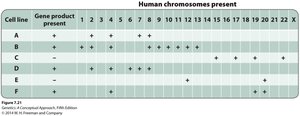
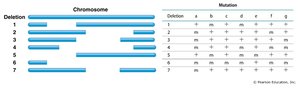
Deletion Mapping: Technique to locate genes by observing which gene products are missing in cells with chromosome deletions.
Linkage and Mendelian Inheritance
Linked genes break the rules of Mendelian inheritance because they do not assort independently. The behavior of linked, incompletely linked, and unlinked genes affects inheritance patterns and recombination frequencies.
Completely Linked Genes: No recombination occurs; only parental types are observed.
Incompletely Linked Genes: Some recombination occurs; both parental and recombinant types are observed.
Unlinked Genes: Assort independently; recombination frequency is 50%.
Genes far apart: High recombination frequency, indistinguishable from genes on different chromosomes.
Crossing Over and Linkage Notation
Crossing over occurs at the chiasma during meiosis, breaking linkage between genes. The arrangement of linked genes (cis or trans) affects the results of genetic crosses.
Notation: AB/ab (cis), Ab/aB (trans).
Testcrosses: Used to determine linkage patterns; parental types are most frequent, recombinants less frequent.
Calculating Genetic Distance
Genetic distance is calculated using recombination frequency:
Formula:
Distance in centimorgans (cM) is equivalent to percent recombination.
Three-Point Testcross Mapping
Three-point testcrosses help determine gene order and distances. Double crossovers (DC) alter only the middle gene. The most common offspring are parental, the least common are double crossovers.
Single crossovers in each region are added to DCs to calculate distances.
Distance between genes is approximately additive.
Rate of crossing over varies across the genome.
Coefficient of Coincidence:
Interference:
Somatic Cell Hybridization and Deletion Mapping
Somatic cell hybridization identifies which chromosome contains a gene of interest. Deletion mapping locates genes physically on chromosomes by observing which gene products are missing in cells with specific deletions.
Somatic Cell Hybridization: Used to determine the chromosome carrying a gene.
Deletion Mapping: Used to pinpoint gene location within a chromosome.
Chapter 8: Bacterial Recombination
Mechanisms of Genetic Exchange in Bacteria
Bacteria exchange genetic information through several mechanisms, which are important for gene mapping and recombinant technology.
Conjugation: Transfer of DNA between bacteria via direct contact, often involving a fertility factor (F plasmid).
Transformation: Uptake of free DNA from the environment by competent cells.
Transduction: Transfer of DNA via bacteriophages.
Vertical vs. Horizontal Gene Transfer: Vertical is parent to offspring; horizontal is between unrelated cells.
Gene Mapping in Bacteria
Conjugation can be used to map gene location by timing the transfer of genes.
Transformation is used in genetic engineering and creation of GMOs.
Bacteriophage life cycles (lytic and lysogenic) contribute to recombination in bacteria.
Chapter 9: RNA/DNA Structure
Key Terminology and Concepts
Nucleotide: Consists of a sugar (ribose or deoxyribose), a phosphate group, and a nitrogenous base.
Deoxyribonuclease/Ribonuclease: Enzymes that degrade DNA/RNA.
Complementary Base Pairing: A-T (2 hydrogen bonds), G-C (3 hydrogen bonds).
Pyrimidines: Cytosine, Thymine, Uracil (single ring).
Purines: Adenine, Guanine (double ring).
Chargaff’s Rules: Amount of A = T, G = C in DNA.
Central Dogma: DNA → RNA → Protein.
Nucleotide Structure and Base Pairing
Each carbon in ribose/deoxyribose has a specific function (e.g., 3’ hydroxyl for chain extension, 5’ phosphate for linkage).
DNA contains deoxyribose; RNA contains ribose.
DNA bases: A, T, G, C; RNA bases: A, U, G, C.
Hydrogen bonds: A-T (2), G-C (3); more G-C pairs make DNA harder to separate.
RNA vs. DNA
RNA is single-stranded, contains uracil, and is more reactive.
Major types of RNA: mRNA (messenger), rRNA (ribosomal), tRNA (transfer).
Hairpin structures form in RNA due to complementary base pairing within the strand.
Chapter 10: DNA Replication
Replication Mechanisms and Key Enzymes
Theta Replication: Occurs in circular DNA (bacteria).
Rolling-Circle Replication: Used by some viruses and plasmids.
Linear Eukaryotic Replication: Multiple origins, bidirectional.
Semi-conservative Replication: Each new DNA molecule contains one old and one new strand.
Replication Fork: Site where DNA is unwound.
Leading Strand: Synthesized continuously.
Lagging Strand: Synthesized discontinuously in Okazaki fragments.
Key Enzymes: DNA helicase, primase, DNA polymerase III, DNA polymerase I, DNA ligase, topoisomerase, telomerase.
Replication Process and End-Replication Problem
Phosphodiester linkage connects 5’ phosphate to 3’ hydroxyl.
Okazaki fragments are created on the lagging strand.
Primase is required to lay down RNA primers.
Gyrase (topoisomerase) relieves supercoiling; absence impedes replication.
End-replication problem: Linear DNA cannot fully replicate ends; telomerase extends telomeres in germline/stem cells.
Chapter 11: Chromosomal Structure
Chromatin and Chromosome Organization
Chromatin: DNA-protein complex; can be euchromatin (active) or heterochromatin (inactive).
Epigenetic Changes: Modifications (acetylation, methylation) alter chromatin structure and gene expression.
Supercoiling: Most DNA is negatively supercoiled, aiding strand separation.
Histones: Positively charged proteins around which DNA winds; acetylation reduces positive charge, loosening DNA.
Polytene Chromosomes: Giant chromosomes in Drosophila larvae, formed by repeated replication without cell division.
Chapter 12: Transcription and RNA Processing
Transcription and RNA Types
rRNA: Forms ribosomes.
tRNA: Transfers amino acids during translation.
mRNA: Carries genetic information from DNA to ribosome.
Transcription Process
RNA transcript is made 5’ to 3’; RNA polymerase moves 3’ to 5’ along template.
Promoter, enhancer, silencer regulate transcription rates.
Bacterial transcription involves core RNA polymerase and sigma factor.
RNA polymerase does not require a primer.
RNA Processing
5’ cap, poly(A) tail, RNA splicing, and RNA editing are required for mature mRNA.
Alternative splicing allows production of multiple proteins from one gene.
Chapter 13: Translation and Protein Building
Genetic Code and Translation
Wobble Hypothesis: Flexibility in base pairing at the third codon position.
Genetic Code: Degenerate (multiple codons for one amino acid), unambiguous (each codon specifies one amino acid).
Reading frame is set by start codon; translation proceeds to stop codon.
Codon-anticodon relationship: tRNA anticodon pairs with mRNA codon.
5’ cap and 3’ poly(A) tail aid translation.
Application
Use amino acid tables to determine codon-amino acid relationships.
Predict effects of mutations on protein sequence.
Apply wobble rules to codon-anticodon pairing.
