 Back
BackGenomics and Molecular Genetics Study Guide: Step-by-Step Guidance
Study Guide - Smart Notes
 Tailored notes based on your materials, expanded with key definitions, examples, and context.
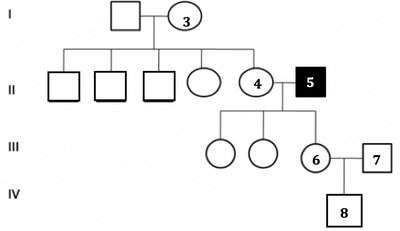
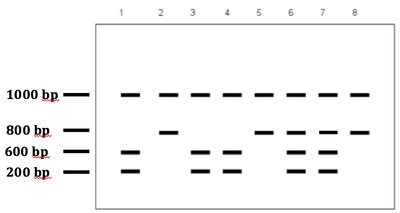
Q1. The enzyme lactase breaks down lactose into glucose and galactose. A polymorphism that converts a valine to a methionine in the lactase gene results in a congenital form of lactose intolerance. The restriction enzyme BglII recognizes the sequence 5’-AGATCT-3’. The mutation removes one BglII site. Wild-type lactase gene has two BglII sites; lactose-intolerant individuals have one. You isolate DNA from a baby and family members, amplify the lactase gene, digest with BglII, and run the samples on an agarose gel. Lane 1: negative control (wild-type), Lane 2: positive control (lactose intolerant), Lanes 3-8: family members (baby is individual 8). a. Underline the BglII site(s) in the wild-type DNA sequence.
Background
Topic: Restriction Enzyme Mapping and Polymorphism Detection
This question tests your understanding of restriction enzyme recognition sites, DNA sequence analysis, and how mutations can alter restriction sites, leading to different fragment patterns in gel electrophoresis.
Key Terms and Formulas:
Restriction enzyme: Protein that cuts DNA at specific sequences.
BglII site: Recognizes 5’-AGATCT-3’.
Polymorphism: Variation in DNA sequence that can affect restriction sites.
Step-by-Step Guidance
Examine the provided DNA sequence and look for the exact sequence 5’-AGATCT-3’ on both strands.
Remember that restriction sites are palindromic, so check both the top and bottom strands for the BglII site.
Underline or mark each occurrence of the BglII site in the wild-type sequence.
Compare the wild-type sequence to the mutant sequence to see which BglII site is lost due to the polymorphism.
Try solving on your own before revealing the answer!
Q1b. Is this form of lactose intolerance dominant or recessive? Explain your answer using the pedigree and genomic analysis results.
Background
Topic: Inheritance Patterns and Pedigree Analysis
This question tests your ability to interpret pedigrees and molecular data to determine the mode of inheritance for a genetic disorder.
Key Terms:
Dominant: Only one copy of the mutant allele needed for phenotype.
Recessive: Two copies of the mutant allele needed for phenotype.
Pedigree: Diagram showing inheritance patterns in families.
Step-by-Step Guidance
Examine the pedigree for affected and unaffected individuals. Note which family members have the disease and their relationship to each other.
Look at the gel electrophoresis results for each individual and correlate the banding pattern with their phenotype (affected or unaffected).
Determine if affected individuals have one or two mutant alleles based on the restriction site pattern.
Assess whether the disease appears in every generation (suggesting dominance) or skips generations (suggesting recessiveness).
Try solving on your own before revealing the answer!
Q1c. Is the baby lactose intolerant? If so, color in the appropriate position on the pedigree.
Background
Topic: Molecular Diagnosis Using Gel Electrophoresis
This question tests your ability to interpret gel electrophoresis results to diagnose a genetic disorder in a specific individual.
Key Terms:
Gel electrophoresis: Technique to separate DNA fragments by size.
Ethidium bromide: Stain used to visualize DNA bands.
PCR: Polymerase chain reaction, amplifies DNA.
Step-by-Step Guidance
Identify the lane corresponding to the baby (individual 8) on the gel.
Compare the banding pattern in lane 8 to the positive and negative controls (lanes 1 and 2).
Determine if the baby has the same pattern as the lactose-intolerant individual (one BglII site) or the wild-type (two BglII sites).
If the baby is lactose intolerant, mark the corresponding position on the pedigree.
Try solving on your own before revealing the answer!
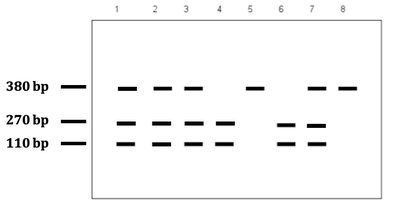
Q2a. In mouse Hind III restriction digests, a RFLP has two alleles: one creates 270 and 110 bp bands, one gives a 380 bp band. The bent tail allele does not have the HindIII site. How many bands will an individual with a bent tail have? What size(s) will the band(s) be?
Background
Topic: RFLP Analysis and Allele Identification
This question tests your understanding of restriction fragment length polymorphism (RFLP) and how restriction sites affect band patterns in gel electrophoresis.
Key Terms and Formulas:
RFLP: Variation in DNA fragment sizes due to presence/absence of restriction sites.
HindIII site: Restriction site recognized by HindIII enzyme.
Step-by-Step Guidance
Recall that the bent tail allele lacks the HindIII site, so the DNA is not cut.
Determine the expected band pattern for an uncut allele (single band at 380 bp).
Compare this to the normal allele, which is cut into two bands (270 bp and 110 bp).
Count the number of bands and note their sizes for the bent tail allele.
Try solving on your own before revealing the answer!
Q2b. Write the genotypes of each individual based on their RFLP analysis. Use T for normal allele and t for bent tail allele.
Background
Topic: Genotype Assignment from Gel Patterns
This question tests your ability to assign genotypes based on band patterns from RFLP analysis.
Key Terms:
Genotype: Genetic constitution of an individual (e.g., TT, Tt, tt).
Allele: Variant form of a gene.
Step-by-Step Guidance
For each lane, observe the band pattern: two bands (270 bp and 110 bp) indicate the normal allele; one band (380 bp) indicates the bent tail allele.
Individuals with both patterns (three bands) are heterozygous (Tt).
Assign the genotype for each individual based on their band pattern.
Fill in the table with the genotypes for lanes 1–8.
Try solving on your own before revealing the answer!
Q2c. Which individual(s) will have the bent tail phenotype?
Background
Topic: Phenotype Prediction from Genotype
This question tests your ability to connect genotype (tt) to phenotype (bent tail) using RFLP analysis.
Key Terms:
Phenotype: Observable trait (bent tail).
Homozygous recessive: Two copies of the mutant allele (tt).
Step-by-Step Guidance
Identify individuals with only the 380 bp band (no 270 or 110 bp bands).
These individuals are homozygous for the bent tail allele (tt).
List the lane numbers corresponding to the bent tail phenotype.
Try solving on your own before revealing the answer!
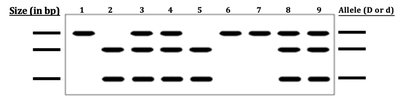
Q3d. Individuals from which lane(s) of the gel would be affected by the disorder? (Identify each individual by the number above each lane on the gel)
Background
Topic: Autosomal Recessive Disease and RFLP Analysis
This question tests your ability to identify affected individuals based on gel band patterns and inheritance of recessive alleles.
Key Terms:
Autosomal recessive: Disease only appears in individuals with two copies of the mutant allele.
RFLP band: 1,000 bp fragment corresponds to disease allele (d).
Step-by-Step Guidance
Look for lanes with only the 1,000 bp band (no 700 or 300 bp bands).
These lanes represent individuals homozygous for the disease allele (dd).
Identify the lane numbers and match them to the individual numbers above the gel.
Try solving on your own before revealing the answer!
Q3e. If individual 5 mates with individual 8, what are the genotypes, phenotypes, and phenotypic proportions of their children?
Background
Topic: Mendelian Genetics and Punnett Squares
This question tests your ability to predict offspring genotypes and phenotypes based on parental genotypes.
Key Terms and Formulas:
Punnett square: Tool for predicting genetic crosses.
Genotype: DD, Dd, or dd.
Phenotype: Affected or unaffected.
Step-by-Step Guidance
Determine the genotype of individual 5 and individual 8 based on their gel band patterns.
Set up a Punnett square using the parental genotypes.
Calculate the possible genotypes and phenotypes of their children.
Determine the expected proportions for each phenotype.
Try solving on your own before revealing the answer!
Q3f. If you have no new deletions and/or mutations, can you have an individual that has only the 700 bp fragment on the gel (with the same primers)? Why or why not?
Background
Topic: RFLP Band Interpretation and Allele Analysis
This question tests your understanding of how restriction sites and alleles affect band patterns in gel electrophoresis.
Key Terms:
Restriction site: Location where enzyme cuts DNA.
Allele: D (normal, 700 bp and 300 bp bands), d (disease, 1,000 bp band).
Step-by-Step Guidance
Recall that the normal allele produces two bands (700 bp and 300 bp) after digestion.
Consider whether it is possible to have only the 700 bp band without the 300 bp band, given the restriction site locations and absence of new mutations.
Explain your reasoning based on the expected digestion pattern.
Try solving on your own before revealing the answer!
Q4a. What are the band size(s) corresponding to the B form of the PRL gene?
Background
Topic: PCR and Restriction Mapping of Gene Variants
This question tests your ability to interpret restriction maps and predict band sizes for different gene variants.
Key Terms:
PRL gene: Prolactin gene, important for milk production.
HaeIII site: Restriction site used to distinguish A and B forms.
Step-by-Step Guidance
Examine the restriction map for the B form of the PRL gene.
Identify the expected PCR product size for the B form (uncut by HaeIII).
Note the band size(s) that would appear on the gel for the B form.
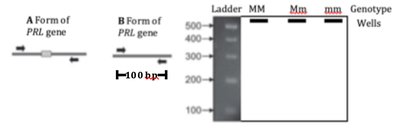
Try solving on your own before revealing the answer!
Q4b. The A form is completely dominant over the B form. Using M for the A form and m for the B form, write out the genotypes of the cows below the gel.
Background
Topic: Dominance and Genotype Assignment from Gel Patterns
This question tests your ability to assign genotypes based on band patterns and dominance relationships.
Key Terms:
Dominant allele: M (A form, high milk yield).
Recessive allele: m (B form, low milk yield).
Step-by-Step Guidance
For each cow, observe the band pattern: two bands (400 bp and 300 bp) indicate A form; one band (700 bp) indicates B form.
Individuals with all three bands are heterozygous (Mm).
Assign the genotype for each cow based on their band pattern.
Write the genotype below each lane on the gel.
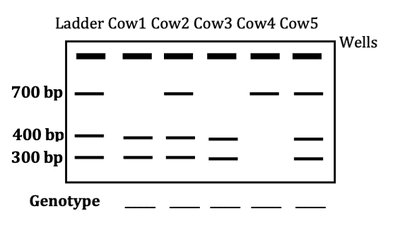
Try solving on your own before revealing the answer!
Q4c. Which cow(s) would have the greatest milk production?
Background
Topic: Phenotype Prediction from Genotype
This question tests your ability to connect genotype (MM or Mm) to phenotype (high milk yield).
Key Terms:
Milk yield: Trait determined by PRL gene variant.
Dominant phenotype: MM or Mm cows have high milk yield.
Step-by-Step Guidance
Identify cows with MM or Mm genotypes based on gel band patterns.
These cows will have the greatest milk production.
List the cow numbers corresponding to the highest milk yield.
Try solving on your own before revealing the answer!
Q4d. Which cows would you recommend to use for breeding in the future and why?
Background
Topic: Selective Breeding and Genotype Selection
This question tests your ability to use genetic information to make breeding recommendations for desired traits.
Key Terms:
Selective breeding: Choosing individuals with desirable genotypes.
Dominant allele: M (A form, high milk yield).
Step-by-Step Guidance
Identify cows with MM or Mm genotypes (high milk yield).
Recommend breeding cows with MM genotype for maximum milk production.
Explain the genetic reasoning for your recommendation.
Try solving on your own before revealing the answer!
Q4e. The A form has a 200 bp insertion. Draw the PCR products on the gel for each genotype marked on the wells.
Background
Topic: PCR Product Size Analysis
This question tests your ability to predict PCR product sizes based on insertions and gene variants.
Key Terms:
PCR product: DNA fragment amplified by PCR.
Insertion: Extra DNA sequence increases product size.
Step-by-Step Guidance
Determine the expected PCR product size for each genotype (MM, Mm, mm) based on the presence or absence of the 200 bp insertion.
Draw the bands on the gel for each genotype, using the ladder as a reference.
Label the bands according to the genotype in each well.
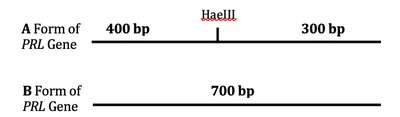
Try solving on your own before revealing the answer!
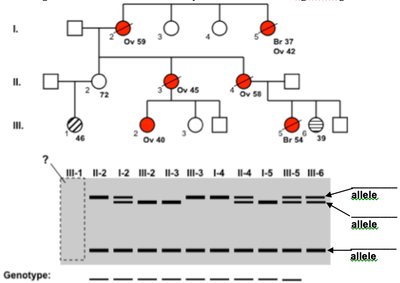
Q5a. On the lines to the right of the gel, write down the allele(s) that each band corresponds to (BRCA-1 gene RFLP analysis).
Background
Topic: RFLP Analysis of BRCA-1 Gene
This question tests your ability to interpret gel band patterns and assign alleles based on fragment sizes.
Key Terms:
BRCA-1 gene: Associated with breast and ovarian cancer risk.
RFLP: Fragment sizes indicate normal or mutant alleles.
Step-by-Step Guidance
Examine the gel and note the fragment sizes for each individual.
Match each band size to the corresponding allele (B or b) based on the restriction map.
Write the allele assignment next to each band.
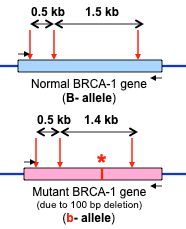
Try solving on your own before revealing the answer!
Q7. During gel electrophoresis, the DNA is:
Background
Topic: Gel Electrophoresis Principles
This question tests your understanding of the purpose and process of gel electrophoresis in molecular genetics.
Key Terms:
Gel electrophoresis: Technique to separate DNA fragments by size.
Fragment size: Determines migration distance in gel.
Step-by-Step Guidance
Recall the steps of gel electrophoresis: DNA is loaded into wells, an electric current is applied, and fragments migrate based on size.
Identify the main purpose of gel electrophoresis in DNA analysis.
Choose the correct answer from the options provided.
Try solving on your own before revealing the answer!
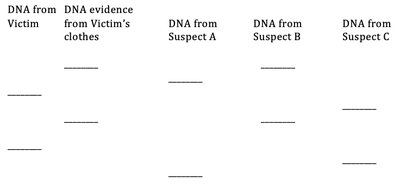
Q8. Use this DNA RFLP pattern of evidence from a crime investigation to answer: The evidence suggests which suspect committed the crime?
Background
Topic: DNA Fingerprinting and Forensic Genetics
This question tests your ability to interpret DNA RFLP patterns to match evidence to suspects.
Key Terms:
RFLP: Restriction fragment length polymorphism, used for DNA fingerprinting.
DNA evidence: Comparison of band patterns between evidence and suspects.
Step-by-Step Guidance
Compare the band pattern from the evidence (victim's clothes) to the band patterns from each suspect.
Look for an exact match in the banding pattern between evidence and a suspect.
Determine which suspect(s) could have committed the crime based on the match.
Try solving on your own before revealing the answer!
