Back
BackGenomics, Bioinformatics, and Proteomics: A Comprehensive Study Guide
Study Guide - Smart Notes
 Tailored notes based on your materials, expanded with key definitions, examples, and context.
Genomics, Bioinformatics, and Proteomics
Introduction to Key Terms
This chapter explores the rapidly advancing fields of genomics, bioinformatics, transcriptomics, proteomics, and synthetic biology. These disciplines collectively enable the comprehensive analysis of genomes, gene expression, and protein function, providing insights into biological complexity and human health.
Bioinformatics: The application of computer-based tools to organize, share, and analyze biological data, especially related to gene and protein structure and function.
Genomics: The study of entire genomes, including their structure, function, evolution, and mapping.
Transcriptomics: The global analysis of mRNA expression levels in a cell population, revealing patterns of gene expression.
Proteomics: The study of the complete set of proteins (proteome) expressed by a genome, cell, tissue, or organism at a given time.
Synthetic Biology: The design and construction of new biological parts, devices, and systems, or the redesign of existing biological systems for useful purposes.
Whole-Genome Sequencing (WGS)
Shotgun Sequencing and Genome Assembly
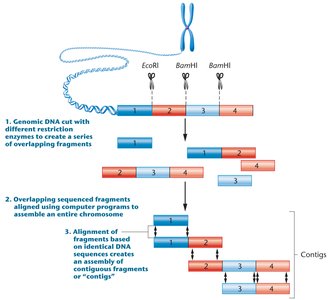
Whole-genome sequencing (WGS) involves determining the complete DNA sequence of an organism's genome. Shotgun sequencing is a common approach where the genome is randomly fragmented, sequenced, and then computationally assembled.
Shotgun Sequencing: DNA is cut into random fragments, sequenced, and overlapping sequences are aligned to reconstruct the entire genome.
Contigs: Overlapping DNA sequences that together represent a consensus region of DNA.
Genomics: Structural and Functional Analysis
Structural Genomics
Structural genomics focuses on sequencing and analyzing nucleotide sequences to identify genes and regulatory elements. Databases like GenBank and tools such as BLAST are essential for sequence comparison and annotation.
Open Reading Frames (ORFs): Stretches of nucleotides that can potentially encode proteins, identified by the presence of start and stop codons.
Gene Density: Refers to regions of the genome that are gene-rich or gene-poor.
Annotation: The process of identifying coding and non-coding regions, regulatory elements, and functional motifs within a genome sequence.
Functional Genomics
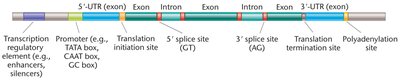
Functional genomics investigates gene functions, regulatory elements, and gene expression patterns. It often involves comparing ORFs with known genes to predict function based on conserved motifs and domains.
Gene Function Prediction: Comparison with known genes and identification of functional domains help predict gene function.
Gene Expression Regulation: Analysis of regulatory elements such as promoters, enhancers, and silencers.
Major Features of the Human Genome
Summary of Human Genome Characteristics
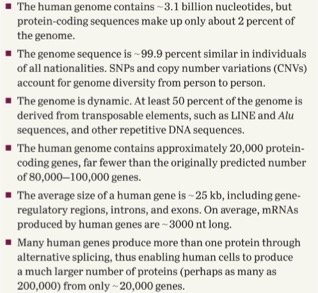
The human genome is complex and dynamic, with several notable features regarding its size, gene content, and organization.
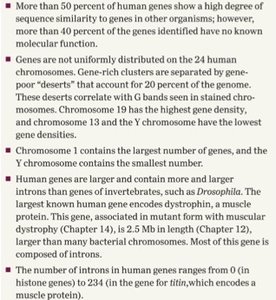
Feature | Description |
|---|---|
Genome Size | ~3.1 billion nucleotides |
Protein-coding DNA | ~2% of the genome |
Genetic Variation | 99.9% identical among humans; variation due to SNPs and CNVs |
Gene Number | ~20,000 protein-coding genes |
Gene Density | Varies across chromosomes; gene-rich and gene-poor regions |
Introns | Human genes have more and larger introns than invertebrates |
Alternative Splicing | Enables production of multiple proteins from a single gene |
Genetic Variation and Functional Categories
SNPs and CNVs
Genetic differences among individuals are primarily due to single-nucleotide polymorphisms (SNPs) and copy number variations (CNVs). These variations contribute to phenotypic diversity and disease susceptibility.
SNPs: Single base-pair changes in the DNA sequence.
CNVs: Segments of DNA that are duplicated or deleted, affecting gene dosage.
Pharmacogenomics and Nutrigenomics
Personalized Medicine
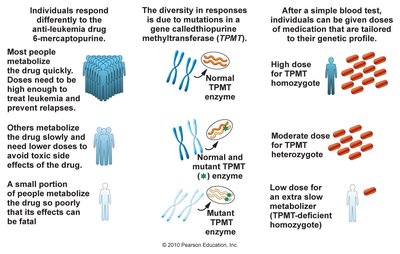
Pharmacogenomics studies how genetic variation affects individual responses to drugs, enabling personalized medicine. Nutrigenomics examines the interaction between nutrition and the genome.
Pharmacogenomics: Tailors drug therapy based on genetic makeup to maximize efficacy and minimize adverse effects.
Nutrigenomics: Investigates how diet interacts with genes to influence health.
Beyond the Human Genome
Large-Scale Genomic Projects
Several projects extend beyond sequencing the human genome, focusing on functional elements, epigenetics, ancient DNA, and comparative genomics.
ENCODE Project: Identifies and analyzes functional elements that regulate gene expression.
Whole-Exome Sequencing: Focuses on sequencing the protein-coding regions (exomes) of the genome.
Human Epigenome Project: Studies epigenetic modifications across different cell types and tissues.
Genome 10K Plan: Aims to sequence 10,000 vertebrate genomes for evolutionary studies.
Comparative Genomics
Genome Comparison Across Species
Comparative genomics compares the genomes of different organisms to understand evolutionary relationships, gene function, and genome organization.
Model Organisms: Dogs, chimpanzees, and other species are compared to humans to study genetic diseases and evolutionary divergence.
Gene Conservation: Humans and chimpanzees share over 96% of their genes; gene duplications and reductions play roles in evolution.

Metagenomics
Analysis of Environmental Genomes
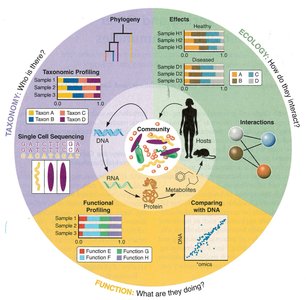
Metagenomics involves sequencing DNA from environmental samples without culturing organisms, revealing the diversity and function of microbial communities.
Human Microbiome Project: Aims to sequence the genomes of all microbes associated with the human body to understand their role in health and disease.
Applications: Used in ecology, medicine, and biotechnology to study complex microbial ecosystems.
Transcriptomics
Global Gene Expression Analysis
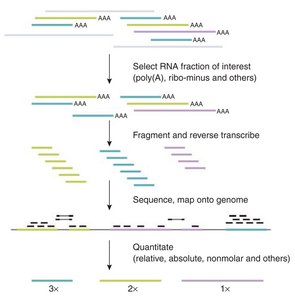
Transcriptomics analyzes the complete set of RNA transcripts produced by the genome under specific circumstances, providing insights into gene regulation and cellular function.
Microarrays: Allow simultaneous measurement of expression levels for thousands of genes.
RNA Sequencing (RNA-seq): Provides quantitative and qualitative analysis of all RNAs expressed in a cell or tissue.
Proteomics
Study of the Proteome
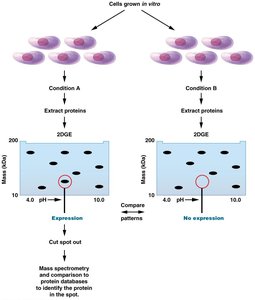
Proteomics is the large-scale study of proteins, including their structures, functions, and interactions. It provides a direct measure of cellular function and complements genomic and transcriptomic data.
Proteome: The entire set of proteins expressed by a genome, cell, tissue, or organism.
Techniques: Mass spectrometry and two-dimensional gel electrophoresis are commonly used for protein identification and quantification.
Synthetic Genomes and Synthetic Biology
Design and Construction of Artificial Genomes
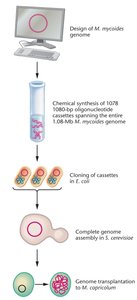
Synthetic biology enables the creation of artificial genomes and the engineering of organisms with novel functions. The minimal genome project seeks to determine the smallest set of genes required for life.
Minimal Genome: In 2016, researchers synthesized a bacterial genome with only 473 genes, the minimal number required for life in that organism.
Applications: Synthetic genomes can be used in biotechnology, medicine, and research to create organisms with desired traits.