 Back
BackHardy-Weinberg Equilibrium: Principles, Calculations, and Applications
Study Guide - Smart Notes
 Tailored notes based on your materials, expanded with key definitions, examples, and context.
Hardy-Weinberg Equilibrium
Introduction to Hardy-Weinberg Principle
The Hardy-Weinberg equilibrium is a foundational concept in population genetics, describing the genetic structure of a population that is not evolving. It predicts that allele and genotype frequencies will remain constant from generation to generation in the absence of evolutionary forces. This principle provides a mathematical baseline for detecting evolutionary change.
Key Equations:
Allele frequencies:
Genotype frequencies:
Assumptions: Random mating, no mutation, no migration, infinite population size, and no selection.
Implication: Dominant alleles do not automatically increase in frequency; genetic variation can be maintained over time.

Consequences of Hardy-Weinberg Law
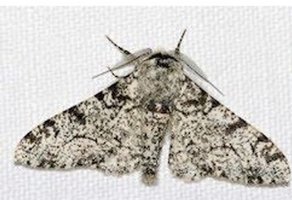
The Hardy-Weinberg law demonstrates that genetic variation can persist in a population, even for alleles that do not confer a selective advantage or disadvantage. For example, in a population of Biston betularia (peppered moths), if there are no predators, both dark and light morphs can be maintained without selection pressure.
Genetic variability is preserved in the absence of evolutionary forces.
Genotype frequencies can be predicted from allele frequencies and vice versa.


Calculating Allele and Genotype Frequencies
Allele Frequency vs. Genotype Frequency
Allele frequency refers to the proportion of a specific allele among all alleles for a gene in a population, while genotype frequency refers to the proportion of a specific genotype among all individuals.
Example: In a population with genotypes AA (5), Aa (4), and aa (1):
Total alleles = 20 (since each individual has 2 alleles)
A alleles = 14, a alleles = 6
Gene Counting Method
The gene counting method is used to calculate allele frequencies from observed genotype numbers. This method is applicable regardless of whether the population is in Hardy-Weinberg equilibrium.
Formula: Frequency of allele = freq(homozygous) + ½ freq(heterozygous)
Example Calculation:
Frequency of allele a (q):
Frequency of allele A (p):
Check:
Square Root Method
The square root method can be used to estimate allele frequencies if the population is in Hardy-Weinberg equilibrium. This method is especially useful when only the frequency of a recessive phenotype is known.
Formulas:
If is known (frequency of homozygous recessive):
Then
Heterozygote frequency:
Testing for Hardy-Weinberg Equilibrium
Steps to Test for Equilibrium
To determine if a population is in Hardy-Weinberg equilibrium, follow these steps:
Determine observed genotype frequencies: Count each genotype and divide by total population size.
Calculate observed allele frequencies: Use the gene-counting method.
Calculate expected genotype frequencies: Use , , and .
Compare observed and expected frequencies: If they are similar, the population is likely in equilibrium; if not, one or more assumptions are violated.
Example: Hardy-Weinberg Equilibrium in Natural Populations
Consider a population of 200 lizards with two alleles (A and a) for a gene controlling scale color. By calculating observed and expected genotype frequencies, one can assess whether the population is in equilibrium. Similar steps apply to other organisms, such as beetles or flies, using their genotype data.
Applications and Limitations of Hardy-Weinberg Equilibrium
Medical Genetics Example: Phenylketonuria (PKU)
PKU is a recessive genetic disorder. If 1 in 4000 individuals is affected and the population is in Hardy-Weinberg equilibrium, the carrier frequency (heterozygotes) can be estimated using the square root method.
Calculation: If , then , , and carrier frequency .
Hardy-Weinberg in Human Populations: HIV-1 Resistance and CCR5
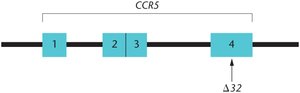
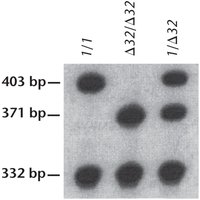
The Hardy-Weinberg principle can be applied to study allele frequencies related to disease resistance, such as the CCR5-Δ32 allele, which confers resistance to HIV-1 infection. Genotype frequencies can be determined by direct DNA analysis, and allele frequencies are calculated using genotype counting.
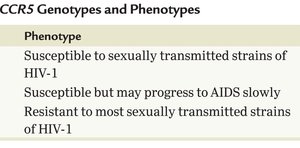
Genotype | Phenotype |
|---|---|
CCR5/CCR5 | Susceptible to sexually transmitted strains of HIV-1 |
CCR5/Δ32 | Susceptible but may progress to AIDS slowly |
Δ32/Δ32 | Resistant to most sexually transmitted strains of HIV-1 |
Genotype | Number of Individuals | Genotype Frequency |
|---|---|---|
1/1 | 79 | 0.79 |
1/Δ32 | 20 | 0.20 |
Δ32/Δ32 | 1 | 0.01 |
Total | 100 | 1.00 |
Frequency of CCR5-1 in sample: (89%)
Frequency of CCR5-Δ32 in sample: (11%)

Limitations of the Hardy-Weinberg Model
The Hardy-Weinberg model is based on several assumptions that are rarely met in natural populations. Deviations from equilibrium indicate that evolutionary forces such as selection, mutation, migration, genetic drift, or nonrandom mating are acting on the population.
Assumptions:
Random mating
No selection
No migration
Infinitely large population
No mutation
Evolutionary change can be detected by measuring changes in allele frequencies over time.
