 Back
BackHeritability and Phenotypic Variance in Population Genetics
Study Guide - Smart Notes
 Tailored notes based on your materials, expanded with key definitions, examples, and context.
Heritability in Genetics
Definition and Scope of Heritability
Heritability is a central concept in quantitative genetics, describing the proportion of phenotypic variance in a population that is attributable to genetic variance. It is crucial to understand that heritability refers to populations, not individuals, and does not indicate the degree to which a trait in a single individual is genetically determined.
Heritability (h2): The proportion of total phenotypic variance in a population due to genetic differences among individuals.
Population-specific: Heritability values are unique to a given population and environment.
Interpretation: A heritability of 0.8 for height means 80% of the variance in height within the population is due to genetic differences, not that 80% of an individual's height is genetic.

Population Genetics Foundations
Population genetics provides the framework for understanding heritability by analyzing allele and genotype frequencies within a group of interbreeding organisms.
Population: A group of interbreeding organisms of the same species in a defined area.
Gene pool: The total collection of alleles in the population.
Genotype frequency: Determined by allele frequencies in the gene pool.
Phenotypic variation: Differences in allele frequencies contribute to observable trait variation.
Partitioning Phenotypic Variance
Mathematical Expression of Variance
The total phenotypic variance (VT or VP) in a population can be partitioned into genetic variance (VG) and environmental variance (VE):
Formula:
VT (Total phenotypic variance): The observed variance in a trait within a population.
VG (Genetic variance): The portion of variance due to genetic differences.
VE (Environmental variance): The portion of variance due to environmental factors.
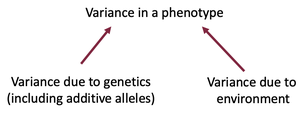
Components of Phenotypic Variance
Understanding the sources of phenotypic variance is essential for estimating heritability and for designing experiments to separate genetic and environmental effects.
Genetic variance: Includes additive, dominance, and epistatic effects of alleles.
Environmental variance: Includes all non-genetic influences, such as nutrition, climate, and random developmental events.
Estimating Heritability
Selection Experiments and Controlled Crosses
Selection experiments, such as controlled crosses, are used to determine whether a trait is heritable by manipulating genetic and environmental variables.
If the environment is kept constant, any observed variance is attributed to genetic differences.
If the mean phenotype changes in response to selection, the trait is heritable.
If the mean does not change, variance is likely due to environmental factors.
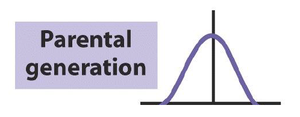
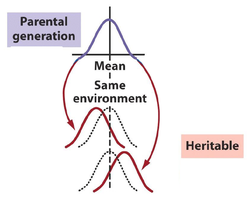
Comparing Parental, F1, and F2 Generations
By analyzing variance among parental, F1, and F2 generations, researchers can estimate genetic and environmental contributions to trait variance.
Parental lines: Genetically uniform, so variance is environmental.
F1 progeny: Also genetically uniform, variance is environmental.
F2 progeny: Genetic recombination introduces genetic variance, so total variance is genetic plus environmental.
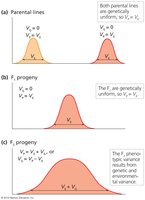
Calculating Genetic Variance
Genetic variance can be estimated by subtracting the average environmental variance (from parental and F1 generations) from the total variance in the F2 generation:
Formula:
Example: If the average variance in parentals and F1 is 3, and the variance in F2 is 12, then .
Heritability in Different Populations
Population and Environmental Effects
Heritability is not a fixed property of a trait; it varies with population and environmental context. The same trait can have different heritabilities in different populations due to differences in genetic diversity or environmental conditions.
Heritability increases if genetic variance increases or environmental variance decreases.
Heritability values are meaningful only for the specific population and environment studied.
Applications and Interpretation
Experimental Design and Data Interpretation
Careful experimental design, including the use of clonal lines and controlled environments, allows researchers to distinguish between genetic and environmental sources of phenotypic variance.
In clonal populations, all variance is environmental, so selection does not change the mean phenotype.
In genetically variable populations, selection can shift the mean, indicating heritability.
Summary Table: Partitioning Variance in Generations
Generation | Genetic Variance (VG) | Environmental Variance (VE) | Total Variance (VT) |
|---|---|---|---|
Parental | 0 | VE | VE |
F1 | 0 | VE | VE |
F2 | VG | VE | VG + VE |
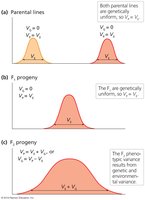
Graphical Representation of Variance in Generations
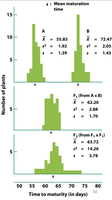
Key Equations
Total phenotypic variance:
Genetic variance:
Heritability (broad sense):
Conclusion
Heritability quantifies the genetic contribution to phenotypic variation in a population. It is estimated by partitioning total variance into genetic and environmental components, often using controlled crosses and statistical analysis. Understanding heritability is essential for predicting responses to selection and for interpreting the genetic architecture of complex traits.
