 Back
BackHolliday Junctions, Homologous Recombination, and Transposable Elements
Study Guide - Smart Notes
 Tailored notes based on your materials, expanded with key definitions, examples, and context.
Holliday Junctions and Homologous Recombination
Introduction to Holliday Junctions
Holliday junctions are critical intermediates in homologous recombination, a process that facilitates the exchange of genetic material between homologous DNA molecules. This mechanism is essential for genetic diversity, DNA repair, and proper chromosome segregation during meiosis.
Holliday Junction: A cross-shaped, four-stranded DNA structure formed during homologous recombination.
Function: Allows for the physical exchange of DNA strands between homologous chromosomes.
Importance: Ensures genetic diversity and accurate DNA repair.
Mechanism of Holliday Junction Formation
The formation and resolution of Holliday junctions involve several key steps:
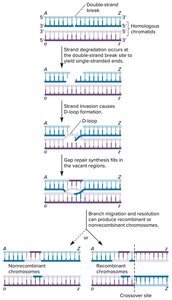
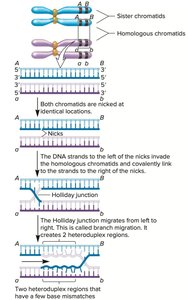
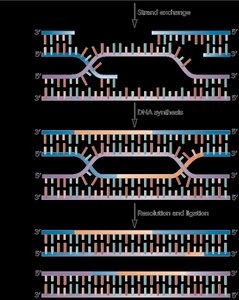
Strand Break and Invasion: One DNA strand is cut and invades a homologous DNA molecule, pairing with its complementary strand.
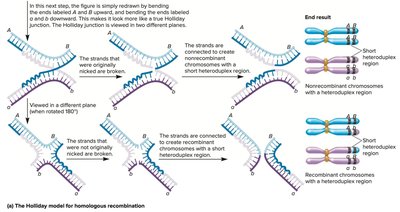
Formation of the Holliday Junction: The interconnected strands create a four-stranded cross structure, facilitating strand exchange.
Branch Migration: The junction can move along the DNA, extending the region of strand exchange.
Resolution: Enzymatic cleavage of the junction can result in either non-crossover (restoring original configuration) or crossover (exchange of large chromosome segments) outcomes.
Homologous Recombination Repair (HRR)
Homologous recombination repair is a high-fidelity mechanism for repairing double-strand breaks (DSBs) in DNA, using a homologous sequence as a template. This process is also known as Homology Directed Repair (HDR).
Template Requirement: Requires a non-damaged, homologous DNA fragment (usually a sister chromatid).
Cell Cycle Specificity: Predominantly occurs during the S and G2 phases when sister chromatids are available.
Key Steps:
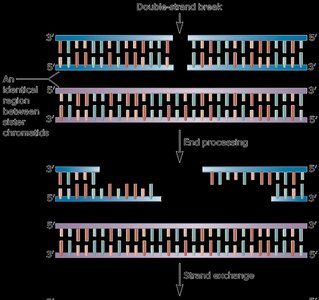
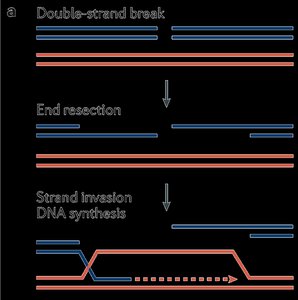
Double-strand break formation
End resection to generate single-stranded overhangs
Strand invasion and D-loop formation
DNA synthesis using the homologous template
Resolution of Holliday junctions
Pathways of Homologous Recombination Repair
There are two main pathways for homologous recombination repair:
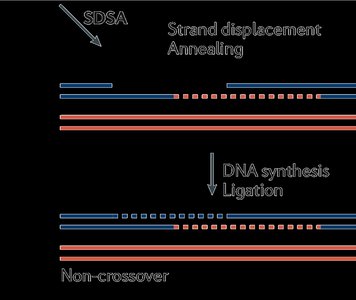
SDSA (Synthesis-Dependent Strand Annealing): The invading strand is displaced and anneals back to the original DNA, resulting in non-crossover products.
DSBR (Double-Strand Break Repair): Involves the formation of two Holliday junctions, which can be resolved to produce either crossover or non-crossover products.
Transposable Elements (TEs)
Introduction to Transposable Elements
Transposable elements (TEs), also known as "jumping genes," are DNA sequences capable of moving within and between genomes. They are found in all organisms and constitute a significant portion of many genomes, including humans.
Impact: TEs can cause mutations, alter gene expression, and contribute to chromosomal rearrangements.
Genome Proportion: Nearly 50% of the human genome is derived from TEs.
Categories of Transposable Elements
TEs are classified into two main categories based on their mechanism of movement:
DNA Transposons (Class II): Move directly as DNA via a "cut-and-paste" mechanism, mediated by the enzyme transposase.
Retrotransposons (Class I): Move via an RNA intermediate using a "copy-and-paste" mechanism, involving reverse transcription.
Key Structural Features of DNA Transposons
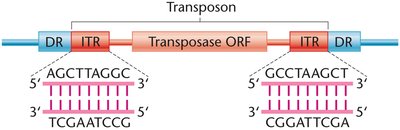
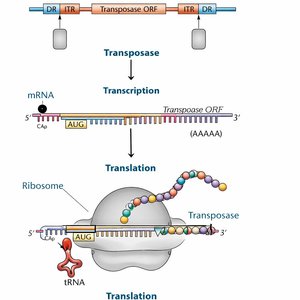
Open Reading Frame (ORF): Encodes transposase, the enzyme responsible for excision and integration.
Inverted Terminal Repeats (ITRs): Short, palindromic sequences at both ends, recognized by transposase.
Direct Repeats (DRs): Short, identical sequences flanking the inserted transposon, generated during integration.
Mechanism of DNA Transposon Movement (Cut-and-Paste)
Transposase cleaves DNA at ITRs, excising the transposon.
Staggered cuts are made at the target site in the genome.
The transposon is inserted into the new site, and gaps are filled by DNA polymerase and ligase, creating new DRs.
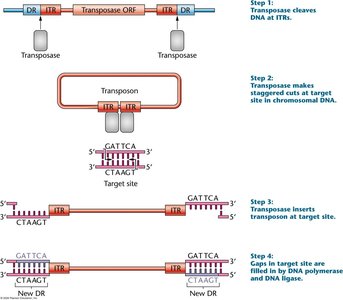
Examples of DNA Transposons
Insertion Elements: Simplest form, containing only the transposase gene and ITRs.
Simple Transposons: Larger elements that may carry additional genes, such as antibiotic resistance.
Retrotransposons (Class I)
Retrotransposons move via an RNA intermediate and increase their copy number through a "copy-and-paste" mechanism. They are structurally and functionally diverse.
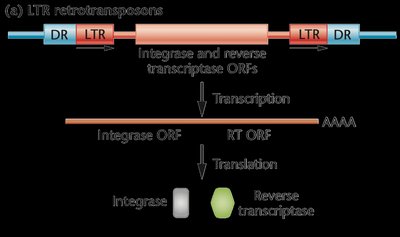
LTR Retrotransposons: Contain long terminal repeats (LTRs) and are similar to retroviruses.
Non-LTR Retrotransposons: Include LINEs (autonomous) and SINEs (non-autonomous), which lack LTRs.
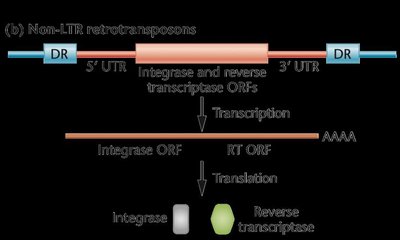
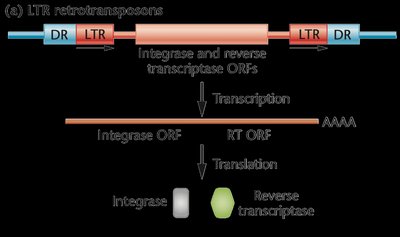
Mechanism of Retrotransposition
Retrotransposon is transcribed into RNA.
Reverse transcriptase synthesizes cDNA from the RNA template.
Integrase inserts the cDNA into a new genomic location.
Examples and Significance
LINE-1 (L1): Autonomous non-LTR retrotransposon, ~17% of the human genome.
Alu Elements: Non-autonomous SINEs, ~13% of the human genome.
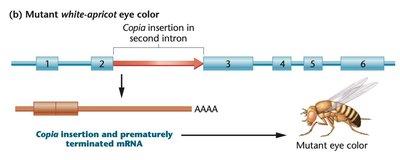
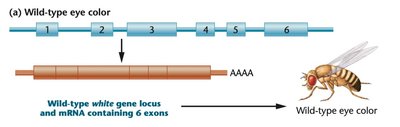
Copia Elements: LTR retrotransposons in Drosophila, can cause mutations such as the white-apricot eye color phenotype.

Impact of Transposable Elements on Genomes
Insertion into coding regions can cause frameshifts or premature stop codons.
Insertion into regulatory regions can disrupt gene expression.
Multiple identical TEs can facilitate chromosomal rearrangements (duplications, deletions, inversions, translocations).
TEs contribute to genome evolution and adaptation by generating genetic diversity.
Experimental and Evolutionary Applications
TEs can be engineered as tools for genetic engineering (e.g., Sleeping Beauty transposon system for generating transgenic mice).
TEs provide raw material for evolutionary innovation and adaptation.
Summary Table: Major Types of Transposable Elements
Category | TE Element | Example | Organism |
|---|---|---|---|
LTR, autonomous | Ty1-copia group | copia | Plants, animals, algae |
LTR, non-autonomous | Large retrotransposon derivatives (LARDs) | Dasheng | Plants |
Non-LTR, autonomous | LINE elements | L1 | Humans, other organisms |
Non-LTR, non-autonomous | SINE elements | Alu | Humans, other organisms |
Example: LINE-1 Insertion and Human Disease
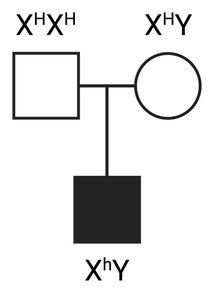
LINE-1 insertions can cause genetic diseases, such as hemophilia, by disrupting gene function.
De novo mutations from TE insertions can explain cases not accounted for by simple inheritance patterns.
Conclusion
Holliday junctions and transposable elements are fundamental to understanding genetic recombination, DNA repair, genome evolution, and the molecular basis of mutation. Their study provides insights into both normal cellular processes and the mechanisms underlying genetic diseases.
