 Back
BackIntroduction to Genetics: Foundations, Concepts, and Molecular Basis
Study Guide - Smart Notes
 Tailored notes based on your materials, expanded with key definitions, examples, and context.
Introduction to Genetics
Course Learning Outcomes
This course provides a comprehensive foundation in genetics, emphasizing its role in scientific research and applications. Students will develop an understanding of fundamental genetic principles, analytical skills, and scientific writing abilities.
Genetics as a Foundation: Genetics underpins many scientific disciplines, including medicine, agriculture, and biotechnology.
Principles of Genetics: Key concepts include heredity, gene structure, gene function, and gene transmission.
Scientific Approaches: Methods for investigating genetic questions, including experimental design and data analysis.
Literature Skills: Ability to read and interpret scientific literature in genetics.
Analytical and Writing Skills: Application of the scientific method and effective communication of genetic concepts.
Definition and Scope of Genetics
Genetics is the scientific study of heredity and variation in organisms. It encompasses the structure, function, expression, and transmission of genes.
Gene Structure: Genes are segments of DNA that encode functional products.
Gene Function and Expression: Genes are expressed through transcription and translation, resulting in phenotypic traits.
Inheritance: Genes are passed from one generation to the next, following specific patterns.
The Age of Genetics: Historical Timeline
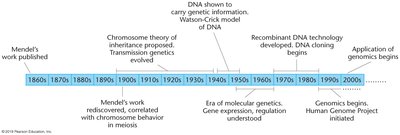
Genetics has evolved from Mendel's foundational work to the modern era of genomics, with significant milestones shaping the field.
1865: Mendel publishes work on inheritance in peas.
Early 1900s: Chromosome theory of inheritance emerges.
1940s: DNA identified as genetic material.
1960s: Molecular genetics and gene regulation understood.
1980s-2000s: Recombinant DNA technology, genomics, and the Human Genome Project.
Major Areas of Genetic Study
Classical Genetics
Classical genetics focuses on gene location, chromosome behavior, and inheritance patterns.
Mendelian Laws: Each organism has two units (alleles) for each trait; traits are inherited according to specific laws.
Chromosome Mapping: Genes are discrete units located on chromosomes.
Molecular Genetics
Molecular genetics investigates the structure and control of genetic material at the molecular level.
DNA as Genetic Material: DNA carries genetic information; mutations alter nucleotide sequences.
Central Dogma: Replication, transcription, and translation are key processes.
Recombinant DNA Technology: Techniques for manipulating DNA sequences.
Evolutionary Genetics
Evolutionary genetics examines mechanisms of evolutionary change and gene frequency in populations.
Population Genetics: Studies variation and gene frequency changes within populations.
Hardy-Weinberg Principle: Describes conditions for genetic equilibrium.
Quantitative Genetics: Analyzes traits controlled by multiple genes.
Fundamental Concepts in Genetics
Chromosomes and Genes
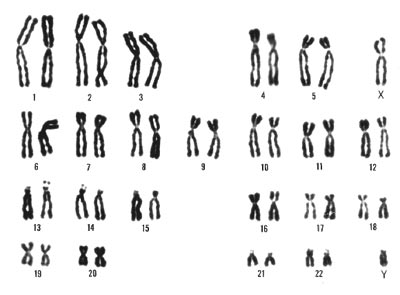
Chromosomes are complexes of DNA and protein, containing hundreds to thousands of genes. Inherited traits are controlled by genes residing on chromosomes.
Diploid Number (2n): Most eukaryotes have a characteristic number of chromosomes, existing in pairs called homologous chromosomes.
Karyotype: The complete set of chromosomes of an organism, including autosomes and sex chromosomes.
Alleles and Genotype-Phenotype Relationships
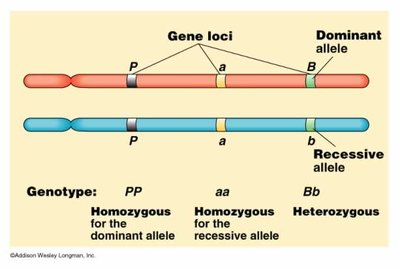
Each gene in diploid organisms occurs as a pair of alleles on homologous chromosomes. Alleles may be dominant or recessive, and the combination determines the organism's phenotype.
Genotype: The genetic makeup of an organism (e.g., PP, aa, Bb).
Phenotype: The observable traits resulting from the genotype.
Homozygous: Both alleles are identical (e.g., PP or aa).
Heterozygous: Alleles are different (e.g., Bb).
Cell Division: Mitosis and Meiosis
Mitosis
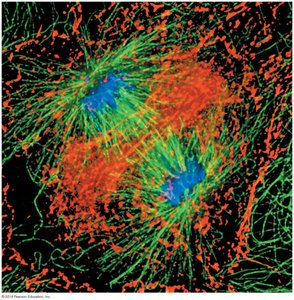
Mitosis is the process by which somatic cells divide, resulting in two daughter cells each with a diploid set of chromosomes.
Purpose: Growth, repair, and asexual reproduction.
Outcome: Daughter cells are genetically identical to the parent cell.
Meiosis
Meiosis is the process by which gametes (sperm and egg cells) are produced, resulting in cells with half the number of chromosomes (haploid).
Purpose: Sexual reproduction and genetic diversity.
Outcome: Gametes contain one set of chromosomes (n).
Molecular Basis of Genetics
Chemical Structure of DNA
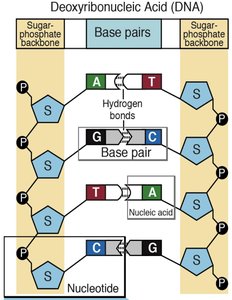
DNA is composed of nucleotides, each containing a nitrogenous base, a sugar, and a phosphate group. The four bases are adenine (A), guanine (G), cytosine (C), and thymine (T).
Nucleotide: The basic unit of DNA, consisting of a base, sugar, and phosphate.
Base Pairing: A pairs with T, and G pairs with C via hydrogen bonds.
Genome: The entire set of genes in an organism.
Summary Table: Key Genetic Concepts
Concept | Description |
|---|---|
Gene | Unit of heredity; segment of DNA encoding a product |
Allele | Variant form of a gene |
Chromosome | DNA-protein complex containing genes |
Genotype | Genetic makeup of an organism |
Phenotype | Observable traits of an organism |
Mitosis | Cell division producing identical diploid cells |
Meiosis | Cell division producing haploid gametes |
Genome | Complete set of genes in an organism |
Key Equations in Genetics
Hardy-Weinberg Principle
The Hardy-Weinberg equation describes allele and genotype frequencies in a population under equilibrium conditions:
Where p and q are the frequencies of two alleles.
Central Dogma of Molecular Biology
The flow of genetic information is summarized as:
Conclusion
Genetics is a dynamic and foundational field in biology, integrating classical, molecular, and evolutionary perspectives. Understanding its principles is essential for further study in biological sciences and related applications.
