Back
BackIntroduction to Genetics: Foundations, History, and Modern Applications
Study Guide - Smart Notes
 Tailored notes based on your materials, expanded with key definitions, examples, and context.
Genetics Has a Rich and Interesting History
Early Theories of Heredity
The study of heredity began with philosophical speculation and gradually evolved into scientific inquiry. Two major theories emerged in the early history of biology: epigenesis and preformation.
Epigenesis: Proposed by William Harvey, this theory states that organs and structures develop de novo from undifferentiated material in the embryo.
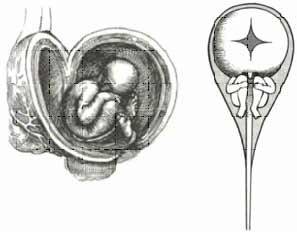
Preformation: Suggested that a miniature, fully formed human (homunculus) exists in the sperm or egg and simply grows larger during development.
Cell Theory: Formulated by Schleiden and Schwann in the 1830s, this theory established that all living organisms are composed of cells.
Example: The homunculus illustration demonstrates the preformation concept, which was later disproven by epigenesis.
Additional info: The mystical "developmental force" (Bildungstrieb) was proposed to explain regeneration in organisms like hydra, foreshadowing later studies in developmental genetics.
Darwin and the Intersection of Evolution and Genetics
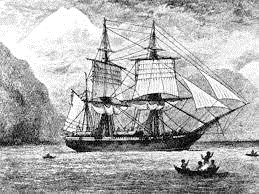
Charles Darwin's observations during his voyage on the HMS Beagle contributed to the formulation of evolutionary theory. He proposed that species evolve through descent with modification and that natural selection is the driving force behind evolutionary change.
Natural Selection: The process by which organisms with advantageous traits are more likely to survive and reproduce.
Genetics and Evolution: The intersection occurs as genetic variation provides the raw material for natural selection.
Hardy-Weinberg Equilibrium: A principle that describes the genetic makeup of a population under ideal conditions, providing a baseline for studying evolutionary change.
Genetics Progressed From Mendel to DNA in Less Than a Century
Mendelian Genetics and Chromosomal Theory
Gregor Mendel's experiments with pea plants established the principles of inheritance, demonstrating that traits are transmitted from parents to offspring in predictable patterns. The chromosomal theory of inheritance later clarified that genes reside on chromosomes and are passed through gametes, ensuring genetic continuity.
Mutation: Changes in DNA sequence that produce new alleles and are the source of genetic variation.
Genotype: The set of alleles for a given trait.
Phenotype: The observable expression of the genotype.
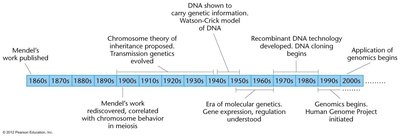
Discovery of DNA as Genetic Material
Several key experiments established DNA as the genetic material responsible for inheritance:
Frederick Griffith: Demonstrated transformation in bacteria.
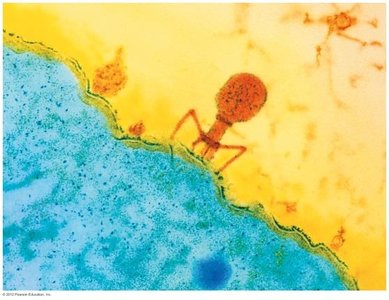
Hershey-Chase: Used bacteriophages to show DNA, not protein, is the genetic material.
Meselson-Stahl: Proved the semi-conservative replication of DNA.
Avery, MacLeod, and McCarty: Identified DNA as the transforming principle.
Watson and Crick: Elucidated the double helix structure of DNA.
Structure and Function of DNA and RNA
DNA Structure
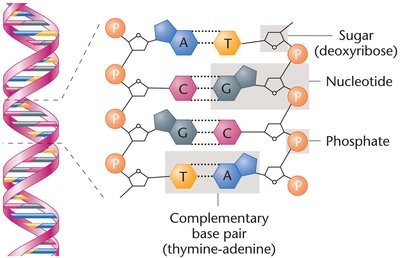
DNA is an antiparallel, double-stranded helix composed of nucleotides. Each nucleotide consists of a sugar (deoxyribose), a phosphate group, and one of four bases: adenine (A), cytosine (C), guanine (G), and thymine (T). Complementary base pairing occurs between A–T and G–C.
Antiparallel: The two strands run in opposite directions.
Complementary Base Pairing: Ensures accurate replication and transcription.
RNA Structure and Central Dogma
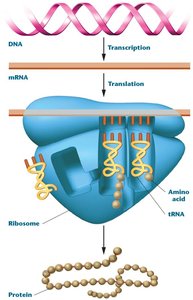
RNA is similar to DNA but is usually single-stranded, contains uracil (U) instead of thymine (T), and has ribose as its sugar. The central dogma of genetics describes the flow of genetic information: DNA is transcribed to RNA, which is then translated into protein.
Transcription: DNA → RNA
Translation: RNA → Protein
Genetic Code: Triplet nucleotides (codons) in mRNA specify amino acids.
Mutations and Phenotypes
Impact of Mutations
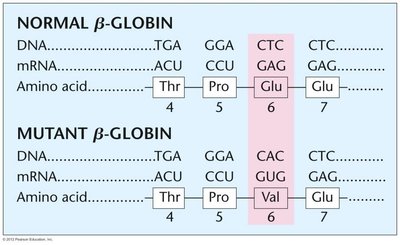
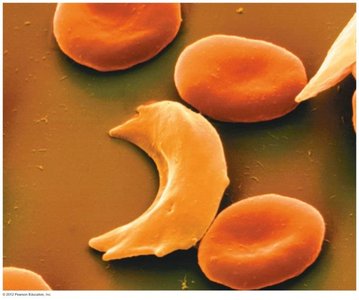
Mutations in the genetic code can alter protein structure and function, leading to alternative phenotypes and disease states. For example, a single nucleotide change in the β-globin gene causes sickle cell anemia.
Normal β-globin: Encodes glutamic acid at position 6.
Mutant β-globin: Encodes valine at position 6, resulting in sickle-shaped red blood cells.
Recombinant DNA Technology and Biotechnology
Development of Recombinant DNA Technology
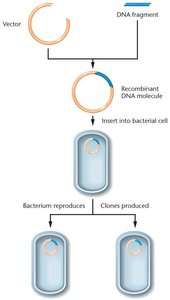
Restriction enzymes discovered in bacteria enabled the development of recombinant DNA technology, allowing scientists to cut and recombine DNA fragments. This led to the era of cloning and genetic engineering.
Restriction Enzymes: Cut DNA at specific sequences.
Cloning: Inserting recombinant DNA into bacterial cells to produce clones.
Applications of Biotechnology
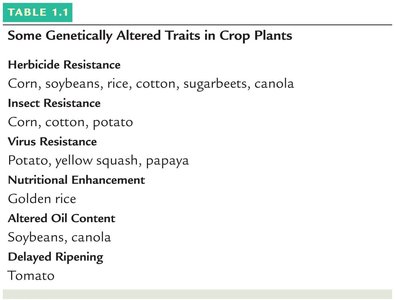
Biotechnology has enabled the genetic modification of crop plants for improved resistance and nutritional enhancement. Table 1.1 summarizes some genetically altered traits in crop plants.
Herbicide Resistance: Corn, soybeans, rice, cotton, sugarbeets, canola
Insect Resistance: Corn, cotton, potato
Virus Resistance: Potato, yellow squash, papaya
Nutritional Enhancement: Golden rice
Altered Oil Content: Soybeans, canola
Delayed Ripening: Tomato
Trait | Example Crops |
|---|---|
Herbicide Resistance | Corn, soybeans, rice, cotton, sugarbeets, canola |
Insect Resistance | Corn, cotton, potato |
Virus Resistance | Potato, yellow squash, papaya |
Nutritional Enhancement | Golden rice |
Altered Oil Content | Soybeans, canola |
Delayed Ripening | Tomato |
Additional info: Students should be prepared to discuss both the pros and cons of genetically engineering crops.
Genetic Disorders and Medical Applications
Gene Therapy and Genetic Testing
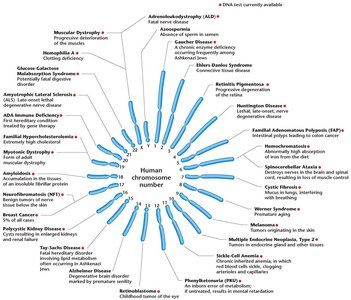
Gene therapy and genetic testing are increasingly important in medicine. The molecular basis for hundreds of genetic disorders is now known, enabling targeted treatments and diagnostics.
Gene Therapy: Introduction of functional genes to treat genetic disorders.
Genetic Testing: Identification of mutations responsible for disease.
Genomics, Proteomics, and Bioinformatics
Emerging Fields in Genetics
Modern genetics has expanded into new fields that analyze genetic information at a systems level:
Genomics: Study of genome sequences, structure, function, and evolution.
Proteomics: Analysis of the set of proteins in cells, their modifications, locations, and interactions.
Bioinformatics: Computational storage, retrieval, and analysis of genetic and protein data.
Model Organisms in Genetic Studies
Criteria and Examples of Model Organisms
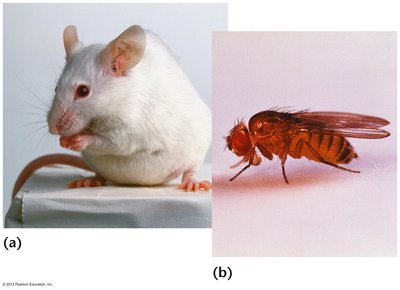
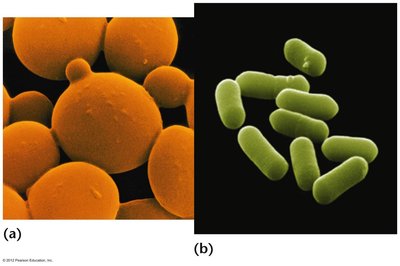
Model organisms are essential for genetic research due to their ease of growth, short life cycles, and ability to produce many offspring. They provide insights into human biology and disease.
Criteria: Easy to grow, short life cycle, many offspring.
Examples: Mouse (Mus musculus), fruit fly (Drosophila melanogaster), yeast (Saccharomyces cerevisiae), nematode (Caenorhabditis elegans), zebrafish (Danio rerio), bacterium (Escherichia coli).
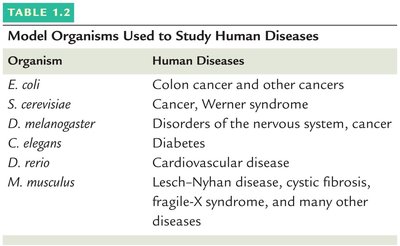
Model Organisms Used to Study Human Diseases
Table 1.2 lists model organisms and the human diseases they help study.
Organism | Human Diseases |
|---|---|
E. coli | Colon cancer and other cancers |
S. cerevisiae | Cancer, Werner syndrome |
D. melanogaster | Disorders of the nervous system, cancer |
C. elegans | Diabetes |
D. rerio | Cardiovascular disease |
M. musculus | Lesch-Nyhan disease, cystic fibrosis, fragile-X syndrome, and many other diseases |