 Back
BackIntroduction to Genetics: Molecular Basis, Heredity, and Evolution
Study Guide - Smart Notes
 Tailored notes based on your materials, expanded with key definitions, examples, and context.
The Molecular Basis of Heredity, Variation, and Evolution
Course Overview and Learning Objectives
This course introduces the foundational principles of genetics, focusing on the molecular basis of heredity, chromosome structure, genetic mapping, gene expression, mutation, and evolution. Students will develop problem-solving skills relevant to genetic analysis and understand the experimental basis of genetic discoveries.
Key Learning Goals:
Understand the molecular basis of genetics and inheritance patterns.
Describe chromosome structure and cellular reproduction.
Explain genetic mapping and linkage analysis methods.
Detail transcription and translation in prokaryotes and eukaryotes.
Understand mutation mechanisms, impacts, and repair.
Describe gene regulation in bacteria and eukaryotes.
Apply the Hardy-Weinberg principle to population genetics problems.
Introduction to Genetics
Historical Perspectives and Fundamental Questions
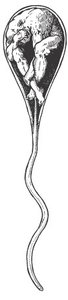
Genetics seeks to answer how traits are inherited and what molecular mechanisms underlie heredity. Early hypotheses included the homunculus theory and blending inheritance, but modern genetics is based on the work of Gregor Mendel and subsequent discoveries about chromosomes and genetic material.
Observation: Offspring tend to resemble their parents.
Key Questions: What is the genetic material? How do gametes and chromosomes contribute to heredity?
Chemical Nature of the Gene
Discovery of DNA as Genetic Material
By the early 20th century, scientists debated whether proteins or nucleic acids (DNA/RNA) were the genetic material. Two landmark experiments resolved this question:
Avery, MacLeod, and McCarty Experiment (1944): Demonstrated that DNA, not protein or RNA, transforms non-virulent bacteria into virulent forms, identifying DNA as the genetic material.
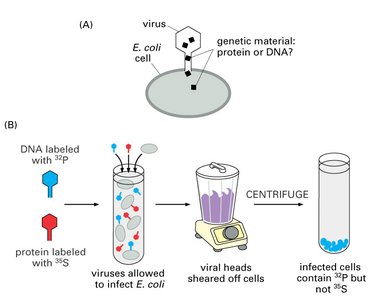
Hershey-Chase Blender Experiment (1952): Used radioactive labeling to show that DNA, not protein, enters bacterial cells during viral infection and directs viral replication.
Fundamental Concepts in Genetics
Key Definitions and Principles
Cell Types:
Eukaryotic cells have membrane-bound organelles and a nucleus.
Prokaryotic cells lack a nuclear membrane and most organelles.
Gene: The fundamental unit of heredity, defined as a DNA sequence encoding a functional product.
Alleles: Different forms of a gene found at the same locus on homologous chromosomes.
Chromosomes: Long molecules of double-stranded DNA and protein containing genes.
Phenotype: Observable traits conferred by genes and environmental interactions.
DNA Structure and Function
Nucleic Acid Structure
DNA and RNA are polymers of nucleotides, each consisting of a phosphate group, a five-carbon sugar (deoxyribose in DNA, ribose in RNA), and a nitrogenous base.
Nitrogenous Bases:
Purines: Adenine (A), Guanine (G)
Pyrimidines: Cytosine (C), Thymine (T, in DNA), Uracil (U, in RNA)
Base Pairing: A pairs with T (or U in RNA), C pairs with G.
Chargaff’s Rules
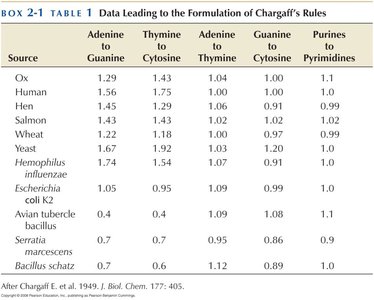
Erwin Chargaff discovered that in DNA, the amount of adenine equals thymine, and the amount of guanine equals cytosine. This provided key evidence for the double helix structure.
Source | A:G | T:C | A:T | G:C | Purines:Pyrimidines |
|---|---|---|---|---|---|
Human | 1.56 | 1.14 | 1.00 | 1.00 | 1.0 |
Hen | 1.45 | 1.29 | 1.02 | 0.91 | 0.99 |
Salmon | 1.62 | 1.18 | 1.00 | 1.02 | 1.0 |
DNA Double Helix
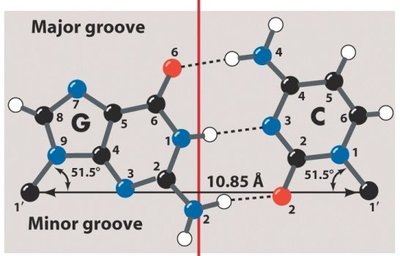
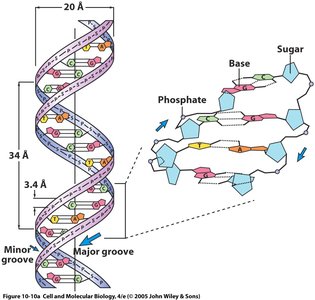
Watson and Crick, building on Chargaff’s rules and Rosalind Franklin’s X-ray data, described the double helix structure of DNA. The two strands are antiparallel and held together by complementary base pairing.
Major and Minor Grooves: The double helix has alternating wide (major) and narrow (minor) grooves, important for protein-DNA interactions.
Dimensions: The helix is 2 nm wide, with 10 base pairs per turn and a 3.4 nm pitch.
Central Dogma of Molecular Biology
Flow of Genetic Information
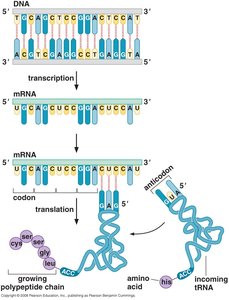
The central dogma describes the flow of genetic information from DNA to RNA to protein. This process involves two main steps: transcription and translation.
Transcription: DNA is transcribed into messenger RNA (mRNA) by RNA polymerase.
Translation: mRNA is translated into a polypeptide (protein) by ribosomes.

DNA, RNA, and Protein Synthesis
DNA: Double-stranded, contains deoxyribose, bases A, T, C, G.
RNA: Single-stranded, contains ribose, bases A, U, C, G. Uracil replaces thymine.
Proteins: Polymers of amino acids, each with a unique R-group. The sequence of amino acids determines protein structure and function.
Types of RNA
Several types of RNA play distinct roles in gene expression:
mRNA (messenger RNA): Encodes the amino acid sequence of proteins.
tRNA (transfer RNA): Brings amino acids to the ribosome during translation.
rRNA (ribosomal RNA): Forms the core of ribosome structure and catalyzes protein synthesis.
miRNA, piRNA, snRNA, lncRNA: Regulatory and structural roles in gene expression and genome stability.
Genetics and Evolution
Genetic Basis of Evolution
Evolution is driven by genetic variation, which arises from mutations and is shaped by natural selection, genetic drift, and other evolutionary forces. DNA mutations can lead to new traits, some of which may confer advantages in specific environments.
Darwin’s Principles: Variation exists in populations, is heritable, and affects survival and reproduction.
Modern Genetics: DNA mutations are the source of heritable variation. Example: The CCR5 gene variant confers resistance to HIV infection.
Phylogenetics
Phylogenetics uses genetic data to reconstruct evolutionary relationships. Closely related species have fewer genetic differences in shared genes.
Applications: Determining relatedness among species and within populations.
Summary Table: DNA vs. RNA
Feature | DNA | RNA |
|---|---|---|
Sugar | Deoxyribose | Ribose |
Bases | A, T, C, G | A, U, C, G |
Strandedness | Double-stranded | Single-stranded (usually) |
Function | Genetic storage | Information transfer, catalysis, regulation |
Practice Questions
If the sequence of one DNA strand is 5′-ATG CAT CTA TGA-3′, what is the sequence and polarity of the complementary strand?
Which type of RNA forms part of the ribosomes?
Which evolutionary process best fits the CCR5 example (mutation, natural selection, migration, genetic drift)?
Additional info: This guide covers material from Chapter 1 and foundational concepts relevant to the first several chapters of a college genetics course, including the molecular basis of heredity, gene structure, and the central dogma.
