 Back
BackLinkage and Chromosome Mapping in Eukaryotes: Study Notes for Genetics Students
Study Guide - Smart Notes
 Tailored notes based on your materials, expanded with key definitions, examples, and context.
Linkage and Chromosome Mapping
Introduction to Linkage and Independent Assortment
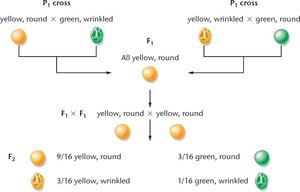
Linkage and chromosome mapping are fundamental concepts in genetics that explain how genes are inherited together or separately. Mendel's law of independent assortment states that the segregation of any pair of hereditary determinants is independent of the segregation of other pairs, but this is not always the case when genes are located close together on the same chromosome.
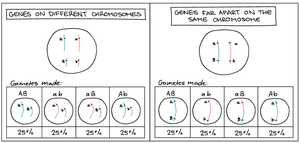
Independent Assortment: Genes on different chromosomes assort independently during gamete formation.
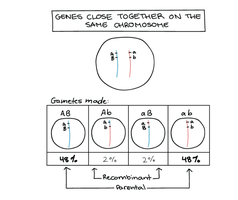
Linkage: Genes located close together on the same chromosome tend to be inherited together.
Synteny: Physical linkage of genes on the same chromosome.
Linkage Groups: Chromosomes that carry physically linked genes.
Segregation of Genes: Chromosomal Context
The inheritance of genes depends on their chromosomal location. Genes on different chromosomes are inherited independently, while genes on the same chromosome may be inherited together, especially if they are close to each other.
Human Genome: ~20,000 genes distributed across 23 chromosomes.
Inheritance Scenarios:
Genes on different chromosomes: independent inheritance.
Genes on same chromosome, far apart: may independently assort due to crossing over.
Genes on same chromosome, close together: likely inherited together (linked).
Experimental Evidence for Linkage
Bateson and Punnett's experiments in sweet pea plants revealed deviations from the expected Mendelian ratios, indicating that some traits do not assort independently. A much greater proportion of parental types were observed in the F2 generation, suggesting linkage.
Linked Genes: Two or more genes that do not independently assort and tend to be transmitted together.
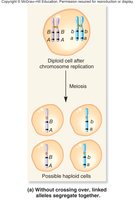
Explanation: Linked alleles segregate together unless crossing over occurs.
Crossing Over and Recombination
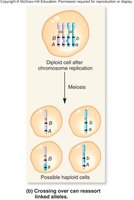
Crossing over during meiosis can reassort linked alleles, producing recombinant chromosomes and increasing genetic diversity. The likelihood of crossing over depends on the distance between genes.
Without Crossing Over: Linked alleles segregate together.
With Crossing Over: Linked alleles can be reassorted, producing new combinations.
Recombination Frequency: Proportional to the distance between genes.
Genetic Mapping and Recombination Frequency
Genetic mapping determines the order and proximity of genes on a chromosome using recombination frequencies. The recombination frequency is an approximation of the physical distance between genes and is expressed in map units (m.u) or centimorgans (cM).
Map Distance:
Maximum Recombination Frequency: 50% (same as independent assortment).
Calculation Example: If the distance between two genes is 16 map units and 500 offspring are produced, expect recombinants.
Linkage Mapping in Drosophila
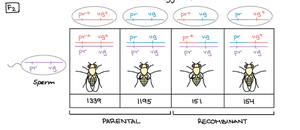
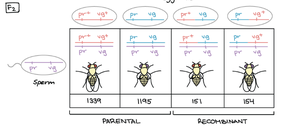
Linkage mapping in Drosophila involves crosses to determine whether genes are linked and to calculate recombination frequencies. The majority of offspring will show parental chromosome configurations, while fewer will show recombinant configurations.
Parental Classes: Offspring with the same allele combinations as the parents.
Recombinant Classes: Offspring with new allele combinations due to crossing over.
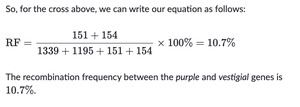
Example Calculation:
Recombination frequency:
Double Crossovers and Mapping Limitations
Double crossovers can occur between genes, but if only two genes are considered, double crossovers may not be detected, leading to an underestimation of recombination frequencies and map distances. Multiple crossovers set a quantitative limit on measurable recombination frequencies.
Product Rule: Probability of double crossover = product of individual probabilities.
Maximum Recombinant Offspring: 50% (same as independent assortment).
Mitotic Recombination
Mitotic recombination is a rare event during mitosis that can produce recombinant chromosomes with new allele combinations. If it occurs early in embryonic development, it may result in patches of tissue with different characteristics (twin spots).
Twin Spots: Adjacent patches of tissue with different phenotypes due to mitotic recombination.
Example: Patch with gray color and singed bristles in Drosophila.
Summary Table: Linkage vs. Independent Assortment
Scenario | Gamete Types | Proportion |
|---|---|---|
Genes on different chromosomes | AB, ab, Ab, aB | 25% each |
Genes far apart on same chromosome | AB, ab, Ab, aB | 25% each |
Genes close together on same chromosome | AB, ab (parental); Ab, aB (recombinant) | 48% parental, 2% recombinant each |
Key Terms and Concepts
Linkage: Tendency of genes located close together on a chromosome to be inherited together.
Recombination: Exchange of genetic material between homologous chromosomes during meiosis.
Map Unit (m.u): Unit of measurement for genetic distance; 1 m.u. = 1% recombination frequency.
Parental and Recombinant Gametes: Parental gametes retain original allele combinations; recombinant gametes have new combinations due to crossing over.
Cis and Trans Configuration: Alleles on the same chromosome (cis); alleles on different chromosomes (trans).
Practice Problems and Applications
Calculate recombination frequencies and map distances using observed offspring numbers.
Predict gamete types and proportions for linked and unlinked genes.
Construct genetic maps based on recombination data.
Conclusion
Understanding linkage and chromosome mapping is essential for predicting genetic outcomes, constructing genetic maps, and appreciating the mechanisms that generate genetic diversity. Recombination frequencies provide valuable information about the relative positions of genes, and crossing over is a key process in reshuffling alleles during meiosis.
