 Back
BackCh 7P1 Linkage and Chromosome Mapping in Eukaryotes: Study Notes
Study Guide - Smart Notes
 Tailored notes based on your materials, expanded with key definitions, examples, and context.
Linkage and Chromosome Mapping in Eukaryotes
Introduction to Linkage
Linkage refers to the phenomenon where certain genes are inherited together because they are located on the same chromosome. This violates Mendel’s postulate of independent assortment, which states that genes on different chromosomes assort independently during meiosis.
Linked genes are transmitted as a single unit and do not assort independently.
Genes that are part of the same chromosome form linkage groups.
The number of linkage groups corresponds to the haploid number of chromosomes in an organism.
Linkage and Mendel’s Postulates
Linkage affects expected Mendelian ratios because it violates the postulate of independent assortment. When genes are linked, their alleles do not segregate independently during meiosis.
Key Point: Linkage violates the independent assortment of homologs in meiosis.
Crossing Over and Recombination
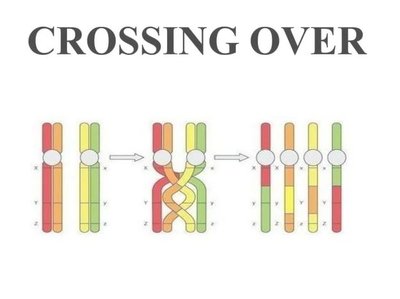
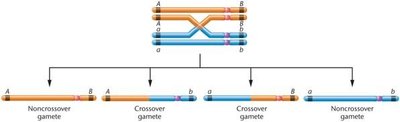
During meiosis, synapsed homologous chromosomes can exchange segments in a process called crossing over. This results in the reshuffling (recombination) of alleles between homologs.
The frequency of crossing over is proportional to the distance between two loci on a chromosome.
More distance between genes = more crossing over events.
If two linked genes are far apart, the number of recombinant gametes approaches 50%, making their transmission indistinguishable from unlinked genes.
Meiotic Consequences of Linkage
The arrangement of genes on chromosomes affects the types of gametes produced:
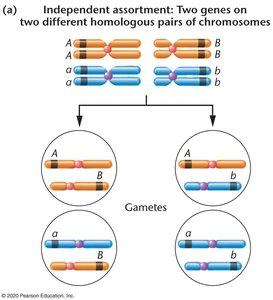
Independent assortment: Genes on different chromosomes assort independently, producing four types of gametes in equal proportions.
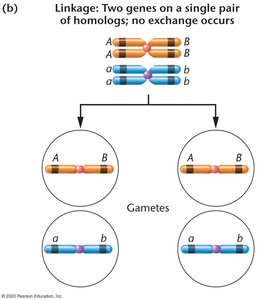
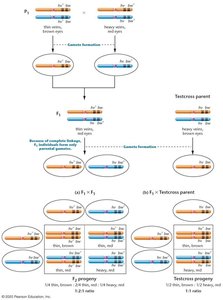
Linkage without crossing over: Genes on the same chromosome are inherited together, producing only parental types of gametes.
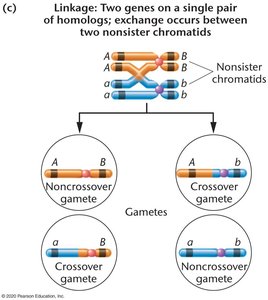
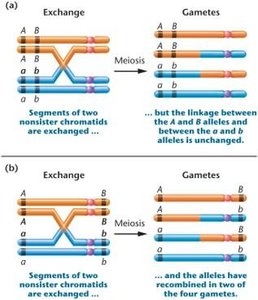
Linkage with crossing over: Exchange between nonsister chromatids produces both parental and recombinant gametes.
The Linkage Ratio
When complete linkage exists between two genes (i.e., they are very close together), organisms heterozygous at both loci produce a unique phenotypic ratio known as the linkage ratio. However, complete linkage is rare; most linked genes show some recombination due to crossing over.
Linkage groups can be established by analyzing inheritance patterns.
Historical Experiments: Morgan, Sturtevant, and Crossing Over
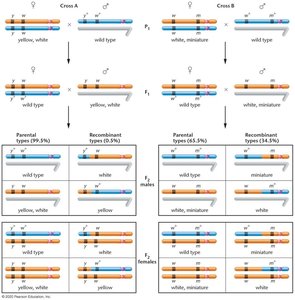
Research on Drosophila melanogaster (fruit fly) by Thomas Hunt Morgan and Alfred Sturtevant established the chromosomal theory of inheritance. They observed that some X-linked genes did not assort independently and hypothesized that physical exchange (crossing over) at chiasmata during meiosis produced recombinant gametes.
Chiasmata are points where homologous chromosomes overlap and exchange genetic material.
Genes closer together are less likely to have a chiasma form between them, resulting in fewer recombinants.
Chromosome Mapping and Map Units
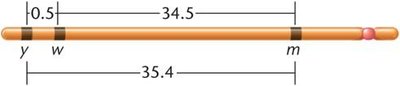
Sturtevant used recombination frequencies to construct the first genetic map. The frequency of exchange between linked genes is additive and provides an estimate of their relative distance on a chromosome.
1 map unit (m.u.) = 1% recombination frequency.
Map units are also called centimorgans (cM).
Genes with higher recombination frequencies are farther apart.
Example Table: Recombination Rates and Gene Distance
Gene Pair | Recombination Rate (%) | Distance (map units) |
|---|---|---|
yellow, white | 0.5 | 0.5 |
white, miniature | 34.5 | 34.5 |
yellow, miniature | 35.4 | 35.4 |
Interpreting Map Units
If two genes are 6 map units apart, recombination (crossing over) occurs 6% of the time between them. This is a direct measure of genetic distance, not physical distance in base pairs.
Single Crossovers
The relative distance between two loci influences the likelihood of a single crossover event. A single crossover occurs between two nonsister chromatids, producing recombinant gametes. The closer two loci are, the less likely a crossover will occur between them.
If two linked genes are 50 map units apart, crossing over is expected in 100% of tetrads, yielding equal proportions of all four gametes (theoretical maximum).
Summary Table: Types of Gametes Produced
Condition | Gamete Types | Proportion |
|---|---|---|
Independent assortment | Parental and recombinant | 1:1:1:1 |
Complete linkage (no crossing over) | Parental only | 1:1 |
Linkage with crossing over | Parental and recombinant | Depends on distance |
Key Terms and Definitions
Linkage group: A set of genes located on the same chromosome and inherited together.
Chiasma (plural: chiasmata): The point where crossing over occurs between homologous chromosomes.
Map unit (m.u.): A unit of measure for genetic linkage; 1 m.u. = 1% recombination frequency.
Recombinant gametes: Gametes with new combinations of alleles due to crossing over.
Parental gametes: Gametes with the same allele combinations as the parents.
Applications
Genetic mapping is essential for locating genes associated with traits and diseases.
Understanding linkage and recombination is fundamental for plant and animal breeding, as well as for studying inheritance patterns in populations.
