 Back
BackCh7P2 Linkage and Chromosome Mapping in Eukaryotes: Advanced Concepts and Applications
Study Guide - Smart Notes
 Tailored notes based on your materials, expanded with key definitions, examples, and context.
Linkage and Chromosome Mapping in Eukaryotes
Multiple Crossovers
Multiple crossovers are essential for understanding the arrangement and mapping of several linked genes on a chromosome. While single crossovers help determine the distance between two linked genes, multiple crossovers provide more comprehensive chromosome maps, especially when many genes are involved.
Single crossover: Used to estimate the distance between two genes, but cannot always reveal the sequence of multiple genes.
Double crossover (DCO): Involves two separate exchanges of genetic material between chromatids. To detect DCOs, three gene pairs must be analyzed, each heterozygous for two alleles.
Product law: The probability of two independent crossover events occurring simultaneously is the product of their individual probabilities.
Consequences: Double crossovers between two nonsister chromatids produce two noncrossover gametes and two double-crossover gametes.
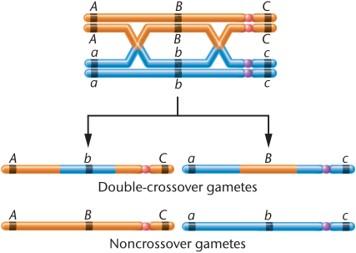
Additional info: The presence of double crossovers is critical for accurate gene mapping, as they can mask the true genetic distance if not accounted for.
Three-Point Mapping in Drosophila
Three-point mapping is a genetic technique used to determine the order and relative distances between three linked genes. This method is particularly useful in model organisms such as Drosophila melanogaster.
Criteria for three-point mapping:
The organism producing crossover gametes must be heterozygous at all loci considered.
The cross must allow for the determination of all gamete genotypes by observing offspring phenotypes.
A sufficiently large number of offspring must be analyzed to obtain representative crossover frequencies.
Interpretation: The distance between two genes is equal to the percentage of all detectable exchanges (crossovers) between them.
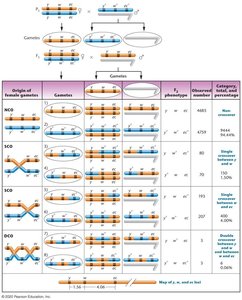
Additional info: Noncrossover (NCO), single-crossover (SCO), and double-crossover (DCO) groups are identified based on offspring phenotypes, which reflect the underlying genetic exchanges.
Determining Gene Sequence from Three-Point Crosses
To determine the order of three genes on a chromosome, geneticists analyze the arrangement of alleles and the phenotypes resulting from double crossovers. The correct gene order is the one that explains the observed double-crossover phenotypes.
Steps:
List all possible gene orders and allele arrangements in the heterozygous parent.
Predict the expected double-crossover phenotypes for each arrangement.
Compare predictions to observed data to identify the correct gene sequence.
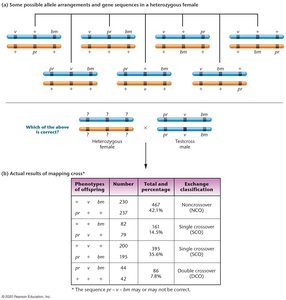
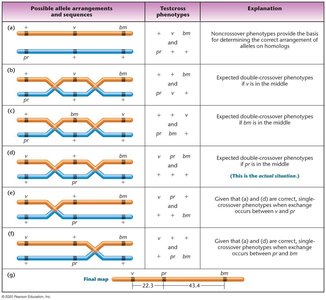
Additional info: The gene in the middle is identified by comparing the double-crossover phenotypes to the parental types; the gene that differs is in the middle.
Physical Evidence for Crossing Over
Physical exchanges between chromatids during crossing over were demonstrated using cytological markers in maize. These experiments provided direct evidence that genetic recombination involves the actual exchange of chromosome segments.
Cytological markers: Visible features such as knobs or translocated segments on chromosomes used to track physical exchanges.
Creighton and McClintock experiment: Showed that recombinant offspring had chromosomes with exchanged physical markers, confirming the physical basis of crossing over.
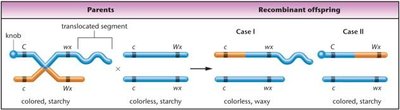
Additional info: This experiment was foundational in linking genetic recombination to physical chromosome behavior during meiosis.
Sister Chromatid Exchanges (SCEs)
Sister chromatid exchanges are reciprocal exchanges of genetic material between sister chromatids during mitosis. Unlike crossing over between homologous chromosomes, SCEs do not produce new allelic combinations but can be visualized using specific staining techniques.
Identification: SCEs are detected by labeling sister chromatids with bromodeoxyuridine (BrdU), which results in a patchlike, harlequin appearance under the microscope.
Harlequin chromosomes: Chromosomes with alternating stained regions, indicating SCE events.
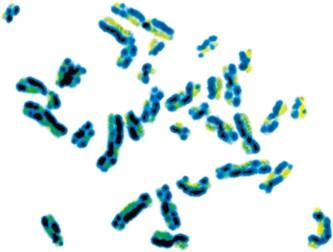
Additional info: The biological significance of SCEs is not fully understood, but their frequency increases in response to DNA-damaging agents and is elevated in certain genetic disorders such as Bloom syndrome.
Significance of SCEs and Bloom Syndrome
The frequency of SCEs is used as an indicator of genomic instability. Agents such as viruses, X-rays, UV light, and chemical mutagens can increase SCE frequency. In Bloom syndrome, a recessively inherited disorder, SCEs are particularly frequent, reflecting underlying defects in DNA repair mechanisms.
Bloom syndrome: Characterized by growth delays, immune deficiency, and increased cancer risk due to high rates of SCEs and chromosomal instability.
Additional info: SCE analysis is a valuable tool in cytogenetics for studying DNA repair and the effects of mutagens.
