 Back
BackLinkage and Recombination: Genetic Mapping and Testcross Analysis
Study Guide - Smart Notes
 Tailored notes based on your materials, expanded with key definitions, examples, and context.
Linkage and Recombination
Introduction to Linkage
Genetic linkage refers to the phenomenon where genes that are located close to each other on the same chromosome tend to be inherited together. This is a deviation from Mendel's law of independent assortment, which applies to genes on different chromosomes or those far apart on the same chromosome.
Linked genes: Genes that are close together on the same chromosome and tend to be inherited together.
Unlinked genes: Genes that are either on different chromosomes or far apart on the same chromosome, assorting independently.
Synteny: The physical co-location of genes on the same chromosome. Not all syntenic genes are necessarily linked if they are far apart.
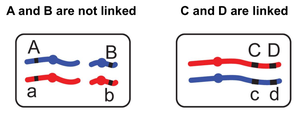
Distinguishing Syntenic and Linked Genes
Syntenic genes are simply genes on the same chromosome, while linked genes are syntenic genes that are close enough to each other that they do not assort independently during meiosis.
Example: Genes A and B on different chromosomes are not syntenic and not linked; genes C and D on the same chromosome and close together are syntenic and linked.
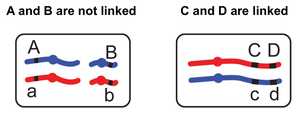
Testcrosses and Linkage Analysis
Dihybrid Testcrosses
A dihybrid testcross is used to determine whether two genes are linked or assort independently. This involves crossing a double heterozygote (dihybrid) with a homozygous recessive tester. The resulting offspring phenotypes reveal the types of gametes produced by the heterozygous parent.
Purpose: To test for linkage and estimate the distance between genes.
Key Point: If genes assort independently, the offspring will appear in a 1:1:1:1 ratio for the four possible phenotypes.
Monohybrid Testcross Review
In a monohybrid testcross, a heterozygote is crossed with a homozygous recessive individual to reveal the genotype of the unknown parent. The expected ratio is 1:1 for the two phenotypes.
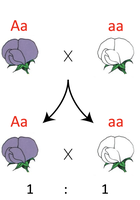
Why Use a Homozygous Recessive Tester?
It reveals which gamete came from the heterozygous parent, as the tester can only contribute recessive alleles.
Dihybrid Testcross – Unlinked Genes
When genes are unlinked, the dihybrid testcross produces four types of offspring in equal proportions (1:1:1:1 ratio). This indicates independent assortment.
Phenotype | Number of Offspring |
|---|---|
Dominant for both traits | 98 |
Dominant for A, recessive for B | 103 |
Recessive for B, dominant for A | 102 |
Recessive for both traits | 97 |
These results support independent assortment.
Linkage and Deviations from Independent Assortment
Dihybrid Testcross – Linked Genes
If genes are linked, the offspring ratios deviate from 1:1:1:1. Parental combinations are more frequent than recombinant types.
Phenotype | Number of Offspring |
|---|---|
Both dominant | 143 |
Neither dominant | 146 |
Only A dominant | 82 |
Only B dominant | 79 |
Here, the parental types (both dominant, neither dominant) are much more frequent than the recombinant types (only A dominant, only B dominant), indicating linkage between the genes.
Effect of Gene Distance on Linkage
The closer two genes are on a chromosome, the less likely crossing over will occur between them, resulting in fewer recombinant gametes. If genes are far apart, crossing over is more likely, and they may appear to assort independently.
Mechanism of Recombination
Crossing Over During Meiosis
Crossing over is the exchange of genetic material between non-sister chromatids of homologous chromosomes during Prophase I of meiosis. The points where crossing over occurs are called chiasmata. This process generates recombinant chromosomes, increasing genetic diversity.
Chiasma (plural: chiasmata): The physical site of crossover between chromatids.
Recombinant gametes: Gametes with new combinations of alleles due to crossing over.
Recombination Frequency and Genetic Mapping
Calculating Recombination Frequency
The recombination frequency is the proportion of recombinant offspring produced in a cross. It is used to estimate the physical distance between genes on a chromosome. The greater the distance, the higher the recombination frequency.
Formula:
1% recombination frequency = 1 map unit (centimorgan, cM)
Genes that are very close together have low recombination frequencies, while those far apart approach 50% (indistinguishable from independent assortment).
Summary Table: Linkage and Testcross Outcomes
Gene Relationship | Testcross Ratio | Interpretation |
|---|---|---|
Unlinked (different chromosomes or far apart) | 1:1:1:1 | Independent assortment |
Linked (close together) | Parental types >> Recombinant types | Linkage detected |
Key Concepts and Definitions
Linkage: The tendency of genes located close together on a chromosome to be inherited together.
Synteny: The physical co-location of genes on the same chromosome.
Testcross: A cross between an individual with an unknown genotype and a homozygous recessive individual to reveal the unknown genotype.
Recombination frequency: The percentage of recombinant offspring among the total, used to estimate genetic distance.
Chiasma: The site of crossing over between homologous chromosomes during meiosis.
