Back
BackCHAPTER 7- Linkage, Recombination, and Genetic Mapping
Study Guide - Smart Notes
 Tailored notes based on your materials, expanded with key definitions, examples, and context.
Linkage and Recombination
Introduction to Linkage
Linkage refers to the phenomenon where two or more genes are located on the same chromosome and tend to be inherited together. This is a deviation from Mendel’s Law of Independent Assortment, which states that genes on different chromosomes assort independently during gamete formation.
Linked genes: Genes that do not assort independently because they are physically close on the same chromosome.
Synteny: The physical co-location of genes on the same chromosome.
Linkage group: All genes on a single chromosome form a linkage group.
Example: Bateson and Punnett’s sweet pea cross showed deviations from the expected 9:3:3:1 ratio, indicating linkage between flower color and pollen shape genes.
Genetic Recombination and Crossing Over
Genetic recombination occurs when homologous chromosomes exchange segments during meiosis, resulting in new combinations of alleles. This process is called crossing over and is a major source of genetic diversity.
Genes that are far apart on the same chromosome are more likely to undergo crossing over and may appear to assort independently.
Genes that are close together are less likely to be separated by crossing over and thus are inherited together more frequently.
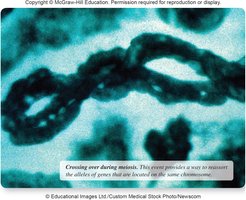
Key Point: The frequency of recombination between two genes is proportional to the distance between them on the chromosome.
Linkage and Independent Assortment
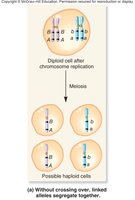
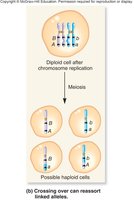
Without crossing over, linked alleles segregate together, producing only parental combinations in gametes. With crossing over, recombinant gametes are produced, leading to new allele combinations.
Experimental Evidence for Linkage
Morgan’s Experiments with Drosophila
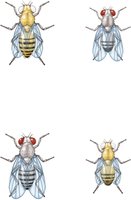
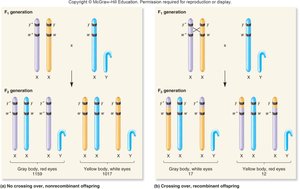
Thomas Hunt Morgan demonstrated linkage using X-linked genes in fruit flies (Drosophila melanogaster). He observed that certain combinations of traits appeared together more frequently than expected by independent assortment, and that recombinants (new combinations) were less common.
Traits studied: body color, eye color, wing length
Most offspring had parental combinations; fewer had recombinant phenotypes.
All three genes were located on the X chromosome and tended to be transmitted together.
Effect of Gene Distance on Recombination
The likelihood of crossing over between two genes increases with the physical distance between them. Genes that are far apart on the same chromosome can recombine frequently, while those that are close together recombine rarely.
Recombination frequency can be used to estimate the distance between genes.
Maximum observable recombination frequency is 50%, which is indistinguishable from independent assortment.
Genetic Mapping
Principles of Genetic Mapping
Genetic mapping uses recombination frequencies to determine the relative positions of genes on a chromosome. The distance between genes is measured in map units (centimorgans, cM), where 1 map unit corresponds to a 1% recombination frequency.
Map distance formula:
Example Calculation: If 76 + 75 recombinants are observed out of 542 + 537 + 76 + 75 total offspring:
map units
Applications of Genetic Maps
Understanding the genome structure of a species
Cloning genes of interest
Inferring evolutionary relationships
Improving agriculture through selective breeding
Other types of maps include physical maps (based on DNA sequence) and cytogenetic maps (based on chromosome features).
Limitations of Genetic Mapping
Multiple crossovers between genes can underestimate the actual physical distance.
Observed recombination frequency cannot exceed 50%.
Special Cases: Mitotic Recombination
Mitotic Recombination
Although rare, crossing over can also occur during mitosis. If this happens early in development, it can produce patches of tissue with different genetic characteristics, known as twin spots.
Mitotic recombination can result in somatic mosaicism.
Example: Patches of different bristle types or body colors in Drosophila.
Genetic Mapping Problems and Practice
Sample Problem: Calculating Map Distance
Given F2 offspring counts:
Gray, long: 321
Ebony, short: 333
Ebony, long: 117
Gray, short: 125
Number of recombinants = 117 + 125 = 242 Total offspring = 321 + 333 + 117 + 125 = 896
map units
Frequency of recombination = 27% or 0.27
Sample Problem: Three-Point Mapping
If the recombination frequency between genes A and B is 20%, between B and C is 15%, and between A and C is 5%, the gene order is:
A — 5 mu — C — 15 mu — B
Summary Table: Key Terms in Linkage and Mapping
Term | Definition |
|---|---|
Linkage | Genes located close together on the same chromosome and inherited together |
Recombination | Exchange of genetic material between homologous chromosomes |
Map unit (cM) | Unit of genetic distance; 1% recombination frequency |
Synteny | Physical co-location of genes on the same chromosome |
Parental type | Offspring with the same allele combination as one of the parents |
Recombinant type | Offspring with new allele combinations due to crossing over |
Advanced Topic: Linkage and Human Disease
Retinoblastoma and Mitotic Recombination
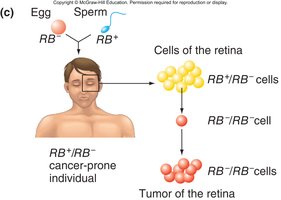
Retinoblastoma is a cancer caused by mutations in the RB gene. Individuals who inherit one mutant allele (RB−) are predisposed to cancer. Loss of the remaining normal allele (RB+) in retinal cells, often through mitotic recombination, leads to tumor formation.