 Back
Linkage, Recombination, and Genetic Mapping
Study Guide - Smart Notes
 Tailored notes based on your materials, expanded with key definitions, examples, and context.
Linkage and Recombination
Introduction to Linkage
Linkage refers to the phenomenon where two or more genes do not assort independently during meiosis because they are located close together on the same chromosome. This physical proximity causes them to be inherited together more frequently than genes located on different chromosomes.
Linked genes: Genes located on the same chromosome that tend to be transmitted together.
Synteny: The physical co-location of genes on the same chromosome.
Linkage group: A set of genes located on the same chromosome.
Mendel’s Law of Independent Assortment and Exceptions
Mendel’s Law of Independent Assortment states that the segregation of one pair of hereditary determinants is independent of the segregation of another pair. However, some traits do not assort independently due to linkage.
When genes are far apart on the same chromosome or on different chromosomes, they assort independently.
When genes are close together on the same chromosome, they tend to be inherited together.
Discovery of Linkage
Bateson and Punnett’s experiments with sweet peas revealed deviations from the expected 9:3:3:1 Mendelian ratio, indicating that some traits did not assort independently. This led to the concept of genetic linkage.
Mechanism of Recombination
Recombination, or crossing over, occurs during meiosis and involves the exchange of genetic material between homologous chromosomes. This process can separate linked genes, resulting in new combinations of alleles.
Crossing over increases genetic diversity by shuffling allele combinations.
The likelihood of crossing over between two genes increases with the distance between them.
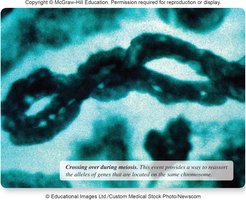
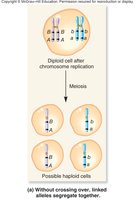
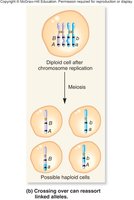
Linked Genes and Crossing Over
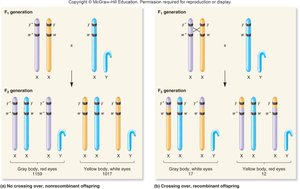
Without crossing over, linked alleles segregate together, producing only parental combinations in gametes. With crossing over, recombinant gametes are produced, allowing for new allele combinations.
Genetic Mapping and Recombination Frequency
Genetic Mapping
Genetic mapping is the process of determining the relative positions of genes on a chromosome based on recombination frequencies. The greater the frequency of recombination between two genes, the farther apart they are on the chromosome.
Map distance is measured in map units (mu) or centimorgans (cM), where 1 map unit = 1% recombination frequency.
Recombination frequency is calculated as:
Example Calculation
If a cross produces 76 + 75 recombinant offspring and 542 + 537 + 76 + 75 total offspring:
Limitations of Recombination Frequency
As genes get farther apart, the chance of multiple crossovers increases, which can underestimate the actual map distance.
The maximum observable recombination frequency is 50%, which is the same as if genes were on different chromosomes.
Genetic Mapping in Model Organisms
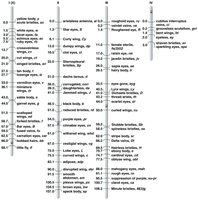
Genetic mapping has been extensively used in plants and animals, such as Drosophila melanogaster (fruit fly), to understand genome organization, clone genes, and study evolutionary relationships.
Case Study: Morgan’s Experiments with Drosophila
X-linked Genes and Linkage
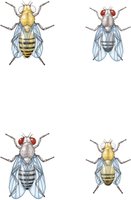
Thomas Hunt Morgan demonstrated linkage using X-linked genes in fruit flies, studying traits such as body color, eye color, and wing length. He observed that certain combinations of traits appeared more frequently than expected, indicating linkage.
Most offspring had parental combinations of traits, but some had recombinant traits due to crossing over.
All three genes studied were located on the X chromosome and tended to be transmitted together.
Recombination Frequency and Genetic Distance
The frequency of recombination between genes can be used to estimate their genetic distance. For example, if the distance between two genes is 16 map units, in a cross producing 500 offspring, the expected number of recombinants is:
Advanced Topics: Multiple Crossovers and Mitotic Recombination
Multiple Crossovers
When genes are far apart, multiple crossovers can occur, which may not be detected as recombination events, leading to an underestimation of genetic distance.
Observed recombination frequencies tend to underestimate actual map distances for widely separated genes.
The maximum measurable recombination frequency is 50%.
Mitotic Recombination
Although rare, recombination can also occur during mitosis. If this happens early in development, it can result in patches of tissue with different genetic characteristics, known as twin spots.
Mitotic recombination can produce cells with new allele combinations, leading to observable phenotypic patches.
Application: Retinoblastoma and Loss of Heterozygosity
Retinoblastoma Tumor-Suppressor Gene
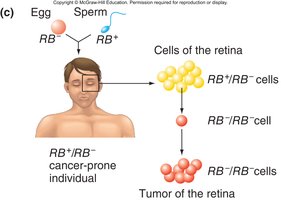
Retinoblastoma is a cancer caused by mutations in the RB gene. Individuals who inherit one mutant allele (RB−) are predisposed to retinal cancer. Loss of the remaining functional allele in retinal cells leads to tumor formation.
Summary Table: Key Concepts in Linkage and Recombination
Concept | Definition | Example/Application |
|---|---|---|
Linkage | Genes located close together on the same chromosome are inherited together | Body color and eye color in Drosophila |
Recombination | Exchange of genetic material between homologous chromosomes during meiosis | Crossing over produces new allele combinations |
Map Unit (cM) | Unit of genetic distance; 1% recombination frequency | 12.3 cM between two genes means 12.3% recombination |
Mitotic Recombination | Rare recombination during mitosis, leading to genetic mosaics | Twin spots in Drosophila |
